On paper, east and west windows look like twins. Each gets about half a day of direct sun. In practice they’re different climates. East sun arrives in the cool morning. West sun arrives in the afternoon, stacked on the day’s accumulated heat: the beam is more intense and the spot around it runs hotter and drier. The plants that want this much sun are the same short direct-sunlight set, with the heat caveats turned up.

Worth a try
It can work here with a little care.
A bit bright, but workable
Comfortable temperature
Humidity suits it
Airflow suits it
How much sun does a west-facing window get?
Published guidance cannot agree on which window a west one resembles. Some of these sources file it with the south, one of them calling the two interchangeable outright; others file it with the east and separate the pair by a single clause about direct sun.
| Published by | The figure | In its own words |
|---|---|---|
| extension.illinois.edu | High: 300 fc | “High or Bright Light (300 foot candles)”, at “East/west window: directly in front” or “South window: up to 5 feet away”. |
| extension.illinois.edu | Distance, per wall | Its low band is reached at “North window: a few feet away” but only at “South window:15-20 feet away”; its medium band at “North window: directly in front” and “South window: 3-10 feet away”. |
| extension.arizona.edu | Four and eight feet | “High Light: areas within four feet of large south-east or west facing windows”; “Medium Light: locations in a range of four to eight feet from south and east windows and west windows that do not receive direct sun.” |
| extension.msstate.edu | 1,000 fc, then 100 a few feet in | Not a floor but a falloff, from the same source: “The intensity of the light can drop from 1,000 to 100 foot-candles in the distance of only a few feet.” |
| extension.illinois.edu | 10,000–12,000 fc | “Outdoors, the amount of sunlight that is cast may be 10,000 to 12,000 foot-candles.” |
| fieldreport.caes.uga.edu | South and west, interchangeable | “Southern and western exposures are interchangeable for most plants.” |
| hgic.clemson.edu | West sits with south, high light | “High light plants (weeping fig, English ivy, schefflera) can usually be grown well near windows or glass doors with western or southern exposures.” |
| extension.wvu.edu | West sits with east, medium light | “Medium light plants do well in areas with east-facing windows or west-facing windows.” |
| rhs.org.uk | Light without being baked | “East or west-facing windowsills are ideal houseplant territory as they’ll have lots of light but plants won’t get baked by day-long sunlight.” |
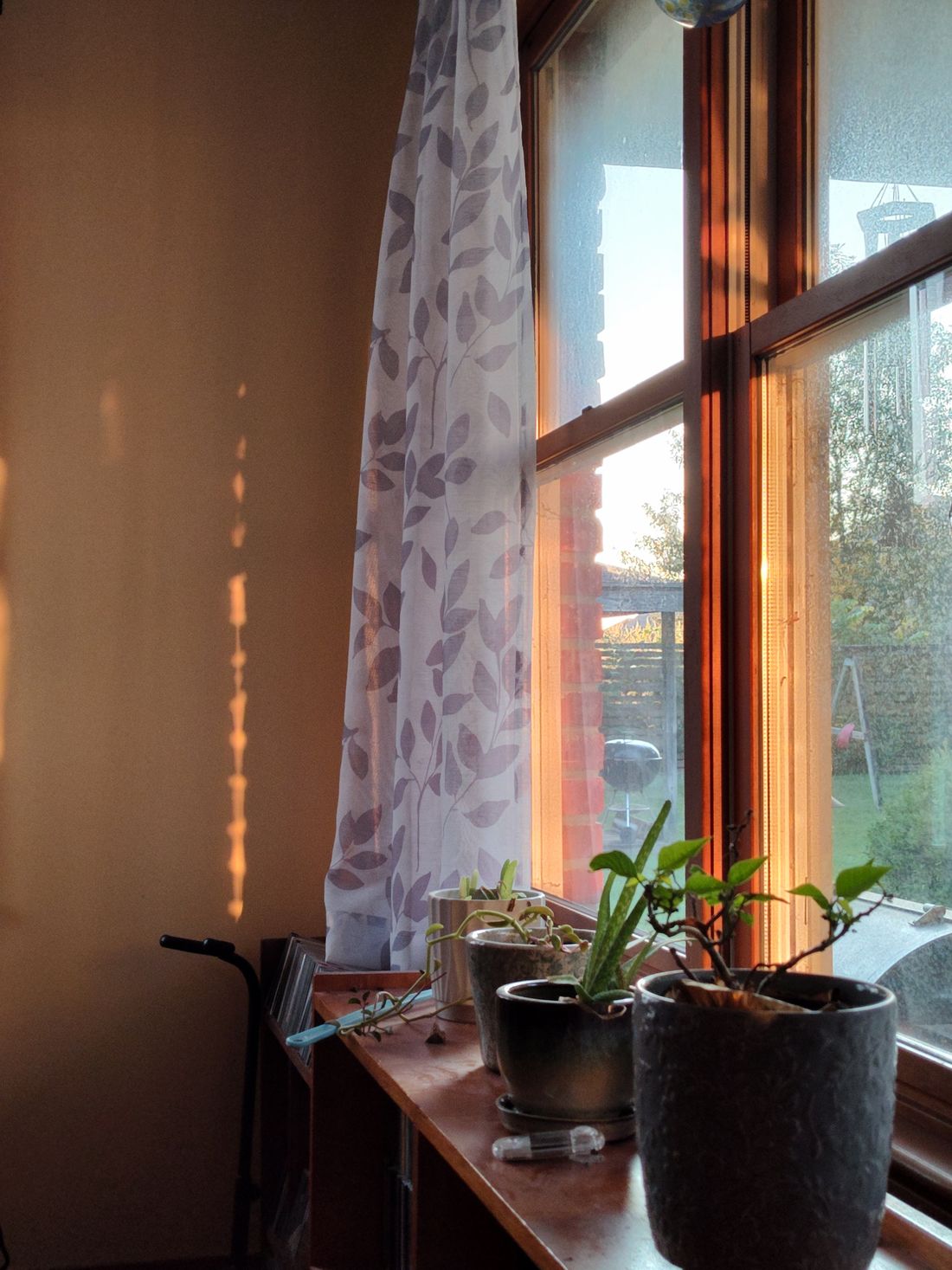
Roughly half a day of direct sun, all of it in the second half. That makes a west window a genuinely strong spot, for plants built for it.
- Afternoon direct beam: several hours of strong, warm sun, harshest in summer.
- Heat pocket: the sill can run noticeably warmer than the room; small pots dry out fast.
- Morning through midday: bright indirect near the glass: the mild half of the day.
- As always: the spot is the sill, not the room. Light collapses within a few steps.
The total for the day usually lands under what a south window collects, because a west window gets no direct sun through the morning and then takes its whole allowance in one block. That distribution is the real story. Two windows can add up to similar daily totals and still suit completely different plants, because one delivers it gently across the day and the other delivers it as an afternoon event.
Is a west-facing window full sun?
For the hours it runs, yes. Whether that counts as full sun for a given plant depends on the tag you’re reading. A seed packet means six or more hours of direct sun; a houseplant label usually means “don’t put me in a beam at all.” A west sill in summer can hit the first definition and demolish anything sold under the second.
Distance changes the answer just as fast.
| Spot | Reading |
|---|---|
| At the bright window | 20,000 lux |
| 1 m from the window | 15,000 lux |
| 2–3 m away, in window shade | 3,500 lux |
| Middle of the room | 570 lux |
| Darker side of the room | 119 lux |
| The dark corner | 18 lux |
The orientation of that room was never recorded, so none of it is a west-window reading. What generalises is the fall-off: two to three metres back from any window is already a fraction of the sill, so a plant that scorches on a west sill can be starving against the far wall of the same room.
Paired readings outdoors say the same from the other direction. A fern hung on a balcony wall read about 10,000 lux while the spot just inside the window beside it read 6,000 lux, and a balcony rail ran 19,000 to 21,000 lux against that same 6,000. The glass takes a large cut before the room even starts.
An east window reads about 6,500 lux at the glass against 7,800 here, close enough that the number is not the difference. The difference is when it arrives, and an east window delivers it before the room heats up.
What plants do well in a west-facing window?
In the beam (heat-tolerant)
 Most cacti & succulents: jade, aloe, echeveria
 Ponytail palm
 Snake plant: takes the beam better than its reputation
 Croton
 Hoya (once acclimated)
Off the beam / filtered
 Rubber plant, fiddle leaf fig
 Bird of paradise
 Monstera: beside the window, not in the beam
What won’t work here (honestly)
- Ferns, calatheas & thin-leaved shade plants near the afternoon beam: the fastest scorch spot in the house after an unfiltered south sill.
- Moisture-lovers in small pots on the hot sill. The heat pocket turns their watering into a treadmill. It’s not you; it’s the spot.
- Moving a plant straight from a dim corner into the beam. Even sun-lovers burn without a gradual move.
Those plants are not asking for less light so much as no beam, which is the one thing a north window guarantees, at about 3,640 lux and no direct sun to speak of. The north window list is built around exactly that.
Where should the plant actually sit in a west window?
A west window is not one spot, it’s three, and they behave differently enough that the same plant can thrive in one and fail in another a metre away.
Two of them are worked through distance by distance on their own pages: a snake plant in a west window, which reads a little bright pressed against the glass and settles at 98 a metre back, and a spider plant in a west window. A heartleaf philodendron is flagged at the glass and a metre back, and settles from about a metre and a half; a monstera runs the opposite way, comfortable at the glass and out of light only past three metres. A ZZ plant clears a metre back, though in summer that metre is flagged too, and a prayer plant is fine on the sill except from April to August, as is a moth orchid. A hoya needs the sill or the first metre; a Chinese evergreen and a croton sit at opposite ends of the same room. A Christmas cactus takes the sill’s light in every month; the afternoon heat is what marks it down.
- In the beam, on the sill. The strongest and hottest position in the house after an unfiltered south sill. Reserve it for plants that want that, and move anything into it gradually rather than in one step.
- A step to the side, still at the glass. This keeps most of the brightness and drops the direct beam. It is the position most plants sold as bright-indirect actually want, and it is the one people skip because it looks like a compromise.
- Behind a sheer during the afternoon. Same effect as stepping aside, without giving up the sill. A curtain you close at four o’clock is a real horticultural tool.
Heat is the part that catches people out. Glass lets sunlight in and traps the warmth it becomes, so a west sill in late afternoon runs above room temperature while the thermostat reports nothing unusual. That produces a specific misdiagnosis: crisping edges get read as thirst, more water goes in, and now hot soil stays wet. If the soil is still damp and the edges are browning, the spot is the problem rather than the watering can.
Season matters too. The afternoon sun swings north through summer and south through winter, so a west window that was brutal in July can be mild by November, and a plant you rescued in summer may want its sill back. Re-reading the spot when the seasons turn costs a minute and saves a plant.
With a peace lily the common advice has the direction right and the number a little short: three to five feet stops just short of where it becomes a great fit, at about 1.75 metres.
How much of the room a west window actually gives you depends entirely on what you put in it, and the spread is wider than any list can show. A burgundy rubber plant holds the high nineties for roughly the first metre and picks up a flag by two; a golden pothos works at every distance we scored, flagged a little bright only within about 1.3 metres, so eight to ten feet back is more distance than it needs. The rubber plant, scored the same way, is here.
Every number here rests on the window facing west rather than east, and the two are easy to mix up because they read 7,800 and 6,500 lux at the glass. What separates them is which half of the day the beam arrives, which is also how you tell them apart.
By GrowSpot · Published July 23, 2026 · Last updated August 30, 2026
