We read six published lists of plants for a north-facing window, wrote down every plant they name, 42 in all, and scored each one on the same north sill, 3,640 lux on a clear day. 36 come back a great fit and none is refused. Then we moved the same 42 plants two metres into the room, to 1,764 lux, and 12 are still a great fit. That is the whole page in two numbers, and the rest of it is which twelve.

Worth a try
It can work here with a little care.
A little dim, but workable
Comfortable temperature
Humidity suits it
Airflow suits it
How much light does a north-facing window get?
The published guidance sorts by wall before it sorts by plant, and this is what it gives a north one.
| Published by | The figure | In its own words |
|---|---|---|
| extension.illinois.edu | Distance, per wall | Its low band is reached at “North window: a few feet away” but only at “South window:15-20 feet away”; its medium band at “North window: directly in front” and “South window: 3-10 feet away”. |
| extension.arizona.edu | Four and eight feet | “High Light: areas within four feet of large south-east or west facing windows”; “Medium Light: locations in a range of four to eight feet from south and east windows and west windows that do not receive direct sun.” |
| extension.arizona.edu | Beyond eight feet | “Low Light: areas more than eight feet from windows as in the center of a room, a hallway or an inside wall.” |
| extension.msstate.edu | 8 or 10 feet | “It is difficult to grow plants in dimly lit areas more than 8 or 10 feet from windows.” |
| extension.psu.edu | 100 footcandles | “a common baseline for low light is 100 footcandles.” |
| open.edu | 200–300 lux | “Daylight penetrating windows into a building can provide illuminance levels of around 200–300 lux in typical naturally lit offices for most of the day.” |
(Northern hemisphere; flip this if you are south of the equator.) A north window gets sky light all day and direct sun almost never: the steadiest window in the house and the dimmest of the four, which is a better trade than it sounds.
Right on the sill it is genuine bright-indirect territory for much of the year. A metre back is already a big step down, and in winter the ceiling drops further. Numbers help more than adjectives here.
| Spot | Reading |
|---|---|
| At the bright window | 20,000 lux |
| 1 m from the window | 15,000 lux |
| 2–3 m away, in window shade | 3,500 lux |
| Middle of the room | 570 lux |
| Darker side of the room | 119 lux |
| The dark corner | 18 lux |
That room’s orientation was never recorded, so none of those is a north-window reading. What travels is the shape of the fall-off: the cliff sits between the glass and the room. A north sill starts lower, about 3,640 lux against 13,000 for a south pane, which is why the south-facing window guide spends its length getting plants away from the glass.
Do north-facing windows get direct sunlight?
Almost never, and that is the useful part. Deep in summer at high latitudes it can catch a sliver of very early or very late sun; every other month, no. People hear “no direct sun” and store it as “low light,” which is a different claim. Direct sun is whether the disc reaches the leaf; brightness is how much light lands there, and only brightness decides whether a plant grows.
The upside is that a north window has no bad hours: it holds roughly the same value from mid-morning to late afternoon while a west sill swings from scorching to nothing. All of this assumes the window really faces north, and one question about where the sun lands settles that without a compass.
What plants are good for north-facing windows?
On the sill, almost all of them. We took six lists (Savvy Gardening, Ohio Tropics, Rural Sprout, Houzz, Gardening Know How and a grow-light maker’s blog, read end to end on 12 September 2026), copied down every plant they name without picking favourites, and put all 42 on one north sill in an ordinary room. Two named plants, the rattlesnake calathea and the Rieger begonia, are not in our care data and are the only ones missing.
| Named by the lists | What our care data asks for | Verdict |
|---|---|---|
| ZZ plant (6) | low, shade-friendly light | Great fit, 93/100 |
| Snake plant (6) | low, shade-friendly light | Great fit, 93/100 |
| Golden pothos (5) | low, shade-friendly light | Great fit, 94/100 |
| Peace lily (5) | low, shade-friendly light | Great fit, 99/100 |
| Cast iron plant (4) | low, shade-friendly light | Great fit, 94/100 |
| Chinese evergreen (3) | low, shade-friendly light | Great fit, 100/100 |
| Calathea (peacock plant) (3) | bright, indirect light | Great fit, 91/100 |
| Heartleaf philodendron (2) | low, shade-friendly light | Great fit, 94/100 |
| Monstera (2) | bright, indirect light | Great fit, 94/100 |
| Spider plant (2) | bright, indirect light | Great fit, 94/100 |
| Dragon tree (2) | bright, indirect light | Great fit, 94/100 |
| Boston fern (2) | bright, indirect light | Great fit, 91/100 |
| Parlor palm (2) | low, shade-friendly light | Great fit, 100/100 |
| English ivy (2) | bright, indirect light | Great fit, 94/100 |
| Moth orchid (2) | bright, indirect light | Great fit, 93/100 |
| Prayer plant (2) | bright, indirect light | Great fit, 91/100 |
| Staghorn fern (2) | bright, indirect light | Great fit, 93/100 |
| Satin pothos (2) | bright, indirect light | Great fit, 94/100 |
| Nerve plant (2) | bright, indirect light | Good fit, 85/100 |
| Philodendron Brasil (2) | low, shade-friendly light | Great fit, 94/100 |
| Swiss cheese vine (2) | bright, indirect light | Good fit, 85/100 |
| Bromeliad (scarlet star) (2) | bright, indirect light | Great fit, 93/100 |
| Peperomia (1) | bright, indirect light | Great fit, 94/100 |
| Rubber plant (1) | lots of bright, indirect light | Worth a try, 65/100 |
| Bird's nest fern (1) | low, shade-friendly light | Great fit, 91/100 |
| Arrowhead plant (1) | bright, indirect light | Great fit, 94/100 |
| African violet (1) | lots of bright, indirect light | Worth a try, 65/100 |
| Cebu blue pothos (1) | bright, indirect light | Great fit, 94/100 |
| Lucky bamboo (1) | bright, indirect light | Great fit, 94/100 |
| Rex begonia (1) | bright, indirect light | Good fit, 89/100 |
| Beefsteak begonia (1) | bright, indirect light | Great fit, 94/100 |
| Christmas cactus (1) | bright, indirect light | Great fit, 99/100 |
| Jewel orchid (1) | low, shade-friendly light | Great fit, 99/100 |
| Maidenhair fern (1) | bright, indirect light | Great fit, 91/100 |
| Lady palm (1) | bright, indirect light | Great fit, 94/100 |
| Fishbone prayer plant (1) | bright, indirect light | Great fit, 99/100 |
| Blue star fern (1) | bright, indirect light | Great fit, 99/100 |
| Cretan brake fern (1) | bright, indirect light | Great fit, 99/100 |
| Moonlight philodendron (1) | bright, indirect light | Great fit, 94/100 |
| Pothos N'Joy (1) | bright, indirect light | Great fit, 94/100 |
| Marble queen pothos (1) | low, shade-friendly light | Great fit, 94/100 |
| Cyclamen (1) | bright, indirect light | Worth a try, 61/100 |
The six plants on the most lists, ZZ, snake plant, pothos, peace lily, cast iron plant and Chinese evergreen, all score 93 or better, and so does nearly everything else: monstera, spider plant, dragon tree, moth orchid, staghorn fern, the beefsteak begonia. Only three miss a great or good fit: the rubber plant and the African violet, a little dim at 65, and the cyclamen at 61, which has the light it wants and loses its points on the room’s warmth.
So a list of north-window plants is easy to write, and that is the problem with the lists. At 3,640 lux the sill is not a low-light spot at all; it is bright indirect light with no scorch risk, and most houseplants are comfortable there.
What happens two metres in?
The same room, the pot moved two metres back from the glass, which is where a shelf or a plant stand usually is. The light there is 1,764 lux, under half of the sill. This table keeps the plants whose verdict changes the story: the twelve that hold, and the two that fail.
| Still named, two metres in | What our care data asks for | Verdict |
|---|---|---|
| ZZ plant (6) | low, shade-friendly light | Great fit, 93/100 |
| Snake plant (6) | low, shade-friendly light | Great fit, 93/100 |
| Golden pothos (5) | low, shade-friendly light | Great fit, 94/100 |
| Peace lily (5) | low, shade-friendly light | Great fit, 99/100 |
| Cast iron plant (4) | low, shade-friendly light | Great fit, 94/100 |
| Chinese evergreen (3) | low, shade-friendly light | Great fit, 100/100 |
| Heartleaf philodendron (2) | low, shade-friendly light | Great fit, 94/100 |
| Parlor palm (2) | low, shade-friendly light | Great fit, 100/100 |
| Philodendron Brasil (2) | low, shade-friendly light | Great fit, 94/100 |
| Rubber plant (1) | lots of bright, indirect light | Not the best fit right now, 47/100 |
| Bird's nest fern (1) | low, shade-friendly light | Great fit, 91/100 |
| African violet (1) | lots of bright, indirect light | Not the best fit right now, 47/100 |
| Jewel orchid (1) | low, shade-friendly light | Great fit, 99/100 |
| Marble queen pothos (1) | low, shade-friendly light | Great fit, 94/100 |
Now the lists split. The twelve that stay a great fit are the plants from the low-light tier of our care data: the six every list agrees on, plus heartleaf philodendron and its Brasil form, parlor palm, bird’s nest fern, jewel orchid and marble queen pothos. The other 28 on the sill table are the medium-tier plants, and they drop together to worth a try: monstera, spider plant, calathea, dragon tree, Boston fern, moth orchid, prayer plant, staghorn fern and the rest. Two are refused outright, the rubber plant and the African violet, which were already flagged on the sill.
That is the sentence the lists leave out. “Good for a north-facing window” is true of almost everything on the sill and of twelve plants two metres in. Which twelve is not a matter of taste; it is the light band each plant is filed under, and the four bands with a box to type your own reading into is where that filing lives.
Two of these have a page each, scored at four distances from this exact window: a monstera, fine at the glass and not much further, and a ZZ plant, which holds a full score to two metres and 99 at three.
What won’t work here (honestly)
Very little, on the sill. Two metres in, the two that fail are the two the lists should not have named: a rubber plant and an African violet sit in the high-light tier and go from a little dim at the glass to refused in the room. A jade is the same story told harder: the sill and the far wall come back two points apart, so there is no better spot in the room to move it to.
The plant most often asked about here is the one this window suits least. A fiddle leaf fig scores 65 pressed against north glass and fails outright from two metres back; no distance at a north window comes back a good fit for it. Anything like it wants a beam, and a west window is the harder version of that trade.
The other failure is not a plant. Anything placed “near” the window but not at it is in the second table, and two metres back is often closer to a dark corner than to a sill.
How far from a north window can a plant sit?
Closer than most people want to hear. Every window loses light with distance, but a north window starts from a lower ceiling, so each step costs it proportionally more. The two tables above are that sentence in numbers: two metres takes the room from 42 comfortable plants to 12.
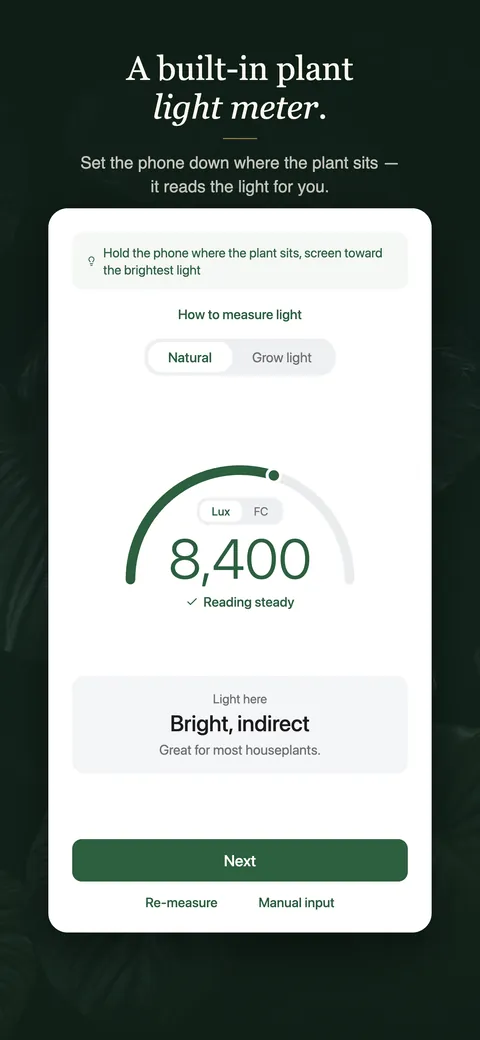
So the working rule: the sill and the first half metre grow almost anything, the next metre and a half is for the twelve, and anything past that is decoration you will be replacing. If the sill is taken, a plant stand that lifts a pot to sill height beats a floor position two metres in, every time.
By GrowSpot · Published July 23, 2026 · Last updated September 12, 2026
