I’ve killed enough plants in spots that “looked fine” to finally stop trusting my eyes. So on a clear day around midday, I measured every spot in one living room where a plant could plausibly live: same hour, sensor facing up, roughly plant height, using a phone as a rough light meter.

Not the best fit right now
The plant's fine, this spot just isn't a match.
Too dim here
Comfortable temperature
Humidity suits it
Airflow suits it
Light is a deal-breaker here. The other three cannot make up for it.
The numbers
One of these definitions names the middle of a room outright, and another says how fast the reading gets there.
| Published by | What it says about distance | In its own words |
|---|---|---|
| extension.arizona.edu | Four and eight feet | “High Light: areas within four feet of large south-east or west facing windows”; “Low Light: areas more than eight feet from windows as in the center of a room, a hallway or an inside wall.” |
| extension.msstate.edu | 1,000 fc, then 100 a few feet in | Not a floor but a falloff, from the same source: “The intensity of the light can drop from 1,000 to 100 foot-candles in the distance of only a few feet.” |
| extension.illinois.edu | Distance, per wall | For its low band: “North window: a few feet away” but “South window:15-20 feet away”. |
| open.edu | 200–300 lux | “Daylight penetrating windows into a building can provide illuminance levels of around 200–300 lux in typical naturally lit offices for most of the day.” |
| extension.msstate.edu | Under 50 fc | “Usually, an intensity of less than 50 foot-candles will not sustain plant life for very long.” |
| Spot | Reading |
|---|---|
| At the bright window | 20,000 lux |
| 1 m from the window | 15,000 lux |
| 2–3 m away, in window shade | 3,500 lux |
| Middle of the room | 570 lux |
| Darker side of the room | 119 lux |
| The dark corner | 18 lux |
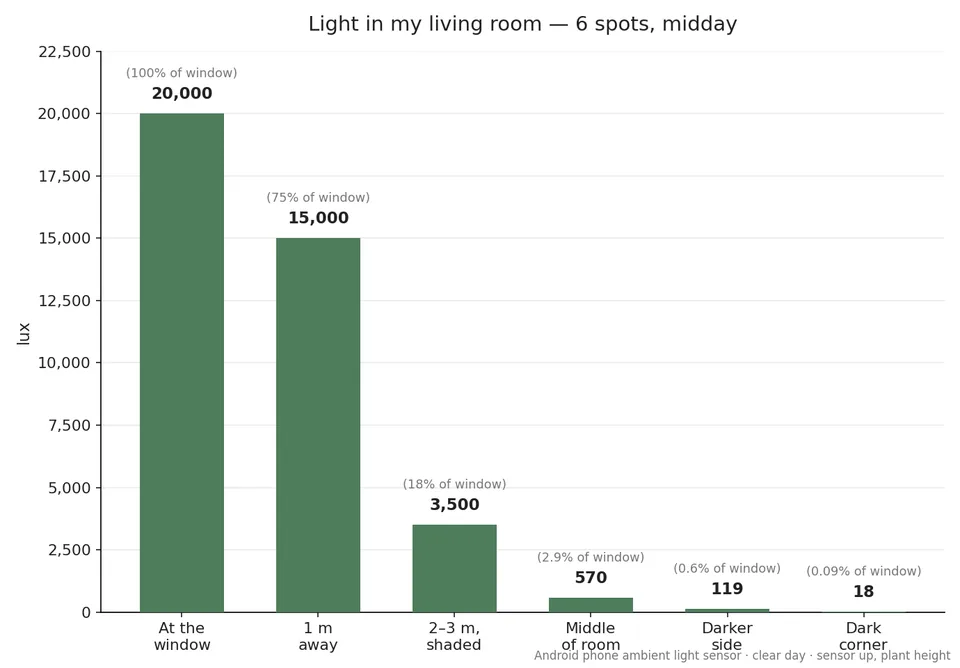
That’s not a typo. The corner gets less than 0.1% of what the window gets. A thousand times less light, in the same room.
The part that should bother you
Standing in that corner, it doesn’t look dark. It looks like “a spot that could use a plant,” which is how a plant ends up dying in a room everybody calls bright. Human eyes adapt so smoothly that a 99.9% drop in light reads as “a bit dimmer”. Meanwhile anything placed there is quietly starving.
The other number that got me: the middle of the room (where “bright indirect light” supposedly lives) sat at 570 lux, under 3% of the window. Most care charts put bright indirect at several thousand lux minimum. The middle of this room is not bright indirect. It’s a cave with good PR — and in an office, that middle is where most desks already sit.
In foot-candles, which is what most handheld meters sold in the US report, that middle-of-the-room reading is about 53 fc. Every published band for bright indirect starts far above it, and they do not agree with each other either.
The same six readings are also the fastest way to watch a label stop applying: 570 lux in the middle and 18 in the corner are both inside one room that gets called bright.
How rough are these numbers?
Rough, and that’s fine. I double-checked with a second phone: the absolute numbers differed (phone sensors are imprecise) but the pattern was identical. Past the first meter, every step away from the glass costs you most of what’s left.
None of this is lab-grade, and it doesn’t need to be. For deciding where a plant can live, the tier a spot falls into matters far more than the third digit of a lux reading. Rough numbers taught me more than years of confident guessing.
We later put a number on how rough. Scoring our own calibration pair through the engine, the same plant came out 28 points apart at 1,800 and 3,500 lux, and four points apart at 900 and 10,764. Across a drop like the one in the table above, a phone’s error changes nothing at all.
What this means for your plants
- The room is not the light environment. The spot is. “My living room is bright” is a sentence about the window, not the shelf.
- Distance is the biggest lever you control. Moving a plant one meter toward the glass can multiply its light several times over, a bigger intervention than any fertilizer.
- If a plant keeps declining and the watering checks out, measure the light before changing anything else. That rule alone would have saved most of the plants I’ve lost.
- Your eyes are the least reliable instrument in the room. Not a character flaw: just biology. Use a sensor.
The corner is the reading with no tier at all. The scale starts at roughly 270 lux, so 18 is not a dim version of anything on it.
Nor is this room unusual. Across 111 indoor readings taken at 97 spots, the median came to 566 lux, almost exactly the middle of this room. If bright indirect starts at several thousand lux, as most care charts have it, the typical indoor spot does not come close. The pattern in this one room is the pattern indoors generally: bright is the window, and almost nowhere else. The middle half of those indoor readings runs from 241 to 2,690 lux, which is the whole argument on one page of open data.
Measure your own room (it takes two minutes)
Pick a clear day and one hour. Lay the phone flat at each spot a plant could plausibly live, screen up, at the height the pot would sit, and note the number. Read tiers rather than digits: what matters is which spots land near your window figure and which land near your corner figure. The full method, including what to do if your meter reports foot-candles, is in how to measure light for plants.
Then put the map to work. Describe the best candidate to the free spot checker (window direction, distance from the glass, the plant you have in mind) and it answers what a reading alone can’t: whether that spot works for that plant. It runs in the browser, no download.
By GrowSpot · Published July 23, 2026 · Last updated October 3, 2026
