Scored for a heartleaf philodendron at 22 °C and 50% humidity, a west sill at 7,800 lux comes back 66 out of 100, flagged as a bit bright. One metre in, it’s 68. At one and a half metres the estimate is 4,762 lux, the flag clears and the score is 99. From there it holds 99 or 100 out to five metres back.
Read on 14 October 2026, the top results for this search agree that a west window can work, then scatter on how close. Plant Addicts names west or east as the window “for best growing results” and gives no distance. Montreal’s Space for Life says the climbing philodendron does best near a west window. Another guide calls east the better window and wants a west one handled with a sheer curtain and the pot several feet back. A 2006 forum thread has one hanging right inside a west window, gone stringy, and the reply suggests a sunnier spot.
None of them gives the distance as a number, and none says it changes with the month. Both decide this plant.

Worth a try
It can work here with a little care.
A bit bright, but workable
Comfortable temperature
Humidity suits it
Airflow suits it
Is a west window too bright for a philodendron?
A little, right at the glass. The engine calls the light on the sill a bit bright but workable, and the other three dimensions sit inside their bands, which is why the card above says worth a try instead of failing. A south window is harder on the same plant: the glass there doesn’t work at all, and the light keeps counting against it until about three metres back.
Here’s what the “several feet” advice leaves out. Three feet is about a metre, and a metre buys this plant two points, 66 to 68. Five feet is about one and a half metres, and that’s where it reaches 99. Whether several means three or five is most of the answer.
Before any more of our numbers, this is what other people publish for a philodendron’s light, copied exactly as each source prints it:
| Who publishes it | What it says a philodendron needs | What the figure is |
|---|---|---|
| theplantrunner.com | 800–2,000+ lux | Standard foliage plants (pothos, Philodendron, Monstera deliciosa …) — a general band, not a single-species figure |
| theplantrunner.com | 1,500–5,000 lux | Light-hungry aroids & Ficus divas (Fiddle Leaf Fig, variegated Monstera) |
| houseplantjournal.com | 100 foot-candles | Philodendron Vines — minimum indirect light |
| houseplantjournal.com | 200 foot-candles | Philodendron Vines — good indirect light |
| growlightmeter.com | 5 – 10 PPFD / DLI | Philodendron |
| extension.arizona.edu | 75–150 foot-candles | listed under the heading "Medium Light (75–150 fc)"; carries the page' |
| houseplantsnook.com | 50–100 foot-candles | chart fc level |
| houseplantsnook.com | 200–400 foot-candles | chart fc level |
Three units, and not one of these figures says where in a room the pot should go, which is the thing the search results argue about. The broadest of them, a band written for standard foliage plants with philodendron named in it, has a floor and no ceiling. Read that way it says the plant copes deep into a room, and the distance table below agrees.
How far back should a philodendron sit from a west window?
About one and a half metres, and past that the distance barely registers. The same plant at six spots in one west room, with nothing changed but how far it stands from the glass:
| Distance from the glass | Estimated light | What the light is doing | Verdict |
|---|---|---|---|
| 0.3 m, against the glass | 7,800 lux | A bit bright, but workable | Worth a try, 66/100 |
| 1 m back | 6,000 lux | A bit bright, but workable | Worth a try, 68/100 |
| 1.5 m back | 4,762 lux | Just the right amount of light | Great fit, 99/100 |
| 2 m back | 3,780 lux | Just the right amount of light | Great fit, 100/100 |
| 3.5 m back | 1,890 lux | Just the right amount of light | Great fit, 100/100 |
| 5 m back | 945 lux | Just the right amount of light | Great fit, 99/100 |
The table turns on a single step. Between one metre and one and a half, the estimate falls from 6,000 to 4,762 lux and the light column goes from a bit bright to just right. Everything after that is flat. Three and a half metres reads 1,890 lux and 100; five metres reads 945 lux and still 99.
That flat run is the useful part: a shelf mid-room or the far wall both suit it. A monstera in the same window has the opposite shape, happy at the glass and running short of light from about three and a half metres, so the two can share a west room if the monstera gets the window end.
These lux figures are estimates built from the window direction, the distance and a clear day, not readings from a meter. What carries over to your room is the shape: one step close to the glass, then a long level floor.
Can a philodendron sit on a west sill in winter?
At latitude 40, yes, from November to January. The sill from the first card, scored on the 21st of six months:
| The month it is | Estimated light | What the light is doing | Verdict |
|---|---|---|---|
| January | 5,070 lux | Just the right amount of light | Great fit, 98/100 |
| March | 7,754 lux | A bit bright, but workable | Worth a try, 66/100 |
| June | 9,360 lux | A bit bright, but workable | Worth a try, 64/100 |
| September | 7,777 lux | A bit bright, but workable | Worth a try, 66/100 |
| November | 5,023 lux | Just the right amount of light | Great fit, 99/100 |
| December | 4,551 lux | Just the right amount of light | Great fit, 99/100 |
The sill reads 99 in November and December and 98 in January. The low winter sun brings the estimate down to 5,023 lux in November and 4,551 in December, inside the plant’s comfortable range. In June the same spot estimates at 9,360 lux and scores 64.
So “several feet back” is a summer rule, and the line it draws moves with the calendar. In June even one and a half metres slips back to worth a try, and the first spot that holds a great fit is two metres out. Two metres reads a great fit in every month of the year.
Latitude shifts the months. Further north, at 50 degrees, the sill gets the same three. Further south, at 30 degrees, around Houston, it stays worth a try all year.
If the pot comes up to the glass for winter, check how cold that sill gets overnight. With December’s light held still, 16 °C drops the score back to worth a try, and 14 °C pushes it below that.
Is my philodendron getting too much light or too little?
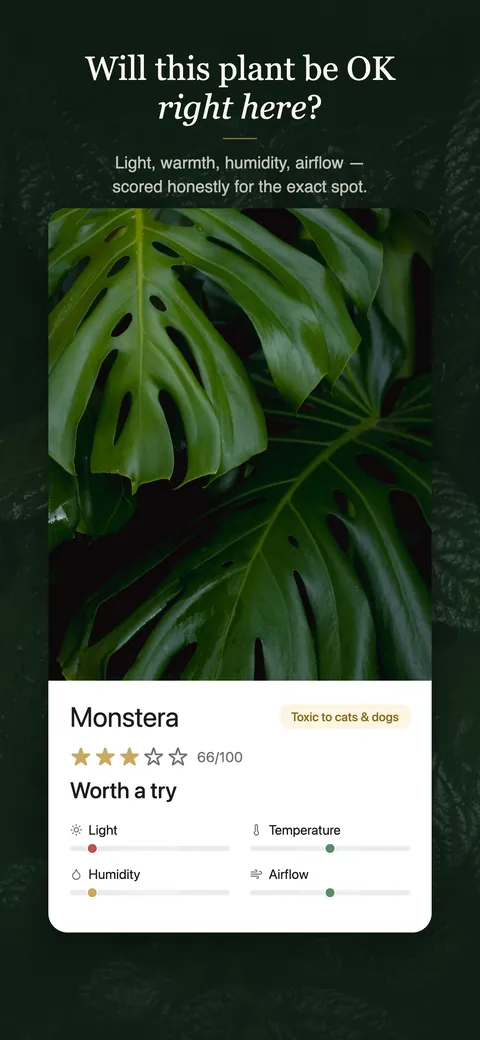
A score alone won’t say which way you’re off. The monstera above sits too far from its light; a heartleaf on a west sill in March sits too close, and both read 66. The light marker is what tells them apart.
If you aren’t sure your plant is a philodendron at all, in this window it makes no difference: a golden pothos scores the same as a heartleaf at every distance and month in the two tables above. The golden pothos page for this window follows the heat side of the story, holding one spot still and changing only the thermometer.
What can make your west window read differently?
Everything above is an open west window on a clear day. A balcony overhead or a tree outside takes light off the sill, and a tree that drops its leaves does it the way this plant would choose, shading July and leaving January open. Neither is an input here. The west window guide covers how much direct sun that wall gets and why it arrives on top of the day’s heat, and the free spot checker scores the spot you actually have, with your own weather.
Published October 14, 2026
