Most plant problems are about too little light. A south-facing window is the one spot where the opposite failure shows up: hours of direct sun, real heat at the glass, and thin-leaved plants developing bleached, crispy patches while their owner wonders what went wrong in the “best” spot. If yours is the unshaded kind and you want the short list that genuinely enjoys it, the direct-sunlight set is measured here.

Worth a try
It can work here with a little care.
A bit bright, but workable
Comfortable temperature
A little dry, but workable
Airflow suits it
How much sun does a south-facing window get?
South is the only wall any published band calls direct, and here is what each of them attaches to it.
| Published by | The figure | In its own words |
|---|---|---|
| extension.illinois.edu | Direct: 1500 fc | “Direct (1500 foot candles)”, reached at “South window: directly in front”. |
| extension.illinois.edu | High: 300 fc | “High or Bright Light (300 foot candles)”, at “East/west window: directly in front” or “South window: up to 5 feet away”. |
| extension.illinois.edu | Distance, per wall | Its low band is reached at “North window: a few feet away” but only at “South window:15-20 feet away”; its medium band at “North window: directly in front” and “South window: 3-10 feet away”. |
| extension.arizona.edu | Four and eight feet | “High Light: areas within four feet of large south-east or west facing windows”; “Medium Light: locations in a range of four to eight feet from south and east windows and west windows that do not receive direct sun.” |
| extension.illinois.edu | 10,000–12,000 fc | “Outdoors, the amount of sunlight that is cast may be 10,000 to 12,000 foot-candles.” |
| open.edu | 100 000 lux | “Sunlight is extremely bright and its illuminance can reach 100 000 lux on the ground”; overcast daylight is “at least 5000 lux”. |
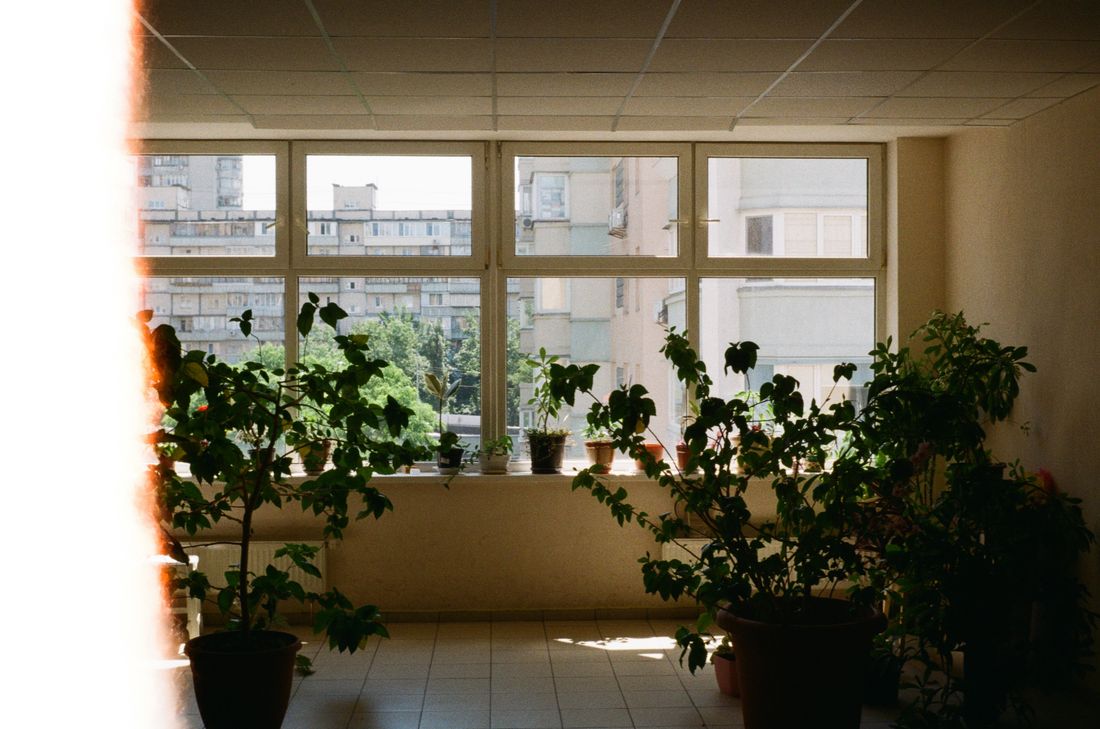
(Northern hemisphere.) Direct sun for much of the day, strongest through midday and afternoon, with three different light tiers sitting within arm’s reach of each other.
- On the sill, unfiltered: the highest light and heat in the house. Full-sun territory.
- Behind a sheer curtain: knocks the intensity down a big step, the filtered tier most “bright indirect” plants actually want.
- A step to the side or back: bright indirect, no direct beam, and easy to place almost anything in.
Heat is part of the deal: glass plus direct sun cooks the air in that pocket, and small pots dry much faster there.
How many hours you actually get is a question about your window, not about the compass. With a clear view out, you may get sun from mid-morning until late afternoon in summer. A building or a tree opposite can cut that to two hours, and a deep reveal or a balcony above will clip the highest part of the day, which is the part that carries the most light. That is why “south-facing” on a listing tells you the ceiling and nothing about the floor.
Worth knowing before you plan around it: three metres into this room the light is down to about 3,969 lux, which is roughly what a north sill delivers. The far side of a south room and the whole of a north one are close to the same offer.
Is a south-facing window considered direct sunlight?
At the glass, yes. A step into the room, no, and that gap is where a good window gets wasted. The sun’s beam reaches a strip of floor near the window; the rest of the room is lit by whatever bounces off the walls and ceiling, which is a small fraction of it.
Daylight written down, in one ordinary room:
| Spot | Reading |
|---|---|
| At the bright window | 20,000 lux |
| 1 m from the window | 15,000 lux |
| 2–3 m away, in window shade | 3,500 lux |
| Middle of the room | 570 lux |
| Darker side of the room | 119 lux |
| The dark corner | 18 lux |
That room’s orientation was never recorded, so none of those numbers is a south-window reading. The shape is what carries over: the drop from the glass to the middle of a room is the steepest thing in your home, and a bright window does not rescue a plant standing three metres away from it.
Practically, a south window gives you a gradient rather than a room. The sill is full sun, half a metre back with a sheer is filtered bright, one to two metres to the side is genuine bright indirect, and past that you are in the same territory a north room lives in. Four very different spots, all of them “the sunny room.”
Three plants are scored across that gradient on their own pages, and they do not agree about where to stand. A fiddle leaf fig keeps a full score to a metre and 98 at two. A peace lily runs the other way: it fails at the glass and only comes good, at 99, around three metres back. A heartleaf philodendron behaves much the same way.
This is the window it costs most to be wrong about, at roughly 13,000 lux against 3,640 for a north pane. Checking the direction without a compass is a two-minute job.
What plants are good for a south-facing window?
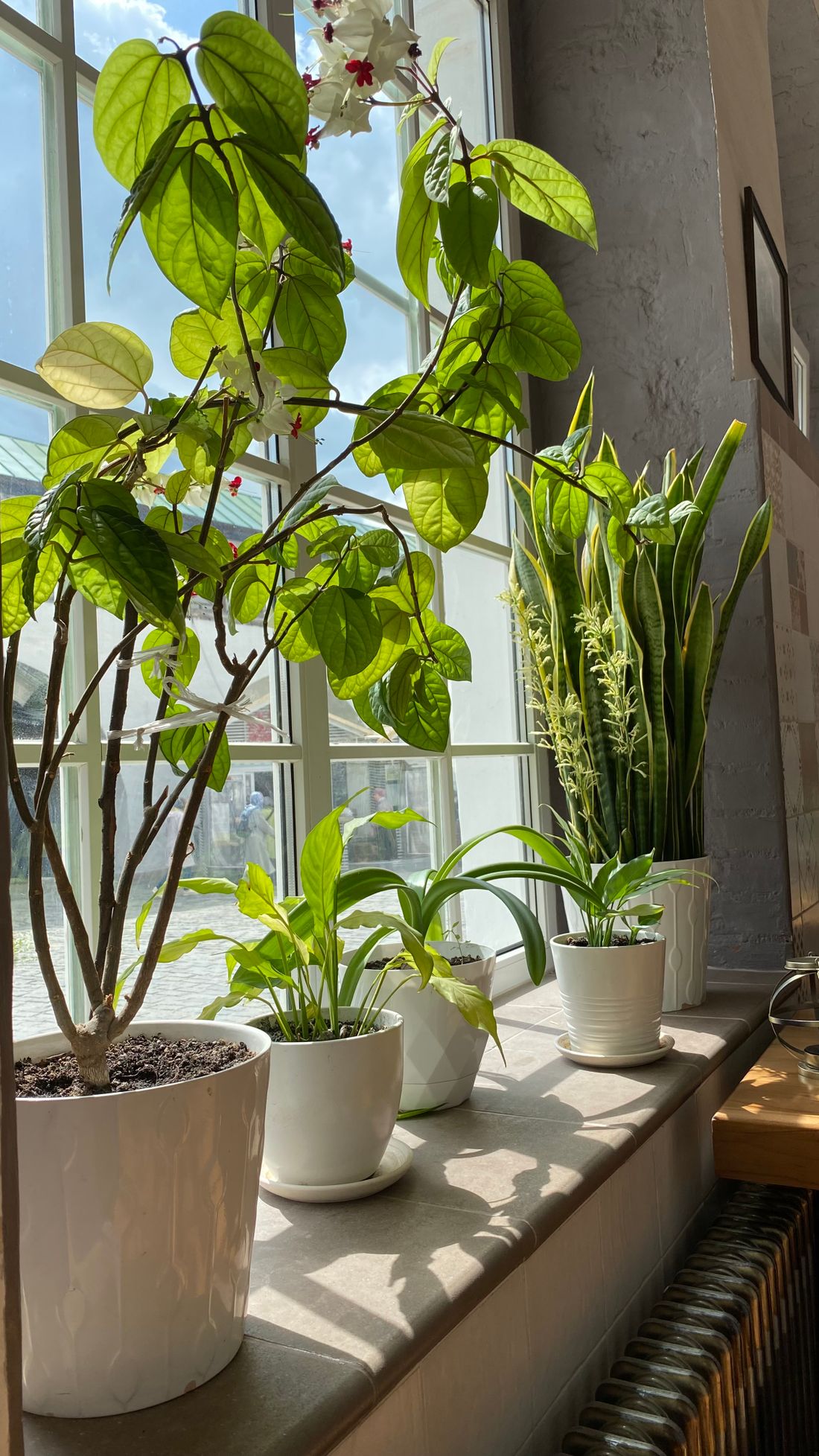
Unfiltered sill (full sun)
 Most cacti & succulents: jade, echeveria, aloe
 Ponytail palm
 Croton (needs the light for color)
 Sun-loving herbs like basil & rosemary
 Rubber plant, fiddle leaf fig and hoya: all three score a great fit on the bare sill
Behind a sheer / off the beam
 Bird of paradise
 Monstera (most prefer the beam filtered)
 Christmas cactus (a bit bright on the sill from September to April)
Four of these are scored plant by plant, at four distances from the same south glass, if you want the specific answer rather than the shortlist: a monstera clears the flag one metre back, a moth orchid about a metre and a quarter, a snake plant just past two, and a jade wants the sill itself.
Three more have pages of their own: a spider plant clears about a metre back, a golden pothos needs two and a half metres, and a rubber plant is at its best on the sill. A prayer plant, the plant in this page’s own worked example, is a great fit from about 1.5 metres to 4, and a ZZ plant from about 2.2 metres. A parlor palm needs two and a half, whatever its name suggests, while an areca is at its best on the sill. A peperomia, an African violet or a string of hearts each have a page too.
What won’t work here (honestly)
Scorches in the beam
- Ferns, calatheas & other shade-adapted thin leaves, pale patches, crisp edges; watering won’t fix a light burn
- Anything touching hot glass: the leaf against the pane takes damage first
Wrong assumption
- That the whole room shares the window’s abundance: light still collapses with distance; the far side can be too dark for the plants the window spoils
Most of what scorches here is comfortable at an east window instead, where the light arrives at about 6,500 lux and in the morning. The east window list is where those plants belong.
Do south-facing windows get hot?
Yes, and the heat is a separate problem from the light. Glass passes sunlight in and traps the warmth it turns into, so the pocket right at the sill can run several degrees above the room while the thermostat reports everything is fine. Leaf temperature climbs faster than air temperature, and a leaf pressed against the pane takes the worst of it.
The knock-on effect is water. A small pot in that pocket can go from watered to bone dry in a day or two in summer, which produces the classic misdiagnosis: crisping edges get read as underwatering, more water goes in, and now the roots sit wet in hot soil. If the edges are crisping in the beam and the soil is still damp, the problem is light and heat, not thirst.
Two things fix most of it, and neither is moving the plant out of the room. A sheer curtain across the beam during the hottest hours turns full sun into filtered bright, which is what most houseplants sold as “bright indirect” are asking for. Failing that, moving a plant a step to the side keeps almost all the brightness and drops it out of the beam entirely.
Winter runs the other way. The sun sits lower, so the beam reaches further into the room, and a plant set back from the glass that sat out of the sun all summer can find itself in it. A south window is the one orientation where the right answer changes twice a year.
A west window hits the same problem from the other end of the day, at roughly 7,800 lux, with the heat arriving late. How that plays out in an afternoon window is covered separately.
By GrowSpot · Published July 23, 2026 · Last updated August 30, 2026
