Scored for a monstera at 22 °C and 50% humidity, a west sill at 7,800 lux comes back 100 out of 100, and the score stays at 99 or 100 all the way to three metres into the room. At three and a half metres the light falls to 1,890 lux and the score to 68. The sill only gets flagged on a hot afternoon, and then it is the warmth doing it.
Read on 14 October 2026, the answer box at the top of Google’s results calls a west window a great spot for a monstera, then offers two placements that pull against each other: right against the glass if the plant is used to it, or two to six feet back if the afternoon sun feels hot. The first result under the box is a four-year-old r/Monstera thread whose title is the worry itself: too much light, because it’s a west window.
Both placements are fine. Neither is why a monstera struggles in a west room. One is an answer about light and the other is an answer about heat, and the box files them under the same worry.

Great fit
This plant should be happy in this spot.
Just the right amount of light
Comfortable temperature
Humidity suits it
Airflow suits it
Is a west window too much light for a monstera?
First, what other people publish for a monstera, copied exactly as each source prints it and in whatever unit it uses:
| Who publishes it | What it says a monstera needs | What the figure is |
|---|---|---|
| theplantrunner.com | 800–2,000+ lux | Standard foliage plants (pothos, Philodendron, Monstera deliciosa …) — a general band, not a single-species figure |
| theplantrunner.com | 1,500–5,000 lux | Light-hungry aroids & Ficus divas (Fiddle Leaf Fig, variegated Monstera) |
| growlightmeter.com | 8 – 12 PPFD / DLI | Monstera |
| houseplantjournal.com | 100 FC (20 µmol) foot-candles | minimum indirect light level |
| houseplantjournal.com | 200 FC (40 µmol) foot-candles | good indirect light level |
| houseplantsnook.com | 50–100 foot-candles | chart fc level |
| houseplantsnook.com | 200–400 foot-candles | chart fc level |
| soltech.com | around 288–325 PPFD / DLI | Monstera FAQ — large / extra-large plant PPFD |
| soltech.com | 80–500 PPFD / DLI | Monstera — Photone's published PPFD range, cited by Soltech |
No. On the sill the estimate is 7,800 lux, and the light dimension reads ideal there, which is why the card above gives the glass itself 100/100. A monstera’s comfortable band reaches high enough to take in the brightest spot a west room has. South glass is the one window where that stops being true: a south sill flags the same plant at 65/100, because it reads brighter than anything a west window delivers.
What the 7,800 doesn’t show is the peak. It’s a clear-day estimate for the spot, and an unfiltered beam late on a July afternoon runs brighter than that for an hour or two. That hour is what the “if it is used to it” hedge is really about. A monstera carried from a dim corner straight into it can scorch on the leaves facing the glass; one brought forward over two or three weeks rarely does.
How far back can a monstera go from a west window?
Three metres, with the score barely moving on the way there. Then it steps down. Here is one monstera walked back from the same west window, half a metre at a time at the end:
| Distance from the glass | Estimated light | What the light is doing | Verdict |
|---|---|---|---|
| 0.3 m, against the glass | 7,800 lux | Just the right amount of light | Great fit, 100/100 |
| 1 m back | 6,000 lux | Just the right amount of light | Great fit, 100/100 |
| 2 m back | 3,780 lux | Just the right amount of light | Great fit, 100/100 |
| 3 m back | 2,381 lux | Just the right amount of light | Great fit, 99/100 |
| 3.5 m back | 1,890 lux | A little dim, but workable | Worth a try, 68/100 |
| 4 m back | 1,500 lux | A little dim, but workable | Worth a try, 66/100 |
Between three metres and three and a half, the reading falls from 2,381 to 1,890 lux and the score from 99 to 68. That’s the dim edge of this plant’s range, and a west room puts it unusually deep. An east window reaches the same edge somewhere between two and three metres, and a north window between one metre and two. A fiddle leaf fig at this same glass reaches far less of the room: it slips out of its band between one metre and a metre and a half.
So the two-to-six-feet advice isn’t wrong. It just isn’t doing anything for the light. Six feet is under two metres, well inside the flat part of the table, and pulling back that far costs the plant nothing and buys it nothing on light. If a monstera in a west room is unhappy at one metre, the cause is somewhere else.
Those lux figures are estimates built from the window direction, the distance and a clear day. They aren’t meter readings, and your room will differ. The shape is the part that travels: a long flat run, then one step.
What actually flags a monstera on a west sill?
Heat. Keep the pot on the sill, change nothing but the air temperature, and the score runs from 100 down to 47 while the light reading never moves:
| Air temperature at the sill | Verdict |
|---|---|
| 16 °C | Worth a try, 64/100 |
| 21 °C | Great fit, 99/100 |
| 24 °C | Great fit, 100/100 |
| 27 °C | Great fit, 100/100 |
| 30 °C | Worth a try, 67/100 |
| 33 °C | Not the best fit right now, 47/100 |
The comfortable run is narrower than the distance run was. Between 21 and 27 °C the sill holds the top band; at 30 °C it drops to 67 and at 33 °C to 47. A west sill is where a room most often reaches that top end, because the afternoon sun lands on top of the warmth the day has already stored, and a closed window in July can run well above the rest of the room.
That is where “pull it back if the sun feels hot” earns its place. A metre in, the light score was already full and stays full. What changes is the pot is out of the warmest pocket of air. The table holds the temperature still on every row, so it can’t tell you how much hotter your sill runs than your thermostat says. A cheap thermometer left on the sill for one sunny afternoon can.
The cold end of the same table belongs to winter: 64 at 16 °C, which is a sill beside old single glazing on a January night rather than anything the sun does.
Does a west window still work for a monstera in winter?
On the sill, yes. The light there falls by around half between June and December and still lands inside this plant’s band, so the sill reads a great fit all year. Three metres back is where the season shows. Given a date and a latitude of 40 degrees, the engine scores that spot a great fit in March, June and September and only worth a try in December: the same step the distance table shows at three and a half metres, arriving with the calendar instead of the tape measure.
So in winter the good band gets shorter from the back. A monstera that was a great fit at three metres in September wants to come forward for the dark months, which is the opposite direction from the one the burn advice points. The heat that flags the sill in July is gone by then, so there is nothing at the glass to step back from.
Which window is best for a monstera?
Up close the four windows are more alike than the arguments suggest. Three metres back is where they separate: west and south still hold a monstera at a great fit there, while east and north have both slipped to worth a try. The four-window table at three metres lives on the page about this plant’s light band, alongside the band itself in lux.
The compass decides how deep into the room the pot can go. In a flat with one good window that matters more than any ranking of directions, because the question is rarely which wall to choose and usually how far from it the floor space starts. Plants differ at the same wall too: a heartleaf philodendron at west glass is flagged on the sill and clears only about a metre and a half back.
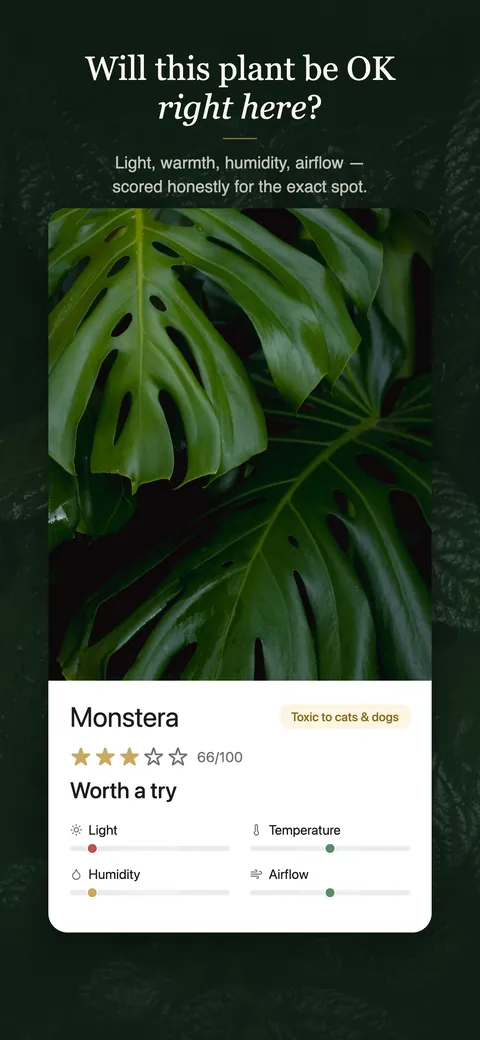
Leaves are the slow way to read the same thing. A monstera that sits past its edge for a season puts out smaller leaves with fewer holes, and a monstera that has stopped splitting is usually telling you about the last few months of light, not about food.
Before you commit the spot
Every number above describes an unobstructed west window on a clear day. A deep eave, a tree, the building across the road or a half-drawn blind will each take more off the reading than the compass puts on it, and none of them is an input here. The west window guide covers what else takes the afternoon beam. For your own window rather than a clean one, the free spot checker scores the spot with live weather where you live.
Published October 14, 2026
