A west sill gives a Christmas cactus 99 out of 100. That’s scored at 22 °C and 50% humidity, with the clear-day estimate on the sill at 7,800 lux, and the great fit carries on to 3.35 metres back before the light thins and the score drops to 68. On the sill itself the light never costs a point. Warmth does: at 27.5 °C the same spot reads worth a try.
Read on 22 October 2026, the answer box at the top of Google’s results says a west window “can work” for this plant if the afternoon sun is softened, with a sheer curtain especially in spring and summer, and it reads pale, yellowing or reddish-purple pads as too much direct light. It adds that plenty of growers prefer east or north. Most of the box is about flowering: some twelve hours of unbroken dark in autumn, nights near 50 to 55 °F, and a box over the plant if a west room stays lit in the evening. Reddit threads and UF/IFAS come next.

Great fit
This plant should be happy in this spot.
Just the right amount of light
Comfortable temperature
Humidity suits it
Airflow suits it
Does a Christmas cactus in a west window need a curtain?
Not for the light, going by our numbers. Start with what other people publish for this plant, each figure kept in the unit its source chose:
| Who publishes it | What it says a Christmas cactus needs | What the figure is |
|---|---|---|
| gardeningsolutions.ifas.ufl.edu | within six feet | How close to place it to a south-, east- or west-facing window |
| gardeningsolutions.ifas.ufl.edu | at least twelve hours of darkness | What it typically needs in order to flower |
| livelyroot.com | 4-6 hours of morning sunlight | Daily morning sun, given so the plant avoids prolonged exposure to harsh light |
| livelyroot.com | 13+ hours of darkness daily | With cooler temperatures, to encourage flowering |
| libanswers.nybg.org | at least two hours of winter sun | NYBG's light preference for Schlumbergera bridgesii, together with very bright light conditions |
| libanswers.nybg.org | 13 hours of uninterrupted darkness | What produces buds when the temperature is between 55° and 70°F |
| site.extension.uga.edu | around 13 to 16 hours each night | Total darkness for the best flowering; UGA Extension county article, December 2022 |
| site.extension.uga.edu | Fourteen hours or more of continuous darkness each day | Required before flower bud set, in the same article |
| extension.arizona.edu | at least 15 hours long | How long the nights must be for Thanksgiving and Christmas cacti to bloom; University of Arizona Cooperative Extension, Yavapai County, July 2024 |
The darkness figures, twelve hours to fifteen and up, are about flowering. The daylight ones are thinner: NYBG wants very bright light with at least two hours of winter sun, Lively Root four to six hours of morning sun, and UF/IFAS a spot within six feet of a south-, east- or west-facing window. None puts a number on afternoon sun being too much.
Our scores settle the light half of the question. Scored on the 21st of every month at latitude 40, the line through Philadelphia and Madrid, the west sill stays a great fit all year, its light reading just right in June as well as December. The sill that reads a bit bright for this plant faces south, from early September to early April.
Where a west sill can flag this plant is warmth. Here is the same sill with the light left alone and only the air warming up:
| Air temperature at the sill | What the light is doing | What the warmth is doing | Verdict |
|---|---|---|---|
| 22 °C | Just the right amount of light | Comfortable temperature | Great fit, 99/100 |
| 27 °C | Just the right amount of light | Comfortable temperature | Great fit, 98/100 |
| 27.5 °C | Just the right amount of light | A little warm, but workable | Worth a try, 68/100 |
| 30 °C | Just the right amount of light | A little warm, but workable | Worth a try, 63/100 |
| 30.5 °C | Just the right amount of light | Too hot here | Not the best fit right now, 48/100 |
| 33 °C | Just the right amount of light | Too hot here | Not the best fit right now, 44/100 |
The light column never moves; the verdict does, and quickly. The sill holds a great fit up to 27 °C, turns worth a try just above it, and reads not the best fit right now once it passes 30 °C. That ceiling comes earlier than for some of its windowsill neighbours: on the same glass a hoya keeps its great fit to 28 °C and a monstera to 29 °C.
The RHS puts discoloured stems down to heat as well as direct midday sun, and on a west sill the two arrive together. A metre back costs nothing on light here, as the next table shows, so when the glass runs hot in July that’s the cheap move.
How far back from a west window can a Christmas cactus go?
Scored for a clear day at no particular time of year, 3.35 metres, about eleven feet. One Christmas cactus, walked back from the same window:
| Distance from the glass | Estimated light | What the light is doing | Verdict |
|---|---|---|---|
| 0.3 m, against the glass | 7,800 lux | Just the right amount of light | Great fit, 99/100 |
| 1 m back | 6,000 lux | Just the right amount of light | Great fit, 99/100 |
| 1.85 m back | 4,051 lux | Just the right amount of light | Great fit, 99/100 |
| 3 m back | 2,381 lux | Just the right amount of light | Great fit, 98/100 |
| 3.35 m back | 2,026 lux | Just the right amount of light | Great fit, 97/100 |
| 3.4 m back | 1,979 lux | A little dim, but workable | Worth a try, 68/100 |
| 4 m back | 1,500 lux | A little dim, but workable | Worth a try, 66/100 |
Between 3.35 and 3.4 metres the reading slips from 2,026 to 1,979 lux and the score from 97 to 68. That step is the bottom edge of the plant’s light band. At an east window the same step comes about 40 centimetres sooner, at three metres.
The calendar moves the step. At latitude 40 the great fit reaches 3.75 metres on 21 June and only 1.85 metres on 21 December, which makes the six feet UF/IFAS gives almost exactly the depth that holds a great fit every day of the year. At 1.9 metres the pot reads worth a try from 8 December to 2 January.
That hands a west window a simple rhythm for this plant. In summer the glass runs hot and the good strip runs deep, so stepping back is free. By December the heat has gone, the strip has shrunk, and the pot wants to be within six feet.
Do cool nights for blooming cost a Christmas cactus points?
Yes. The answer box asks for nights around 50 to 55 °F in autumn, and scored at those temperatures this sill reads not the best fit right now; the great fit only returns at 17 °C, about 63 °F. The east-window page prints that cool end of the scale row by row.
That dip is a trade you make on purpose. Our scores measure how comfortable a plant is in a spot; they know nothing about day length or flowers, so a few weeks of a lower score is simply the price of the bloom. The evening box is about darkness, which none of these numbers can see.
Which window is best for a Christmas cactus?
By light alone, any of three. North, east and west sills each score this plant a great fit; south reads a bit bright. What separates the three is depth: on the same clear day the great fit reaches about 1.7 metres into a north room, 2.95 into an east one and 3.35 into a west one. The north window guide has it on its list.
Growers who prefer east or north are choosing caution; a west room gives you more floor to work with, at the price of a warm afternoon on the glass. If yours turns out to be a Thanksgiving cactus, Schlumbergera truncata, the one with pointed teeth along its stem segments, nothing here changes: our care data scores it the same at every distance, temperature and month on this page.
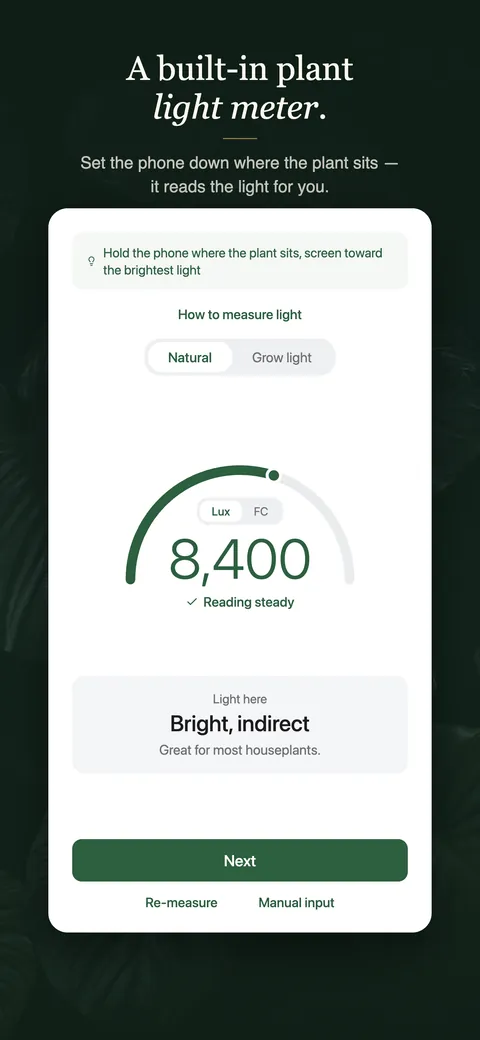
These lux numbers are modelled from the window’s direction, the distance and a clear sky; your own meter will land somewhere else. The line is what carries over: measure at leaf height where the pot will stand, in December if you can, when the line sits closest to the glass.
Before you settle the spot
Every number on this page pictures an unshaded west window under a clear sky. Eaves, a street tree or the block across the road all subtract light, and nothing here knows they exist. For the heat an afternoon beam brings with it, see the west window guide; to score the real sill, with your own weather, try the free spot checker.
Published October 22, 2026
