Scored for a bird’s nest snake plant at 26 °C and 45% humidity, a west sill at 7,800 lux comes back 68 out of 100 with the light flagged as a bit bright; one metre back it is 98, and two and three metres back it is 100. The answer is a distance, about a metre in from the glass.
Search for whether a snake plant can live in a west-facing window and you get three answers that cannot all be true. One well-known care site says any window is fine. A grow-light company says to put it about ten feet back. A gardening blog warns the leaves will burn in a heartbeat. None of the three is lying: they are describing three different spots and calling them all “a west window.”
A west window is not one place. The sill, the stand beside it, and the shelf across the room are three different light environments in the same square metre of wall. So the useful answer is not yes or no. It is a distance.

Worth a try
It can work here with a little care.
A bit bright, but workable
Comfortable temperature
Humidity suits it
Airflow suits it
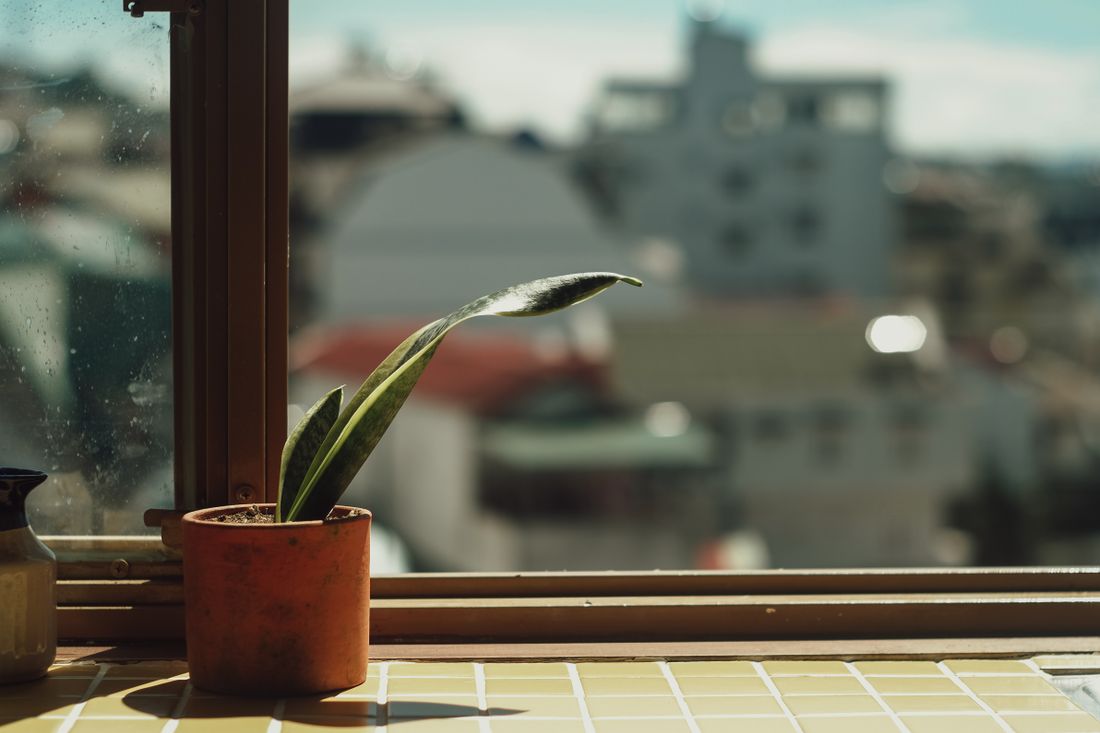
Will a west window burn a snake plant?
Before our own scoring says anything: we gathered every published figure we could find for a snake plant. 8 of them, from 7 separate sources, in 3 different units. They are reproduced below exactly as each source writes them, and nothing here is converted.
| Who publishes it | What it says a snake plant needs | What the figure is |
|---|---|---|
| theplantrunner.com | 300–800 lux | True low-light crew (ZZ, snake plant, cast-iron plant, some ferns) |
| houseplantjournal.com | 100 foot-candles | Sansevieria — minimum indirect light |
| houseplantjournal.com | 200 foot-candles | Sansevieria — good indirect light |
| growlightmeter.com | 5 – 10 PPFD / DLI | Snake Plant |
| extension.arizona.edu | 25–75 foot-candles | listed under the heading "Low Light (25–75 fc)" |
| apps.apple.com | 500 lux | per-plant figure — thrives at this level |
| houseplantsnook.com | 50–100 foot-candles | chart fc level |
| soltech.com | approximately 64–98 PPFD / DLI | Snake Plant FAQ — target PPFD by size |
No — against the glass it scores 68/100 with only the light dimension flagged, and a metre back it is 98/100. What west glass does to this plant is hold a ceiling, not burn it: pressed to the window the light runs a little brighter than a snake plant prefers, which is a flag rather than damage, with the other three dimensions sitting comfortably. Step back about a metre and the flag goes away entirely.
That is the whole finding, and it is worth being precise about it, because “it will burn” and “put it ten feet back” both point you away from the best seat in the room.
How far back should it sit?
About a metre: the glass is 68/100, and a metre back it is already 98/100, with two and three metres alike at 100/100, so the first metre buys nearly the entire improvement and every step after it buys next to none. Here is the same plant scored at four distances from the same west window, on a warm afternoon at 26 °C and 45% humidity:
| Distance from the glass | Estimated light | What the light is doing | Verdict |
|---|---|---|---|
| 0.3 m, against the glass | 7,800 lux | A bit bright, but workable | Worth a try, 68/100 |
| 1 m back | 6,000 lux | Just the right amount of light | Great fit, 98/100 |
| 2 m back | 3,780 lux | Just the right amount of light | Great fit, 100/100 |
| 3 m back | 2,381 lux | Just the right amount of light | Great fit, 100/100 |
Stand a peace lily beside it at the same four distances and both curves climb as you step back, but they do not climb to the same place: the peace lily is only worth a try at the glass and still only a good fit at three metres, where the snake plant is worth a try at the glass and reads 100 out of 100 from two metres back. One window, two answers.
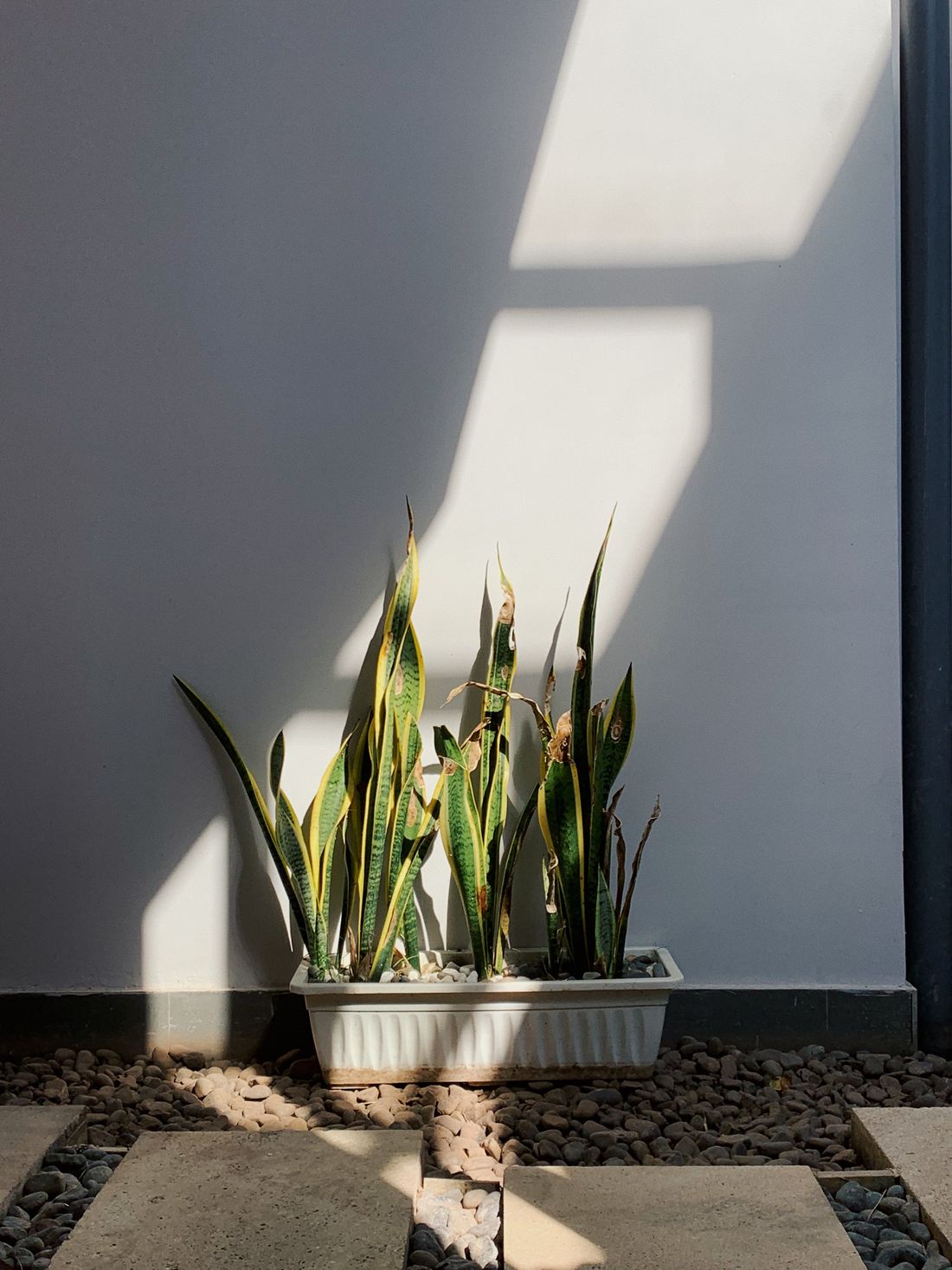
These light figures are estimates, not meter readings: they come from the window direction, the distance, and typical clear-day conditions. Your room will differ. What the numbers are good for is the shape of the curve, and the shape says the plant has a wide comfortable band that starts about a metre in.
The common “three to five feet back” advice is right at its near end and wasted along the rest of it: three feet is about a metre, which is exactly where the flag clears, and the two feet after that move nothing on the table above. The ten-foot advice is not wrong so much as expensive. At three metres the plant is still fine, but you have spent your brightest wall on a plant that would have been just as happy a metre from the window, and you have given up the spot to something else.
Why a “low light” plant scores best in a strong window
Snake plants are sold as low-light plants, and the label is accurate in the way a floor is accurate. It tells you how little the plant can survive on. It says nothing about how much it can enjoy.
Snake plants are drought-adapted, and drought-adapted plants tend to carry a wide light tolerance: they cope with dim, and they also cope with bright. Low light is this plant’s floor, not its ceiling. That is why a west window at one metre lands on 98 out of 100 while a dim corner, the place these plants are famous for “surviving,” only manages a caution.
The reason this trips people up is that the label gets read as a preference instead of a minimum. A plant that tolerates a dark hallway is not asking to live in one.
The flag at the glass comes off the top of the band rather than the bottom: this plant reads ideal to about 6,000 lux, and a west sill delivers 7,800.
What actually goes wrong at a west window
Light is usually not the culprit: on the sill the score sits between 63/100 and 68/100 the whole way from 16 °C to 30 °C, and what actually ends the run is the cold at one end (41/100 at 10 °C) and the heat at the other (45/100 at 33 °C). When a snake plant does badly in a west window, three other things are to blame:
- The heat pocket. Afternoon sun lands on top of the day’s accumulated heat. Our care baseline puts this plant’s upper comfortable limit at 29 °C, and a closed west sill in summer can sit above that while the room reads normal.
- Watering on a schedule. The hot sill dries a small pot fast, which tempts more frequent watering. Root rot from overwatering kills far more snake plants than sunlight does.
- The sudden move. A plant that spent a year in a dim corner and gets moved into an afternoon beam on a Saturday will scorch. Any plant will. Move it in stages over two or three weeks and the same spot is fine.
The first of those is the one you can score. Same spot on the sill, same everything else, across the range a room actually reaches over a year:
| Air temperature at the spot | Verdict |
|---|---|
| 10 °C | Not the best fit right now, 41/100 |
| 16 °C | Worth a try, 63/100 |
| 21 °C | Worth a try, 68/100 |
| 27 °C | Worth a try, 68/100 |
| 30 °C | Worth a try, 64/100 |
| 33 °C | Not the best fit right now, 45/100 |
Nothing in that column reaches a full score, and the reason is the light: pressed against west glass it runs a little brighter than this plant asks for, which holds the ceiling at sixty-eight however comfortable the room is. That is a ceiling rather than a burn, and it is the direct answer to the question at the top of this page. What actually ends the run is the cold at one end and the heat at the other, and a shut-up room behind west glass in July is a real way to reach the hot end.
A spider plant at this window is not scored by distance at all, because its light stays in band everywhere and the heat is what picks up the flag.
The room matters more than the window
We put a phone down in six places in a single bright living room, and the readings collapsed far faster than anyone guesses:
| Spot | Reading |
|---|---|
| At the bright window | 20,000 lux |
| 1 m from the window | 15,000 lux |
| 2–3 m away, in window shade | 3,500 lux |
| Middle of the room | 570 lux |
| Darker side of the room | 119 lux |
| The dark corner | 18 lux |
That room’s orientation was not recorded, so those figures are not west-window readings and we are not presenting them as any. What travels is the shape: a thousand-fold drop inside one room that a person would describe, start to finish, as bright. That is why “a west-facing room” is not a spot and cannot be scored like one. The thousand-fold drop is set out in six readings taken across a single bright room.
South glass is the harder version of the same question, at roughly 13,000 lux against 7,800 here. In a south-facing room the flag does not clear until three metres back.
A snake plant is one of the few that takes the afternoon beam head-on. The west window guide has the rest, and is blunt about which plants that beam will cost you.
Is a snake plant safe around cats and dogs?
No. The ASPCA lists snake plants as toxic to both cats and dogs. That does not rule out a west window, it rules out a west windowsill at cat height. A high shelf or a hanging pot in the same window keeps the light and moves the leaves out of reach.
Listed is still listed, which matters in a house with a cat that chews. The genuinely cat-safe options for a dim room are fewer than the usual lists suggest.
Before you commit the spot
Every number above describes a typical west window, not yours. The overhang outside, the building across the street, the blind you keep half-drawn, and which floor you live on all move the reading more than the compass direction does.
Published July 31, 2026 · Last updated August 30, 2026
