Scored at latitude 40, 22 °C and 50% humidity, a Chinese evergreen five feet from a west window, a metre and a half, comes back 99 out of 100 in March and September. From April to August the same spot drops to 68, because the light there still reads a bit bright for it. Two metres back holds a great fit in every month.
Read on 14 October 2026, the answer box at the top of Google’s results says yes, on terms: five to ten feet back, or a sheer curtain if the pot is closer, and more light for the pink kinds but no direct afternoon sun. The pages under it split on whether west glass is a risk. Soltech names a west window as the way to give this plant bright, indirect light. BabaBerry says afternoon sun scorches leaves on the sill and sends the plant several feet into the room. Flora’s guide says about five feet.
On our numbers, five feet sits right on this plant’s line: the comfortable side of it for seven months a year, the bright side for five.

Worth a try
It can work here with a little care.
A bit bright, but workable
Comfortable temperature
Humidity suits it
Airflow suits it
Can a Chinese evergreen sit on a west windowsill?
First, the light figures other sources publish for this plant, each one in the unit its source uses:
| Who publishes it | What it says a Chinese evergreen needs | What the figure is |
|---|---|---|
| getgrowli.app | 500–800 lux | Its floor: the plant “survives a north room or dim corner” on as little as this (filed under Growli’s Low Light tier) |
| getgrowli.app | 1,500–4,000 lux | Where it “does noticeably better”; Growli prints the same band for several plants, so it is a tier band rather than this plant’s alone |
| foliage-factory.com | approx. 5,000–10,000 lux | Product page for Aglaonema commutatum, listed as “Medium indirect” |
| edis.ifas.ufl.edu | 3,000 to 1,250 foot candles | UF/IFAS EP160, commercial production: Aglaonema grown in 75% to 90% shade. A nursery figure, not a room one |
| edis.ifas.ufl.edu | 25 foot candles | UF/IFAS EP160: the lowest light level it “can tolerate” |
| extension.illinois.edu | 75 foot candles | A tier figure: the page lists Chinese evergreen as Low, and defines Low Light as 75 foot candles |
It can, with a flag. The card above gives the sill 66, worth a try, and light is the only thing it marks: a bit bright, but workable. Warmth, humidity and airflow all sit inside their bands. That’s a milder word than scorch, and at west glass it’s as far as the light goes for this plant.
The figures in that table fall into two camps, and a west room lays both out on the floor. Foliage Factory sells this exact species with a band of about 5,000 to 10,000 lux, which on a clear day takes in everything from the sill to just short of a metre and a half back. That’s the strip the engine flags. Growli’s 1,500 to 4,000 lux, the level it says the plant does noticeably better at, covers the two-, three- and four-metre rows of the distance table below, and each of them scores a full 100.
The top figure belongs to a different job. UF/IFAS gives 3,000 to 1,250 foot-candles for growing Aglaonema commercially under 75 to 90% shade, and its row says so.
How far back from a west window does a Chinese evergreen need to be?
On a spring or autumn day, a little less than a metre and a half. Here’s one plant moved back from the same glass:
| Distance from the glass | Estimated light | What the light is doing | Verdict |
|---|---|---|---|
| 0.3 m, against the glass | 7,800 lux | A bit bright, but workable | Worth a try, 66/100 |
| 1 m back | 6,000 lux | A bit bright, but workable | Worth a try, 68/100 |
| 1.5 m back | 4,762 lux | Just the right amount of light | Great fit, 99/100 |
| 2 m back | 3,780 lux | Just the right amount of light | Great fit, 100/100 |
| 3 m back | 2,381 lux | Just the right amount of light | Great fit, 100/100 |
| 4 m back | 1,500 lux | Just the right amount of light | Great fit, 100/100 |
The flag lasts through the one-metre row at 6,000 lux and is gone by a metre and a half, at 4,762 lux and 99. Past that the light keeps falling and the score stops caring. Ten feet, the far end of the answer box’s range, is three metres and nowhere near a limit for this plant. The darkest spot on this page is still well above Growli’s survival figure of 500 to 800 lux.
A parlor palm at a west window crosses its line in the same place, and its page pins that line down in ten-centimetre steps. As far as light goes, a shelf that suits one suits the other.
These lux figures are estimates built from the window direction, the distance and a clear day, not meter readings. With no date in them, they sit close to the March and September rows of the next table.
Is five feet back enough in summer?
Not at latitude 40, about level with Philadelphia or Naples. Here’s the metre-and-a-half spot, scored on the 21st of eight months:
| The 21st of | Estimated light | What the light is doing | Verdict |
|---|---|---|---|
| February | 3,893 lux | Just the right amount of light | Great fit, 100/100 |
| March | 4,734 lux | Just the right amount of light | Great fit, 99/100 |
| April | 5,467 lux | A bit bright, but workable | Worth a try, 68/100 |
| June | 5,715 lux | A bit bright, but workable | Worth a try, 68/100 |
| August | 5,476 lux | A bit bright, but workable | Worth a try, 68/100 |
| September | 4,748 lux | Just the right amount of light | Great fit, 99/100 |
| October | 3,848 lux | Just the right amount of light | Great fit, 100/100 |
| December | 2,779 lux | Just the right amount of light | Great fit, 100/100 |
March reads 4,734 lux and 99. By April the estimate is 5,467 and the score 68, and it holds there through June’s 5,715 and August’s 5,476 until September brings 99 back. In June the line sits between 1.7 and 1.8 m, just under six feet. So the bottom of the five-to-ten-feet range is spring and autumn advice at this window. Start from two metres, about six and a half feet, and the range holds all year: scored the same way, two, three and four metres each read a great fit in every month. At latitude 51, around London, five feet back carries the flag through the same five months.
Winter runs the other way. From mid-November to late January at latitude 40 the sill itself reads a great fit. If the plant comes forward for those months, check the cold before the light. At 15 °C this plant drops to not the best fit right now even where the light suits it, and the winter guide’s worked example is a Chinese evergreen losing points to cool, dry air while its light is just right.
Will afternoon sun scorch a Chinese evergreen in a west window?
Light alone never takes it past a flag in these tables. The lowest score on the page is the sill’s 66, and even the sill in June stays at worth a try. Warmth can go further. Keep the two-metre spot’s light as it is and raise the air: 28 °C is still a great fit, 29 °C drops to worth a try, and 33 °C is not the best fit right now. West glass takes its sun in the hottest hours of the day, so a west room is the likeliest place to see them. Two metres solves the light. Only cooler air solves the heat, and a thermometer at the pot on a July afternoon will tell you whether yours has any.
Every number here is for Aglaonema commutatum. The pink and red kinds the answer box mentions aren’t scored separately on this page, so read the line as this species’ line and not theirs.
Does a score of 66 mean too much light or too little?
Either, and the number alone won’t say which. The sill’s 66 on this page is a bright-side score. Below is the app’s check screen for a monstera that also scored 66, with its light marker at the dim end of the scale:
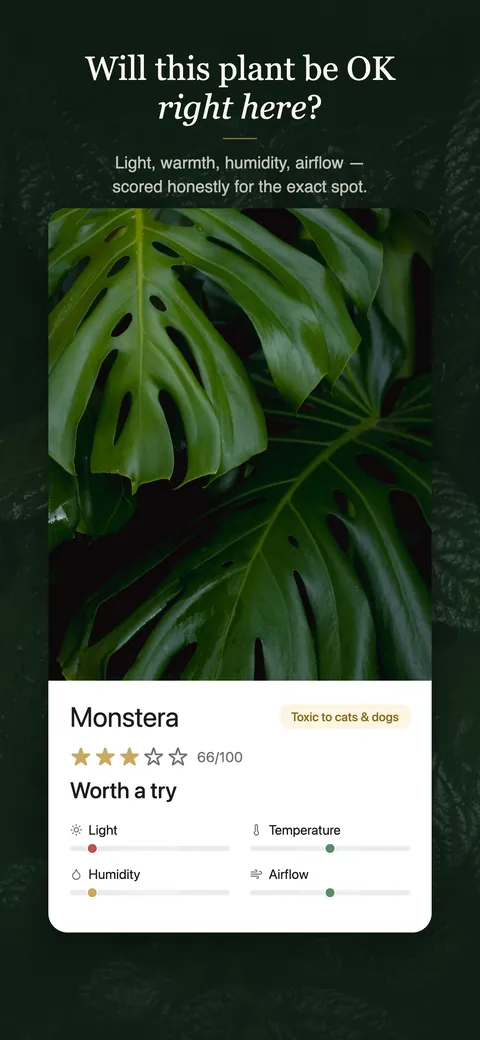
When you score your own spot, read the light line before the stars. For this plant at west glass, a bright-side flag means move back, while a monstera four metres from the same kind of window picks up its flag from the dim side and wants the opposite move. With a light meter, hold it at the pot on a clear afternoon. The line you’re after falls between the 6,000 and 4,762 lux rows of the distance table.
What do these tables leave out?
They picture an unshaded west window on a clear day. A tree or the building opposite takes light off the sill and pulls the line toward the glass, and neither is an input here. The west window guide covers what else that afternoon light suits. If the other choice in your home is north glass, the north window page scores this plant there, where even the sill stays under its line. For the window you actually have, the free spot checker scores the spot with your own weather.
Published October 14, 2026
