A croton wants the front two metres of a south room. Scored at 22 °C and 50% humidity, the sill, at an estimated 13,000 lux, comes back 100 out of 100, and two metres in it still reads 98. By two and a half metres the light reads a little dim and the score is 67.
Read on 14 October 2026, the answer box at the top of Google’s results says a croton can thrive at a south window, then hedges: bring it in gradually, hang a sheer, set it a few feet back or off to the side, and raise the humidity. The pages below mostly cheer for south, a container maker and a grow-light company among them. Plant Addicts dissents, warning of scorch or faded colour and suggesting a spot across the room. Cary Magazine wants a bright south window with the leaves kept off the cold glass. Nobody gives the distance as a number.
Our scores put the line just past two metres, and they give the answer box’s last hedge, the humidity, more weight than its one line there.

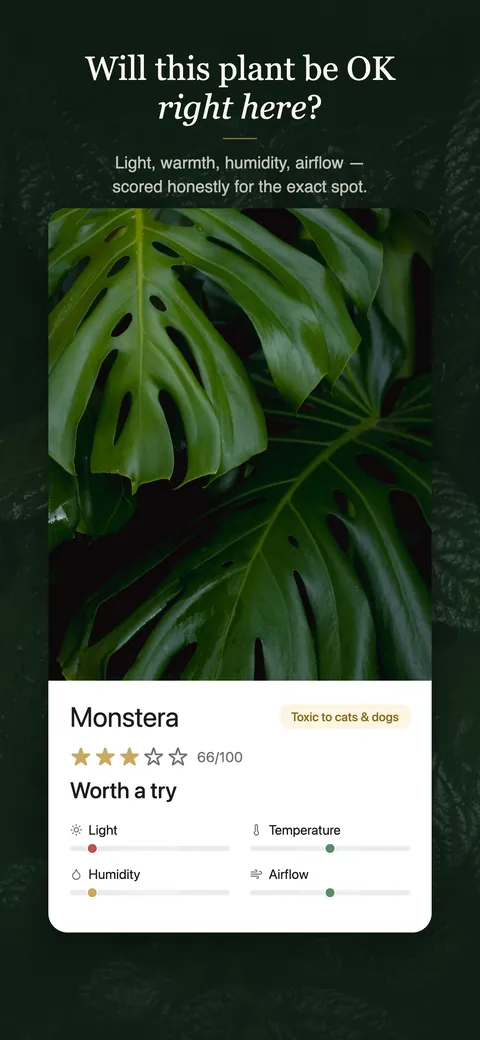
Great fit
This plant should be happy in this spot.
Just the right amount of light
Comfortable temperature
Humidity suits it
Airflow suits it
Is a south window too much sun for a croton?
Here first is what other people publish for a croton, copied as each source prints it:
| Who publishes it | What it says a croton needs | What the figure is |
|---|---|---|
| getgrowli.app | 4,000–8,000 lux | Its “bright, indirect” tier, the same band the app prints for several plants |
| getgrowli.app | 400–800 fc | The same tier, given again in foot-candles |
| foliage-factory.com | approx. 20,000–40,000 lux | Shop product page for croton ‘Petra’: very bright, some direct sun |
| mrec.ifas.ufl.edu | 3000 to 5000 ft-c | University of Florida notes for commercial pot production, “or higher”; read from a 2025 web.archive.org copy, the live page is gone |
| mrec.ifas.ufl.edu | 6000 to 7000 ft-c | Same archived notes: acceptable for production if high temperatures can be controlled |
| lifetips.alibaba.com | 1,500–2,500 foot-candles | Target at peak daylight for a black croton; a content site that cites no source |
| lifetips.alibaba.com | 1,200 fc | Floor on the same page: below it, it expects fading and loss of leaf contrast |
| bloomingexpert.com | 200 foot-candles (FC) | Pigment floor: below roughly this, it says the plant stops keeping its colours |
No. The sill on the card, at 13,000 lux, is the brightest estimate we give any window, and a croton’s light still reads just right there. If our scoring were going to flag this plant for too much light anywhere in a home, it would be here. The table mostly agrees from both ends: apart from Growli’s shared tier band, which tops out at 8,000 lux, its high figures are greenhouse, shop-page and peak-daylight light above any sill, and its low ones are floors below which colour fades, a split the west window page lays against its own rows.
So if a croton fades in a south room, the published floors say check how far it stands from the glass. Scorch on one fresh from the shop is about how fast it got there, and the fiddle leaf fig page walks through that move. The two plants keep company on this window: on our full-sun page the croton and the fig were the two plants a warm south sill suited outright, while jade and aloe read a little dim on the same glass.
How far back from a south window can a croton go?
About two metres. Here is one croton walked straight back from the glass:
| Distance from the glass | Estimated light | What the light is doing | Verdict |
|---|---|---|---|
| 0.3 m, against the glass | 13,000 lux | Just the right amount of light | Great fit, 100/100 |
| 1 m back | 10,000 lux | Just the right amount of light | Great fit, 100/100 |
| 2 m back | 6,300 lux | Just the right amount of light | Great fit, 98/100 |
| 2.5 m back | 5,000 lux | A little dim, but workable | Worth a try, 67/100 |
| 3 m back | 3,969 lux | A little dim, but workable | Worth a try, 66/100 |
| 4 m back | 2,500 lux | A little dim, but workable | Worth a try, 63/100 |
| 5 m back | 1,575 lux | Too dim here | Not the best fit right now, 47/100 |
The flat run ends between the two-metre and two-and-a-half-metre rows. Probing in ten-centimetre steps, 2.1 metres is still a great fit and 2.2 is worth a try, which puts the edge at about seven feet. A rubber plant steps down between the same two rows of its own south table, so the two want the same strip of floor.
That sorts the published distances. A few feet back, the answer box’s phrase, is still in the top band. Across the room, the Plant Addicts fix, lands past the edge in any room deeper than seven feet, and from there the light reads a little dim out to four metres and too dim at five. Off to one side is a direction these tables never walk.
South is the window that gives this plant room. In a west window the same croton has to stay within about a metre of the glass. The back of a south room still has a use: a parlor palm only reaches a great fit from about two and a half metres back, a quarter of a metre behind the croton’s edge.
Does a croton in a south window need more humidity?
Only once the room gets properly dry. This is the sill from the card again, same 22 °C, with only the humidity changing, driest first:
| Humidity at the sill | What the air is doing | Verdict |
|---|---|---|
| 20% | Too dry here | Worth a try, 65/100 |
| 25% | A little dry, but workable | Good fit, 88/100 |
| 30% | A little dry, but workable | Great fit, 91/100 |
| 35% | A little dry, but workable | Great fit, 95/100 |
| 45% | Humidity suits it | Great fit, 99/100 |
| 55% | Humidity suits it | Great fit, 100/100 |
From 55% down to 30% the score slides from 100 to 91, still in the top band. At 25% it’s a good fit, 88. At 20% the humidity reads too dry and the score drops to 65, two points under the 2.5-metre row. A croton on the best spot in the room, in air that dry, scores below one standing past its light edge in ordinary air.
So the answer box is right to bring humidity up, and the table shows where it counts. Going from 35% to 55% buys five points. Going from 20% to 30% buys twenty-six. If your hygrometer already reads in the thirties, a humidifier won’t change much for this plant. Under 25%, it’s the first thing to fix, before you move the pot anywhere.
Take the reading beside the pot. Sun on the glass warms the air there, and warmer air holding the same water reads a lower relative humidity, so a hygrometer on the far wall can flatter the sill.
Should a croton’s leaves touch the glass?
No, and Cary Magazine’s reason is the right one. Hold this sill below 16 °C and it reads not the best fit, with its light still just right; the west window page runs a croton’s sill through the rest of the cold and the heat. A leaf pressed to a cold pane can sit colder than the air around the pot, so leave a hand’s width between them.
What moves the two-metre edge?
Anything that shades the window. Every row on this page assumes clear glass with open sky beyond it, and the lux figures are worked out from the window direction, the distance and a clear day rather than read off a meter. A balcony above or a tree outside takes light off every row at once and draws the croton’s edge toward the sill. A sheer, the answer box’s other fix, does the same by an amount we haven’t scored. Here the sill has light to spare: the two-metre row reads just right at 6,300 lux, under half the sill’s figure, so a sheer that cuts less than half the light leaves the sill in the top band and shortens the strip behind it.
The south window guide has the other plants that can share that sill. To score your own window, shade and all, run the free spot checker where the pot will stand.
Published October 14, 2026
