Scored at 22 °C and 50% humidity, a parlor palm on a south sill comes back 45 out of 100. The card gives one reason, the light: an estimated 13,000 lux, too bright for this plant. A metre back it scores 63, and two metres back 68. At two and a half metres it jumps to 99, and every row behind that, out to five metres, is a full hundred.
Read on 14 October 2026, the top results mostly steer this plant away from south glass. The Old Farmer’s Almanac says east or north works best and that south glass can scorch the leaves, and for a bright room it suggests several feet of distance or a sheer curtain. Epic Gardening picks north over south. Blooming Expert points the parlor palm toward a north window while putting the areca palm it’s compared with within six feet of a south one. One plant-help site breaks ranks and wants it in a sunny south window for more than six hours a day. The oldest answer on the page, a 2013 forum reply about a bedroom with a south window, just put it in the corner.

Not the best fit right now
The plant's fine, this spot just isn't a match.
Too bright here
Comfortable temperature
Humidity suits it
Airflow suits it
Light is a deal-breaker here. The other three cannot make up for it.
If that corner sat two and a half metres or more from the glass, the forum reply had it right. Only the Almanac gives a distance for this plant, and none of the results says where in a south room the answer changes. The areca comparison points the right way, though. Those two palms belong at opposite ends of the same floor.
Is a south-facing window too bright for a parlor palm?
At the glass, yes, and the published figures lean the same way our score does. Here they are, copied exactly as each source prints them:
| Who publishes it | What it says a parlor palm needs | What the figure is |
|---|---|---|
| growlightmeter.com | 6 – 12 PPFD / DLI | Parlor Palm |
| extension.arizona.edu | 25–75 foot-candles | listed under the heading "Low Light (25–75 fc)" |
| houseplantjournal.com | 100 FC (20 µmol) foot-candles | minimum indirect light level |
| houseplantjournal.com | 200 FC (40 µmol) foot-candles | good indirect light level |
| houseplantsnook.com | 100–200 foot-candles | chart fc level |
Every one of those is modest. The Arizona extension lists the plant under low light, and the highest foot-candle figure in the table, 200, is a level our south estimate doesn’t drop to until somewhere between the four- and five-metre rows further down. Our care data files it in the low band too. So the flag on the card is about surplus. The sill gets 13,000 lux, and a plant built for the forest floor has no use for most of it.
Heat doesn’t change that verdict. We held the pot on the sill and ran the air from 10 to 33 °C, and it stayed at not the best fit the whole way, because the light had already pinned the score down. A monstera on a west sill is the reverse case: its light reads ideal there, and it’s the air temperature that brings it down.
How far from a south window should a parlor palm be?
Two and a half metres or more. Here is one plant moved back from one south window, with nothing else changing:
| Distance from the glass | Estimated light | What the light is doing | Verdict |
|---|---|---|---|
| 0.3 m, against the glass | 13,000 lux | Too bright here | Not the best fit right now, 45/100 |
| 1 m back | 10,000 lux | A bit bright, but workable | Worth a try, 63/100 |
| 2 m back | 6,300 lux | A bit bright, but workable | Worth a try, 68/100 |
| 2.5 m back | 5,000 lux | Just the right amount of light | Great fit, 99/100 |
| 3 m back | 3,969 lux | Just the right amount of light | Great fit, 100/100 |
| 4 m back | 2,500 lux | Just the right amount of light | Great fit, 100/100 |
| 5 m back | 1,575 lux | Just the right amount of light | Great fit, 100/100 |
It comes down to one step. Between the two-metre row and the next, the estimate falls from 6,300 to 5,000 lux, the light column turns from a bit bright to just right, and the score goes from 68 to 99. Nothing gives out behind it: at five metres and 1,575 lux the plant still scores 100.
The Almanac’s several feet only gets there if several means eight. Probing between the rows, six feet back is still worth a try, and the step lands at about eight. A golden pothos draws its line in the same place on south glass, so the two can share the back half of a south room.
At an east window this palm is a great fit from about a metre back, and at a west one from about a metre and a half. South glass pushes that start more than twice as deep into the room.
None of these lux figures came off a meter. They’re worked out from the direction of the glass, the distance of the pot and a clear sky.
Which palms can take a south window?
Most of the common indoor ones can, a metre from the glass. Same window, same metre, same 22 °C, six palms:
| The palm, one metre from the glass | What the light is doing | Verdict |
|---|---|---|
| Areca palm | Just the right amount of light | Great fit, 100/100 |
| Kentia palm | Just the right amount of light | Great fit, 99/100 |
| Lady palm | Just the right amount of light | Great fit, 93/100 |
| Bamboo palm | Just the right amount of light | Great fit, 91/100 |
| Majesty palm | A bit bright, but workable | Worth a try, 68/100 |
| Parlor palm | A bit bright, but workable | Worth a try, 63/100 |
Four of the six are a great fit there, the areca at a full hundred and the kentia at 99. An African violet in the same spot would be too. The parlor palm and the majesty palm are the two whose light reads a bit bright at that distance.
Move the same palms back to two and a half metres and the order turns over at both ends. The areca turns a little dim and slips to worth a try, while the parlor palm climbs to 99. The kentia stays a great fit at both distances, which makes it the easy pick if you can’t choose where the pot goes.
So the word palm is a poor guide to a south window. In a room with space for two, the tables give you the layout: an areca or a kentia in the front metre, the parlor palm two and a half metres back or more. The south window guide covers the plants that want the full beam on the sill itself.
How do you tell which way the light is off?
From the plant, slowly. From a score, at once, because each marker on the card leans toward whichever end is wrong:
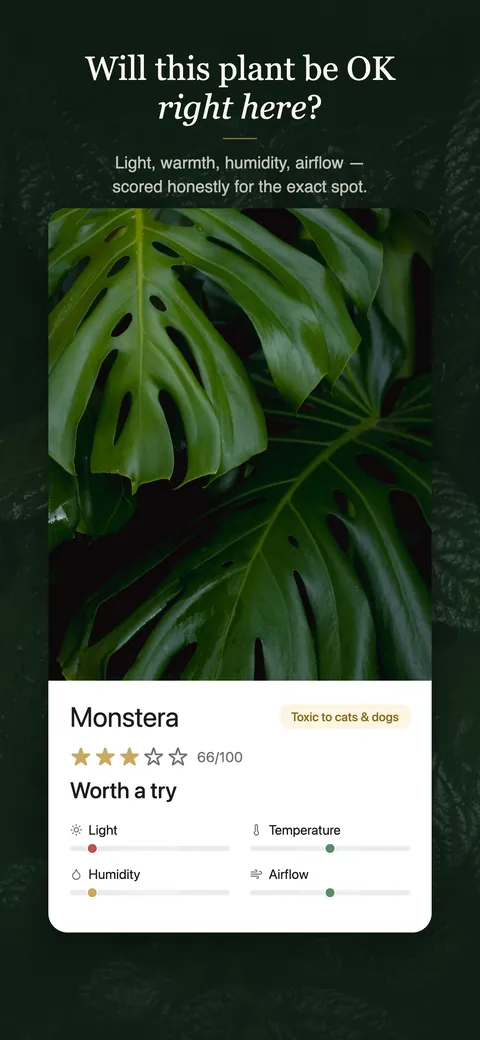
For this plant at this window, the direction is the whole decision. A bright-side flag means move it back, and on a south window there is no dim-side flag to find within five metres of the glass.
One thing does move the step: whatever already shades your window. A balcony overhead or a building across the street cuts the light at every distance, so the step arrives closer to the glass and the palm gets more of the room. How much closer is something no estimate can tell you. A sheer curtain, the Almanac’s other fix, works the same way, lowering the light at every distance by an amount we haven’t scored. The free spot checker reads the spot you actually have.
Published October 14, 2026
