Against the glass a Bambino fiddle leaf fig scores 100/100 at 13,000 lux, and still 100 a metre back. At two metres it is 98; at three — the cautious spot — it falls to 65, a little dim but workable. Same 24 °C, 45% humidity and light airflow at every distance: only the distance changes.
Two things get said about fiddle leaf figs and south-facing windows, usually on the same search results page. One is that a south window is ideal, with the longest run of bright light in the house. The other is that some experts caution against south and west windows for fear of burning the leaves, and that the plant should be kept back or behind a sheer curtain.
The caution is well meant and it is aimed at the wrong end of the room. A fiddle leaf fig is one of the hungriest common houseplants for light, and a south window is the brightest thing most homes have. Pulling it back to be safe removes the one advantage the spot was offering.

Worth a try
It can work here with a little care.
A little dim, but workable
Comfortable temperature
Humidity suits it
Airflow suits it
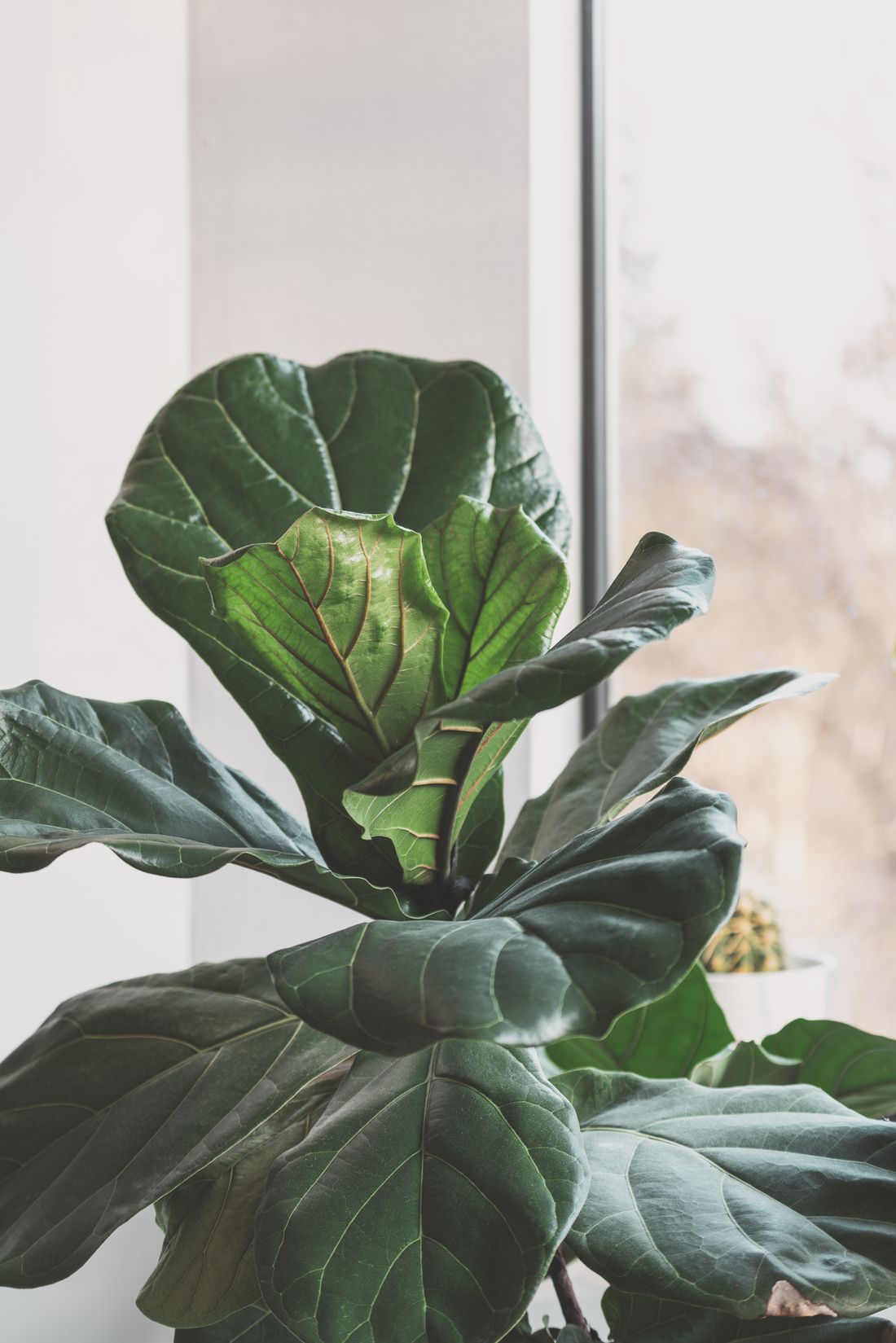
Will a south window burn a fiddle leaf fig?
Before our own scoring says anything: we gathered every published figure we could find for a fiddle leaf fig. 7 of them, from 5 separate sources, in 2 different units. They are reproduced below exactly as each source writes them, and nothing here is converted.
| Who publishes it | What it says a fiddle leaf fig needs | What the figure is |
|---|---|---|
| theplantrunner.com | 1,500–5,000 lux | Light-hungry aroids & Ficus divas (Fiddle Leaf Fig, variegated Monstera) |
| houseplantjournal.com | at least 400 foot-candles | Fiddle leaf fig — leaf-drop threshold |
| bbg.org | under 250 foot-candles | Fiddle-Leaf Fig (Ficus lyrata) |
| bbg.org | 2,000 to 6,000 foot-candles | Fiddle-Leaf Fig (Ficus lyrata) |
| extension.arizona.edu | 75–150 foot-candles | listed under the heading "Medium Light (75–150 fc)" |
| houseplantjournal.com | 400 FC (80 µmol) foot-candles | minimum indirect light level |
| houseplantsnook.com | 400–800 foot-candles | chart fc level |
Against the glass of a south window this plant scores a full hundred, with all four dimensions inside their comfortable bands. Not tolerable. Not a compromise. A clean fit.
The flag appears at three metres, where the light has dropped below what the plant wants and the score falls into caution. If you are going to get this placement wrong, that is the direction you will get it wrong in.
How far back can it go before it stops working?
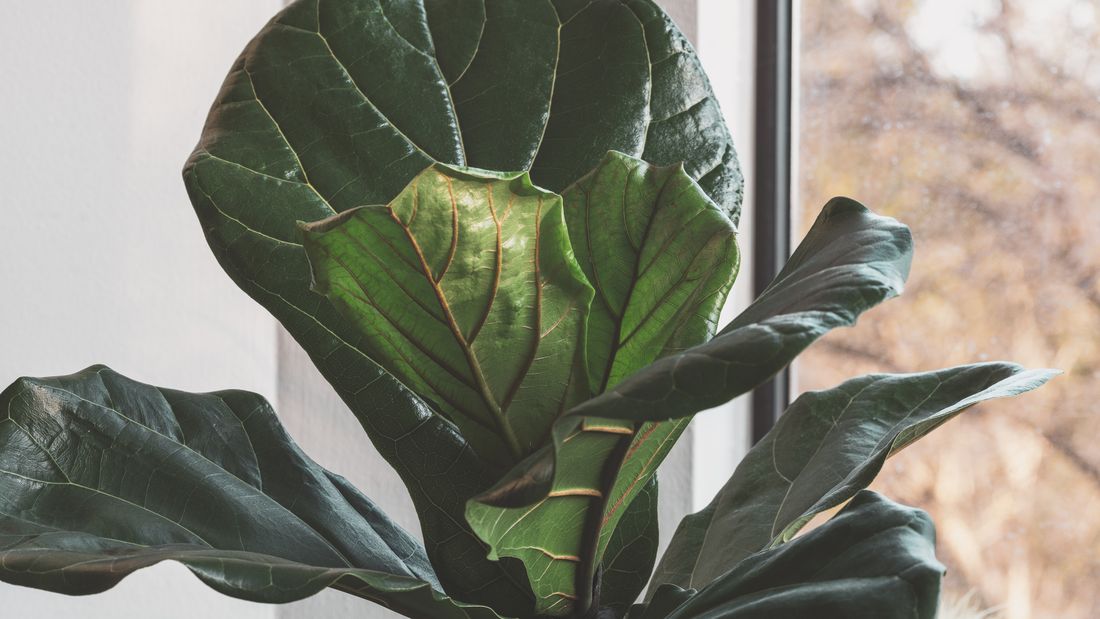
The same plant scored at four distances from the same south window, in a room at 24 °C and 45% humidity:
| Distance from the glass | Estimated light | What the light is doing | Verdict |
|---|---|---|---|
| 0.3 m, against the glass | 13,000 lux | Just the right amount of light | Great fit, 100/100 |
| 1 m back | 10,000 lux | Just the right amount of light | Great fit, 100/100 |
| 2 m back | 6,300 lux | Just the right amount of light | Great fit, 98/100 |
| 3 m back | 3,969 lux | A little dim, but workable | Worth a try, 65/100 |
Those light figures are estimates rather than meter readings, built from the window direction, the distance, and typical clear-day conditions. What travels is the direction of the curve: for this plant and this window, every metre you retreat costs you, and none of them buy you safety.
Two metres of usable band is generous by houseplant standards. Very few plant and window combinations give you that much room to place a large pot without losing points.
How generous is clearest against the same plant at a north window, with the air held at the same 24 °C. There the best spot in the room is a flagged 65 against the glass, and from two metres back the light dimension fails. One wall costs this plant everything, which is the argument for choosing the window before choosing the plant.
The same question at an east window is far tighter: a rubber plant scores 98 at the glass and fails outright by three metres.
Worth putting beside a plant that runs the other way in the identical window:
| Distance from the glass | Bambino fiddle leaf fig | Monstera |
|---|---|---|
| 0.3 m against the glass13,000 lux | 100/100 | 65/100 |
| 1 m back10,000 lux | 100/100 | 92/100 |
| 2 m back6,300 lux | 98/100 | 94/100 |
| 3 m back3,969 lux | 65/100 | 94/100 |
The sill is the best of the four spots for one of them and the worst for the other, and the far wall reverses it. Two plants that both appear on lists of things suited to a south-facing room, wanting opposite ends of it.
Then why do so many people burn theirs?
Because scorch is usually a story about a move, not about a window. A plant that has spent months in a shop, a hallway, or a north room and gets carried into a south window on a Saturday afternoon will mark its leaves, and the marks are permanent on a fiddle leaf fig because it does not shed and replace foliage quickly.
The same window, reached over two or three weeks in stages, is the best seat in the house for this plant. The window did not change. The speed of arrival did.
What the sheer curtain is actually for
Filtering a south window is a real technique with a real purpose, and the purpose is heat, not light.
- Glass at midday in summer can push the pocket right at the window above the 29 °C that this plant is comfortable up to, while the room reads normal. A sheer curtain takes the edge off that pocket.
- South-facing glass with no eave or overhang in a hot climate is the case the warnings are written for. If that is your window in July, the curtain earns its place.
- A north or east room in winter is the opposite problem, and no curtain fixes it. Distance is the lever there.
A sheer is the standard fix for plants that want the light but not the heat, and the south-facing window plants guide splits its list on that same line: the ones that take the unfiltered sill, and the ones that want the beam broken first.
Brown edges are not always sunburn
Fiddle leaf figs mark easily and the marks all look similar from across a room. Sun damage shows as bleached or tan patches on the leaf surfaces that face the glass, and it appears on those leaves only.
Damage that appears on leaves everywhere on the plant, including the shaded side, is telling you about something other than the window. Dry edges that creep in from the rim are more often a watering rhythm or a root problem, and moving the plant away from a perfectly good window will not fix either.
The room is not the spot
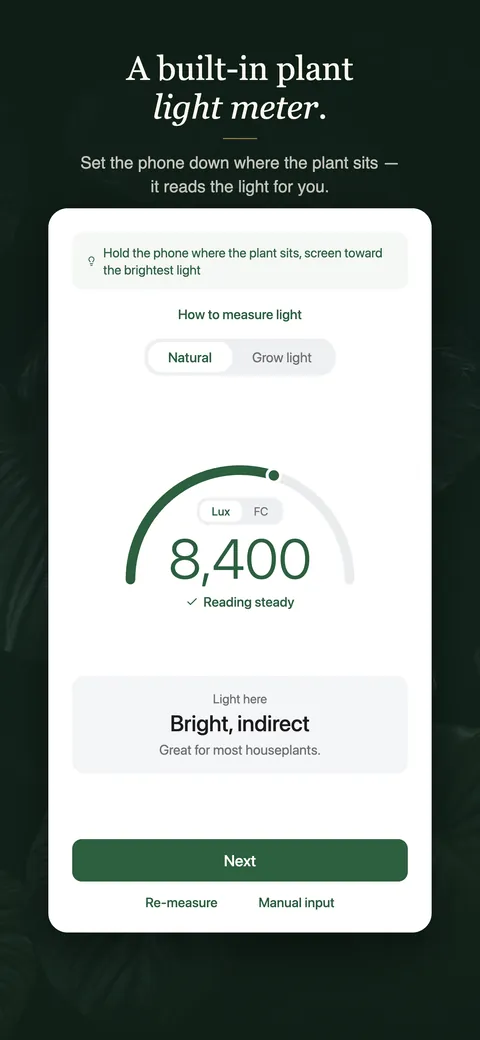
We put a phone down in six places in one bright living room:
| Spot | Reading |
|---|---|
| At the bright window | 20,000 lux |
| 1 m from the window | 15,000 lux |
| 2–3 m away, in window shade | 3,500 lux |
| Middle of the room | 570 lux |
| Darker side of the room | 119 lux |
| The dark corner | 18 lux |
A thousand-fold spread inside one room that a person would describe, start to finish, as bright.
That room’s orientation was never recorded, so those are not south-window figures and we are not presenting them as any. The shape is the part that travels, and it is why a fiddle leaf fig can thrive and fail in the same room depending on which side of it the pot lands. The shape itself came from one room measured at six points, glass to corner.
By GrowSpot · Published July 31, 2026 · Last updated August 30, 2026
