At 22 °C and 50% humidity, an African violet scores 100 out of 100 right at south glass, where we estimate 13,000 lux, 100 again a metre back and 98 at two metres. Half a metre further the light is down to 5,000 lux and the score to 67. It doesn’t come back from there: five metres in, it’s 47.
Read on 14 October 2026, the answer box at the top of Google’s results says yes, with conditions: out of direct sun, three to five feet back or behind a sheer in spring and summer, and a south window turning ideal by late autumn. The pages under it hedge the same way. The Missouri Botanical Garden allows south glass only in mid-winter. A garden centre says to the side of the window, NC State’s extension office says a sheer or slightly out of the sun, and Epic Gardening says use caution.
All of it guards against too much light. None of it says how far back is too far, which is the one line the scores can draw.

Great fit
This plant should be happy in this spot.
Just the right amount of light
Comfortable temperature
Humidity suits it
Airflow suits it
Does a south window give an African violet too much light?
Start with what gets published for this plant. Every figure below is copied as its source prints it, unit and all:
| Who publishes it | What it says an African violet needs | What the figure is |
|---|---|---|
| espacepourlavie.ca | 10,760 to 16,140 lux (1,000 to 1,500 foot-candles) | Montreal Botanical Garden: the light intensity an African violet requires |
| espacepourlavie.ca | 8,600 lux (800 f-c) | Montreal Botanical Garden: what young plants grow best at |
| espacepourlavie.ca | 5,380 lux (500 f-c) | Montreal Botanical Garden: below this, plants stay at the vegetative stage and do not flower |
| edis.ifas.ufl.edu | ~1000 foot candles | UF/IFAS MG028: bright light but no direct sunlight, described as within 3 feet of a southeast- or west-facing window |
| edis.ifas.ufl.edu | approximately 600 foot-candles | UF/IFAS MG028: under fluorescent light only, for about 16 hours a day |
| edis.ifas.ufl.edu | 800 to 1,200 foot candles | UF/IFAS EP360: the satisfactory range for commercial production |
| edis.ifas.ufl.edu | 150 foot candles | UF/IFAS EP360: the interior level (or higher) for plants after shipping |
| getgrowli.app | 1,500–4,000 lux | Moderate, indirect light: the site's Medium Indirect tier, a band it prints for several plants |
| foliage-factory.com | approx. 10,000–20,000 lux | Seller's product page for one cultivar, Saintpaulia 'Little Love Blue': bright indirect |
| bloomingexpert.com | 500–600 foot-candle | Winter minimum that north windows often fall short of, per the site |
Not by these numbers. Our sill estimate of 13,000 lux sits inside the 10,760 to 16,140 lux the Montreal Botanical Garden says an African violet requires, and both University of Florida pages land near a thousand foot-candles, where Montreal’s own foot-candle version of that range starts. The low figure is a care app’s tier band, 1,500 to 4,000 lux, printed for several plants. On the card above, the light reads ideal a metre back, and the sill scores the same.
So what are the warnings for? The beam. Our 13,000 is an estimate from which way the glass faces, how far back the pot sits and a clear sky, not a meter reading, and it leaves out the hours when midday sun falls straight onto the leaves, far brighter than that. Missouri, NC State and the answer box are steering around that beam. Step out of it sideways, as the garden centre says, or break it up with a sheer, and the pot can stay in the first two metres. We haven’t scored a sheer, so treat that part as advice.
How far from a south window should an African violet be?
Within two metres. Here is the same violet stepped back from the glass, with the room left as it was:
| Distance from the glass | Estimated light | What the light is doing | Verdict |
|---|---|---|---|
| 0.3 m, against the glass | 13,000 lux | Just the right amount of light | Great fit, 100/100 |
| 1 m back | 10,000 lux | Just the right amount of light | Great fit, 100/100 |
| 1.5 m back | 7,937 lux | Just the right amount of light | Great fit, 99/100 |
| 2 m back | 6,300 lux | Just the right amount of light | Great fit, 98/100 |
| 2.5 m back | 5,000 lux | A little dim, but workable | Worth a try, 67/100 |
| 3.5 m back | 3,150 lux | A little dim, but workable | Worth a try, 64/100 |
| 5 m back | 1,575 lux | Too dim here | Not the best fit right now, 47/100 |
One step, and it comes late. The light column says just right down to the 6,300 lux row and a little dim from the 5,000 lux row on, and the score falls from 98 to 67 across that half metre. Our score doesn’t model flowering, but Montreal draws its flowering line in the same gap: below 5,380 lux, it says, violets stay at the leafy stage. In a south room, on our estimate, that puts its line and our step in the same half metre of floor, about two metres out.
So the answer box’s three to five feet costs nothing on light; a metre and a half back still scores 99. Probing between the rows, six feet reads a great fit and eight feet worth a try, which backs a line visible in the search preview of an r/AfricanViolets thread calling eight feet pretty far. Go by the care app’s 1,500 to 4,000 lux instead and you’d be aiming for the 3.5 and 5 m rows, where the score is 64 and then 47.
Is a south sill too hot for an African violet?
Sometimes, and sometimes too cold. Hold the pot on the sill and vary nothing but the air:
| Air temperature at the sill | Verdict |
|---|---|
| 14 °C | Not the best fit right now, 44/100 |
| 16 °C | Worth a try, 64/100 |
| 18 °C | Great fit, 99/100 |
| 22 °C | Great fit, 100/100 |
| 27 °C | Great fit, 99/100 |
| 30 °C | Worth a try, 64/100 |
| 33 °C | Not the best fit right now, 44/100 |
The good run is 18 to 27 °C. At 30 °C the sill drops to 64 and at 33 to 44, and the cold side mirrors it, 64 at 16 °C and 44 at 14. The light reads ideal on every row of that table, so every lost point is the air.
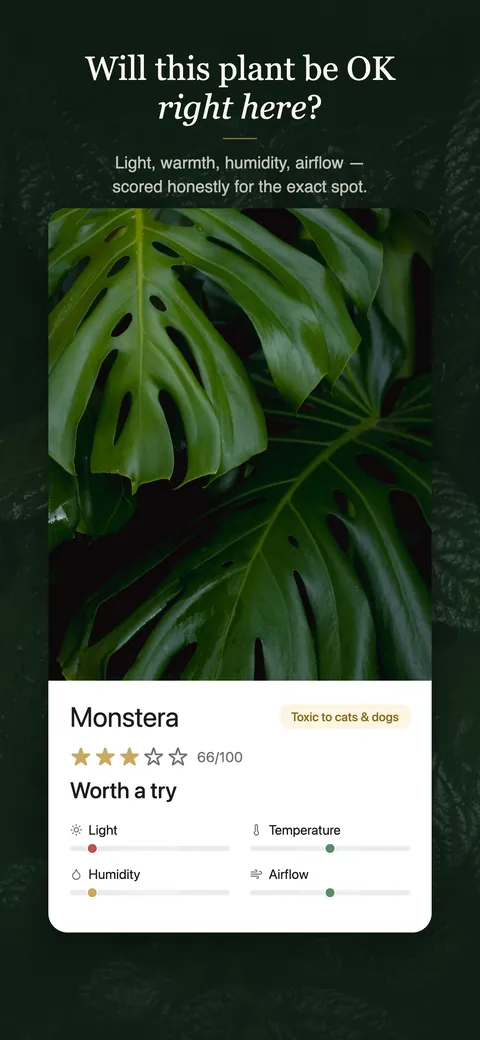
South glass can put a sill at either end. On a sunny afternoon the pocket of air against the pane runs warmer than the thermostat says, and after dark the same pane is the coldest surface in the room. Missouri’s mid-winter advice brings the pot to that glass in the months when its nights are coldest. A min-max thermometer on the sill for a week shows which end your window reaches. If nights dip toward 16 °C, move it a metre back from the cold pane, which in the distance table costs this plant nothing on light.
We don’t score the seasons for south glass, so for winter light, go by the sources: Missouri says mid-winter only, and the Houseplant Resource Center says south and west windows suit violets in the winter months.
Which window suits an African violet best?
On light alone, south gives it the most floor. Probed the same way, an east window, the one most of these sources rank first, keeps a violet at a great fit only for the first two feet or so, and a north sill never reaches one. The sources favour east for something the score doesn’t weigh: cool, soft morning sun with no midday beam.
Other plants split a south room differently. A moth orchid in the same south window is flagged on the sill and clears at about a metre and a quarter, well before the violet runs out, and a parlor palm stays flagged for bright light until two and a half. Violet in front, palm behind.
Every row here assumes a clean south window on a clear day. Shade of any kind, from an overhang to the block opposite, lowers every row, so the two-metre line moves toward the glass. The south window guide covers what a sheer or a step to the side does there, and the free spot checker scores your own window, shade and all.
Published October 14, 2026
