Right on a south sill, a Christmas cactus scores 68 out of 100 at 22 °C and 50% humidity. Its clear-day estimate, 13,000 lux, is a bit bright for this plant, and nothing else is marked down. Give the score a date and the flag turns seasonal: at latitude 40 the sill is a bit bright from 9 September to 3 April and a great fit from 4 April to 8 September.
Read on 22 October 2026, the answer box at the top of Google’s results calls a spot right in a south window usually too bright and hot for this plant, enough to scorch the stems or stop it flowering, and credits Michigan State University. To make one work it suggests a sheer or window film, or a spot three to six feet back; failing that, an east or north window. Below it, a Reddit thread asks why a cactus beside south glass won’t bloom.
“Too bright and hot” sounds like July. On our light scores the bright months are the cool ones, when this plant sets buds and blooms, and the July sill is just right.

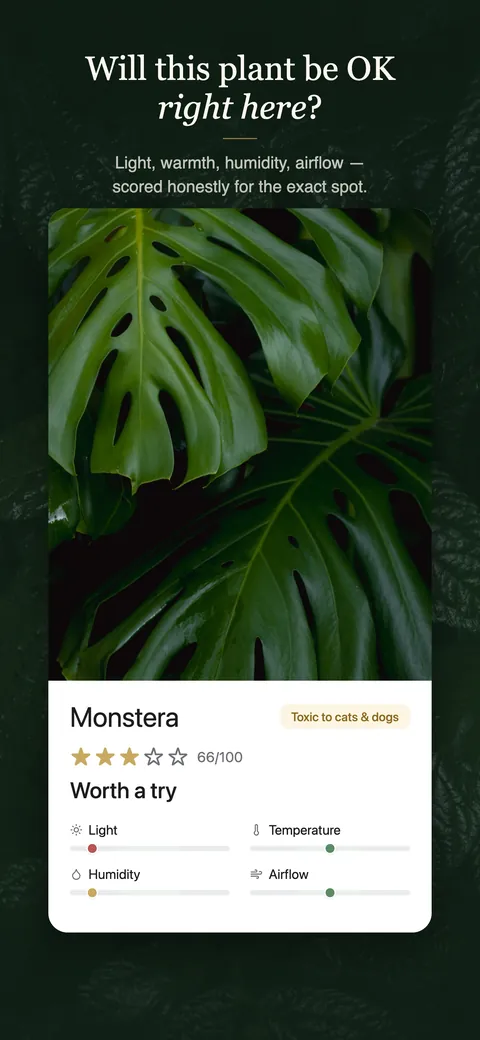
Worth a try
It can work here with a little care.
A bit bright, but workable
Comfortable temperature
Humidity suits it
Airflow suits it
Is a south-facing window too bright for a Christmas cactus?
On the sill, from September to April, which runs against how a south room feels. A summer sun at noon stands so high that it meets the upright pane at a glancing angle and less of it gets through, while the low sun of February and October meets the glass nearly face on, over a longer day than December’s. Here is the card’s spot through one year, scored on each month’s 21st at latitude 40, about where Denver and Beijing sit:
| The 21st of | Estimated light | What the light is doing | Verdict |
|---|---|---|---|
| January | 13,043 lux | A bit bright, but workable | Worth a try, 68/100 |
| February | 13,981 lux | A bit bright, but workable | Worth a try, 68/100 |
| March | 13,069 lux | A bit bright, but workable | Worth a try, 68/100 |
| April | 10,413 lux | Just the right amount of light | Great fit, 99/100 |
| May | 8,164 lux | Just the right amount of light | Great fit, 99/100 |
| June | 7,319 lux | Just the right amount of light | Great fit, 99/100 |
| July | 8,084 lux | Just the right amount of light | Great fit, 99/100 |
| August | 10,369 lux | Just the right amount of light | Great fit, 99/100 |
| September | 13,035 lux | A bit bright, but workable | Worth a try, 68/100 |
| October | 13,959 lux | A bit bright, but workable | Worth a try, 68/100 |
| November | 12,987 lux | A bit bright, but workable | Worth a try, 68/100 |
| December | 12,299 lux | A bit bright, but workable | Worth a try, 68/100 |
Every row from September through March reads a bit bright, at 68. The two highest rows are February, at 13,981 lux, and October, at 13,959, and December’s 12,299 still sits on the bright side. April brings the sill inside the band, and by June it’s down to 7,319 lux and scoring 99.
For this plant the timing matters more than the peak. The flagged months take in autumn bud set and the holiday bloom, and the months the sill gets right are the summer ones. The lux in both tables is modelled, not measured, from a clear day, the compass direction, the distance and, for the months, the date.
How far back from a south window should a Christmas cactus be?
Not far, and the box’s three to six feet is safe all year. First with no date at all, the same pot moved back from the glass, with rows at about three feet and just under six.
| Distance from the glass | Estimated light | What the light is doing | Verdict |
|---|---|---|---|
| 0.3 m, against the glass | 13,000 lux | A bit bright, but workable | Worth a try, 68/100 |
| 0.6 m back | 12,030 lux | A bit bright, but workable | Worth a try, 68/100 |
| 0.65 m back | 11,755 lux | Just the right amount of light | Great fit, 97/100 |
| 0.9 m back | 10,473 lux | Just the right amount of light | Great fit, 99/100 |
| 1.8 m back | 6,910 lux | Just the right amount of light | Great fit, 99/100 |
| 4.45 m back | 2,031 lux | Just the right amount of light | Great fit, 97/100 |
| 4.5 m back | 1,984 lux | A little dim, but workable | Worth a try, 68/100 |
Between 0.6 and 0.65 metres, about two feet out, the estimate falls from 12,030 to 11,755 lux and the score climbs from 68 to 97: the bright edge of this plant’s band. The dim edge is far off, between 4.45 and 4.5 metres, where the light goes a little dim and the score falls back to 68.
Dates move both edges. Run day by day at latitude 40, the bright edge comes in to half a metre in late December and out to 0.8 metres in late February and mid-October, and the dim edge pulls in to 3.2 metres at midsummer. Between 0.8 and 3.2 metres, about two and a half to ten and a half feet, the pot keeps a great fit every day. Three feet clears the brightest weeks; a pot at 0.75 metres is flagged only from 15 February to 3 March and 10 to 25 October.
Does a south window stop a Christmas cactus from blooming?
Our scores can’t tell you. They have no input for scorch and can’t see day length or flowers, so the box’s burnt stems and missing buds are beyond their reach. The care pages we read mostly count hours of darkness:
| Who publishes it | What it says a Christmas cactus needs | What the figure is |
|---|---|---|
| gardeningsolutions.ifas.ufl.edu | within six feet | How close to place it to a south-, east- or west-facing window |
| gardeningsolutions.ifas.ufl.edu | at least twelve hours of darkness | What it typically needs in order to flower |
| livelyroot.com | 4-6 hours of morning sunlight | Daily morning sun, given so the plant avoids prolonged exposure to harsh light |
| livelyroot.com | 13+ hours of darkness daily | With cooler temperatures, to encourage flowering |
| libanswers.nybg.org | at least two hours of winter sun | NYBG's light preference for Schlumbergera bridgesii, together with very bright light conditions |
| libanswers.nybg.org | 13 hours of uninterrupted darkness | What produces buds when the temperature is between 55° and 70°F |
| site.extension.uga.edu | around 13 to 16 hours each night | Total darkness for the best flowering; UGA Extension county article, December 2022 |
| site.extension.uga.edu | Fourteen hours or more of continuous darkness each day | Required before flower bud set, in the same article |
| extension.arizona.edu | at least 15 hours long | How long the nights must be for Thanksgiving and Christmas cacti to bloom; University of Arizona Cooperative Extension, Yavapai County, July 2024 |
Those hours are a night-time matter, and the warning UF/IFAS adds is about lamps left on after dark from October to December. Its other figure, within six feet of south glass, splits on our numbers: the far end holds a great fit every day at latitude 40, and the sill end is flagged from September to April. NYBG asks for very bright light and two or more hours of winter sun, which a south sill supplies in December; our care data puts this plant in the bright, indirect band, so that sill reads a bit bright.
What the score does see is warmth, on its own scale. On the June sill, with the light just right, this plant keeps its great fit to 27 °C and slips to worth a try just past it, the warm edge the west-window page prints row by row. Both tables assume air at 22 °C; the south window guide explains why the air at the glass can run several degrees warmer than the room. A thermometer by the pane on a sunny afternoon settles which side of 27 yours is on.
Cool bud-setting nights cost points at any window: below 13 °C this plant reads not the best fit right now, and the east-window page lines that up against the nights each source asks for. On a south sill from September to April the cost lands on top of the light flag. A metre back the light is right all year, and 17 °C is enough for a great fit.
What is the best facing window for a Christmas cactus?
It depends where the pot will stand. On a sill, north, east and west all keep a great fit through the year at latitude 40, and south doesn’t. Off the sill the order turns over. Here is the strip that keeps a great fit on every day of the year, window by window:
- North: from the glass to 0.55 m
- East: from the glass to 1.45 m
- West: from the glass to 1.85 m
- South: from 0.8 m to 3.2 m, with the sill itself flagged from September to April
December opens the gap widest. On the 21st the great fit reaches 4.35 metres into a south room, about fourteen feet, against 1.85 from west glass, the deepest of the other three. So the box’s east-or-north advice fits a cactus that lives on the sill; one on a side table or a plant stand gets more good floor at a south window than at any other in the months it flowers. A Thanksgiving cactus, Schlumbergera truncata, gets identical scores throughout this page.
What can shade a south window?
Things overhead and things across the street, and they work on opposite seasons. An eave or balcony overhead cuts the high summer sun but lets the winter sun in underneath, which pulls the dim edge closer in summer and barely touches the flagged months. A tall building across the street does the reverse, blocking the low winter sun that flags the sill. Neither is an input here. For something to sit on the glass while this plant stands back, the direct-sun guide scores sun-lovers on an unshaded south sill; the free spot checker will score the pot’s real spot against your local weather.
Published October 22, 2026
