Every list of office plants names the same few: ZZ plant, snake plant, pothos, peace lily, cast iron plant. What none of them attaches is a number. Your office has one, and it is not a guess — it is written into the standard the building was lit to.
EN 12464-1 puts 500 lux on the desk surface for typing, reading and screen work. That is the maintained figure: the level the design is not allowed to fall below as lamps age and dust settles. Reception counters and filing areas are specified at 300 lux, technical drawing at 750. Every one of those numbers was chosen for a human eye reading a document. None of them was ever meant to feed a leaf.
The standard has a blind spot worth naming too: 500 lux is specified for the task area, the patch of desk in front of you. A plant on the corner, on a shelf above a monitor or on a filing cabinet sits in the surrounding zone, which the same standard allows to be lower again.
Nor is 500 lux one committee’s opinion. The international standard ISO 8995-1 (CIE S 008) and the North American IES recommendations land in the same 300–500 lux range for general office work. Three bodies, drawn up separately on three continents, agree on what a desk needs.
The plant side has no such agreement. We read seven published answers to “how bright is bright indirect light” on a single day in August and put them side by side: a cooperative extension service, two Google AI Overviews, a grow-light manufacturer, two plant sites and the top answer on r/houseplants. Their floors run from 1,000 lux to 10,764 lux, a spread of more than ten times, and they are plainly not all equally authoritative.
| Published floor for “bright indirect” | In lux | Against a 500 lux desk |
|---|---|---|
| Spider Farmer (grow-light maker, published in lux) | 1,000 | 2× |
| r/houseplants, top answer | 4,306 | 8.6× |
| Thursd | 5,382 | 10.8× |
| Google AI Overview, for this question | 5,382 | 10.8× |
| Google AI Overview, for “foot candles chart for plants” | 5,382 | 10.8× |
| Arkansas Cooperative Extension, high light | 5,382 | 10.8× |
| How Many Plants | 10,764 | 21.5× |
None of that disagreement matters here. The most generous floor among them is 1,000 lux — already double the 500 lux desk figure — and six of the seven sit at 4,306 lux or higher, roughly nine times what a desk is lit to. Whichever source you believe, a compliant desk is below it.
So the office lighting is not broken. It is doing exactly what three standards bodies designed it to do, about a band below where a plant starts making progress instead of holding position. The indoor readings we publish land on the office side of that line: their median is 566 lux, close to what a desk is lit to and below every published plant floor.
Which is why the useful question about a desk is never which plant. It is how far the desk sits from the glass, because daylight through a window is the only thing in the room operating on a plant’s scale.
What the distance to the window actually costs
An office is lit to a figure that comes from lighting practice, not from horticulture, and the two sets of numbers are in different units.
| Published by | The figure | In its own words |
|---|---|---|
| open.edu | 200–300 lux | “Daylight penetrating windows into a building can provide illuminance levels of around 200–300 lux in typical naturally lit offices for most of the day.” |
| open.edu | 500 lux at the desk | Recommended task levels: office desk and laboratory bench 500 lux, classroom desk 300, circulation areas 150. |
| open.edu | 100 000 lux | For scale, on the same page: “Sunlight is extremely bright and its illuminance can reach 100 000 lux on the ground.” |
| extension.psu.edu | 100 footcandles | “a common baseline for low light is 100 footcandles” — roughly a thousand lux, which is above what the office figures above describe. |
| extension.arizona.edu | 25–75 fc | Its low band, and the places it names for it: “areas more than eight feet from windows as in the center of a room, a hallway or an inside wall.” |
| extension.msstate.edu | Under 50 fc | “Usually, an intensity of less than 50 foot-candles will not sustain plant life for very long.” |
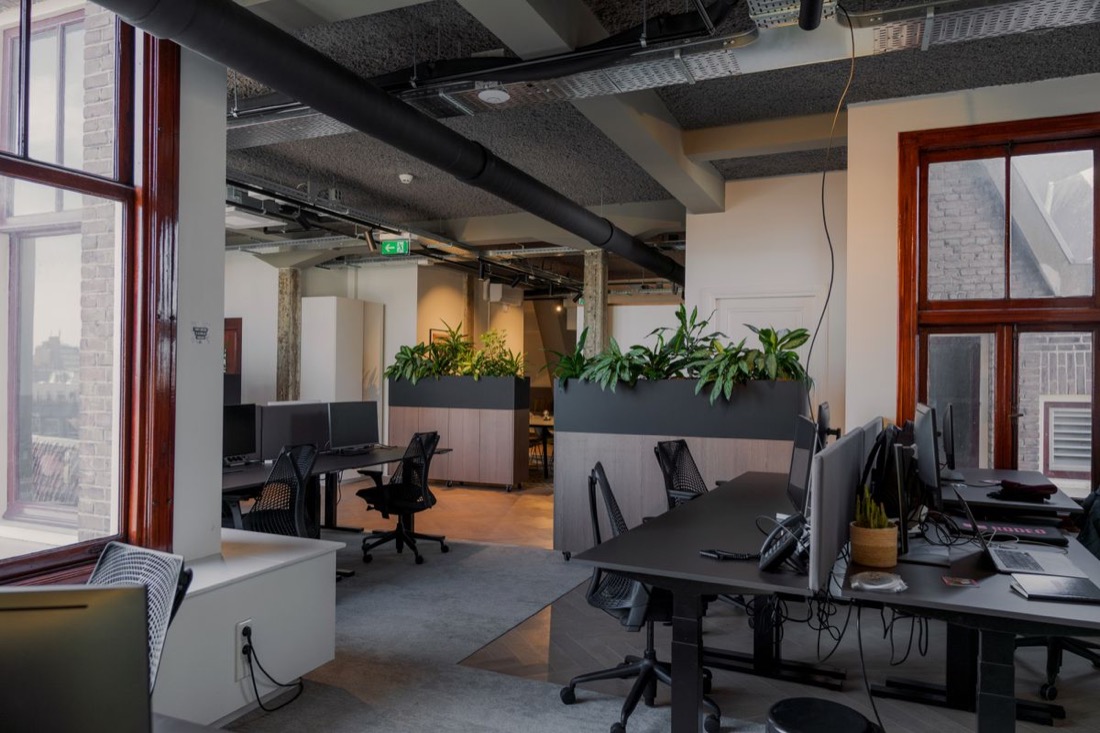
The plant below is a spider plant, and the choice is deliberate: the pothos rows in our species data are mid-merge upstream, and two of them disagree about how much light a golden pothos wants. Until that is settled we would rather run this table on a plant whose entry is unambiguous than publish an argument that could invert underneath us.
| Where the desk sits | Estimated light | What the light is doing | Verdict |
|---|---|---|---|
| Window-row desk, right at an east window | 6,500 lux | Just the right amount of light | Great fit, 93/100 |
| Mid-floor desk, 3 m from the window | 1,984 lux | A little dim, but workable | Worth a try, 66/100 |
| Interior desk, 6 m back | 750 lux | A little dim, but workable | Worth a try, 61/100 |
That shape is the whole guide. Stepping out of the window’s reach is one expensive move; shuffling a desk around the floor afterwards is not. It is also why the advice to “find it a brighter spot” so often fails in an office. Unless the brighter spot is the window row, there is very little brightness left to find. At six metres the room still holds around 750 lux, which tolerant species will sit in, but a desk with no window in sight at all is a different problem with its own arithmetic.
The check that needs no meter
Line of sight from the pot, not from your chair. Crouch to the height the plant will actually sit at and look at how much window is still in view.
- Most of the glass in view — the desk is on the window row, and the window’s direction is now the thing that matters: north, south, east, west.
- The frame in view but little sky — the mid-floor band, where distance has already taken most of the light.
- A partition, a corner or a monitor in the way — ceiling light alone, whatever the room feels like to the people working in it.
The same three desks send three plants in three directions
Those lists name the same few plants because they are nearly all drawn from one light band. Put a plant from each of three bands on the same three desks and the columns stop agreeing with each other.
| Where the desk sits | Estimated light | ZZ plant | Spider plant | Rubber plant |
|---|---|---|---|---|
| Window-row desk, right at an east window | 6,500 lux | Worth a try (66) | Great fit (93) | Great fit (97) |
| Mid-floor desk, 3 m from the window | 1,984 lux | Great fit (94) | Worth a try (66) | Not the best fit right now (47) |
| Interior desk, 6 m back | 750 lux | Great fit (93) | Worth a try (61) | Not the best fit right now (45) |
Read the columns rather than the rows. The ZZ plant is better on the mid-floor desk than at the glass; the rubber plant loses half its score over the same three metres. The window row is not the best desk in the office — it is the best desk for a plant whose band starts high. That is the sentence the lists cannot give you, because they name plants without naming the desk.
It also explains why those lists converge: the plants that survive an ordinary office are the ones whose band is low enough that the mid-floor desk is not a compromise for them. It is the plant that wants more light, not the plant that wants less, that the distance punishes.
Where the honest answer is no
- Anything flowering or fast-growing, in the interior zone. Growth costs energy, and ceiling light does not supply it.
- Ferns and calatheas, almost anywhere in a typical office. Conditioned air is dry and the light is thin; those are the two things they mind most.
- The “it did fine for six months” test. Six quiet months is what slow starvation looks like from a desk chair. If it has not grown, the spot is below its line.
Weekends matter too, in a way that is easy to miss: office climate control often idles, so the plant sits through temperature swings nobody on staff is there to feel. A classroom is the same effect taken to its extreme, where the room empties for weeks at a time.

Worth a try
It can work here with a little care.
A little dim, but workable
Comfortable temperature
Humidity suits it
Airflow isn't quite ideal
What this page cannot see
Every score here comes from the engine behind our free spot checker, applied to a described desk rather than a measured one: a window direction, a distance, a plant. The lux figures are estimates derived from that description, not readings taken at anyone’s desk. The biggest thing the arithmetic cannot see is what stands outside your window. A light well, a facing building and open sky are three different rooms with the same floor plan. The free spot checker runs the same estimate for your own desk, in your browser, with no sign-up.
Published July 23, 2026 · Last updated October 3, 2026
