A plant leans because it grows faster on its shaded side. Cells on the dark side stretch, the stem bows, and over a few weeks the whole thing tips toward the brightest thing within reach. Botanists call it phototropism. It is one of the few plant behaviours that is genuinely simple: more light on one side, more growth on the other, a bend toward the light.
Which makes a lean unusually easy to read. Most symptoms have half a dozen candidate causes and you work through them by elimination. A lean has one dominant cause, and it arrives with a built-in arrow. Your plant has already surveyed its own spot and is pointing at the answer.

Worth a try
It can work here with a little care.
A little dim, but workable
Comfortable temperature
Humidity suits it
Airflow isn't quite ideal
Why is my plant leaning to one side?
Four extension services describe this shape and all four give it the same cause. None of them gives it a number, which is the gap this page is for.
| Published by | What it says the shape means | In its own words |
|---|---|---|
| extension.illinois.edu | Reaching | “Leggy, or stretching plants occur when they are reaching for more light.” |
| yardandgarden.extension.iastate.edu | Low light | “The typical cause of spindly growth is low light levels.” And: “In many cases, houseplants are not provided enough light.” |
| extension.umd.edu | Stretching toward the sun | “Low light levels can result in few or no flowers and spindly, lanky growth as the plant stretches towards the sun.” |
| yardandgarden.extension.iastate.edu | Named per plant | For the dragon tree: “moderate to indirect light (low light may be tolerated, but plants will bend and stretch)”. |
| extension.psu.edu | What a number would be | None of the four gives a threshold. The nearest published one: “a common baseline for low light is 100 footcandles.” |
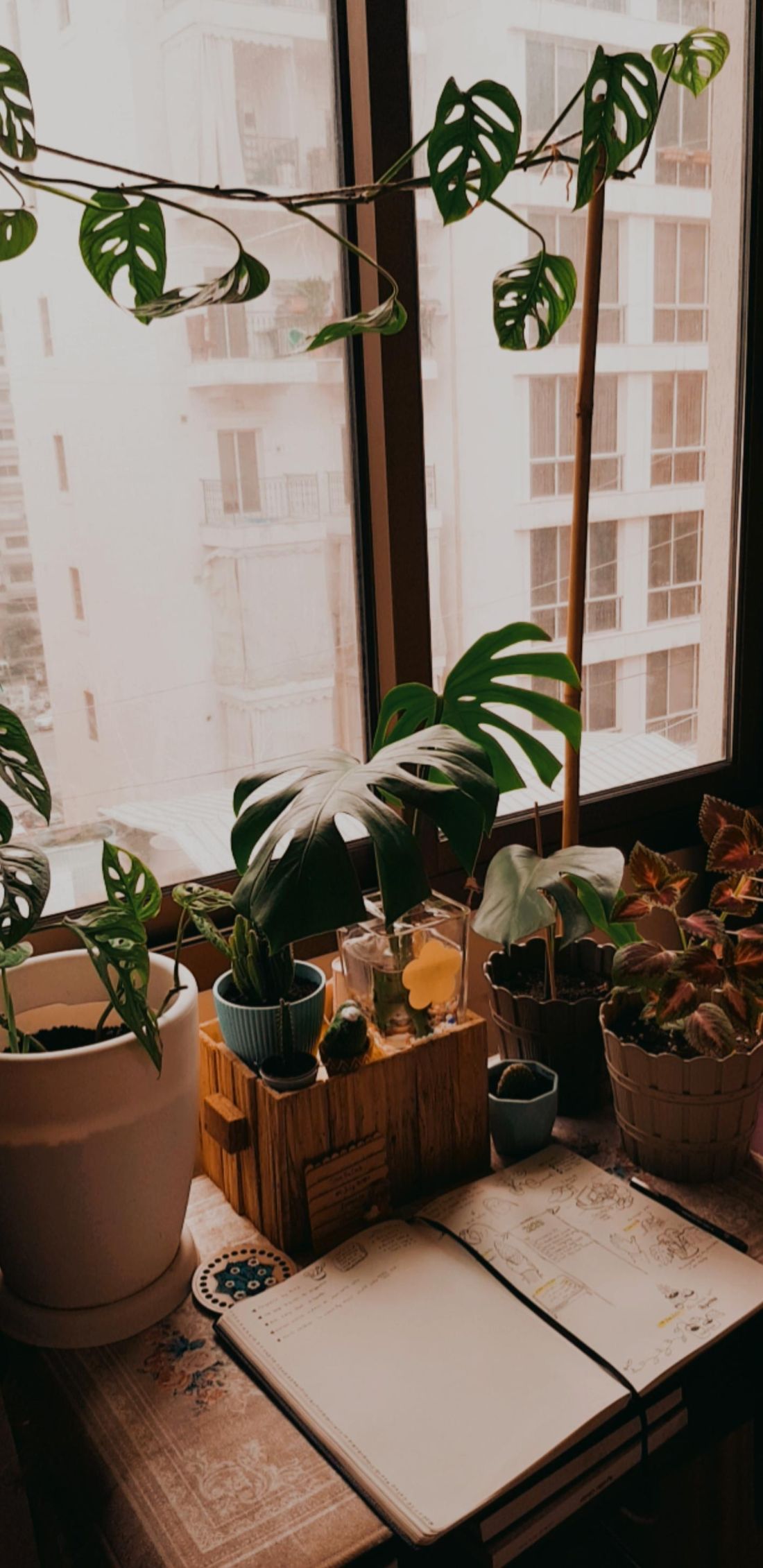
- Light reaching it from one direction: the overwhelming case. Every indoor plant is side-lit, because indoor light comes through windows rather than from overhead. Some lean is therefore normal and universal. A pronounced lean, with a visibly bare or sparse dark side, is that same one-sidedness turned up.
- A weak or top-heavy stem. A plant that has grown tall and thin can simply fail to hold itself up. This looks like leaning but behaves differently: it sags rather than aims, and it does not consistently favour the window.
- Roots loose in the pot, or a pot too light for the plant. A mechanical tip rather than a growth response. Usually sudden, often in a random direction, and it moves if you nudge it.
The first is a spot problem. The other two are a pot problem. Telling them apart takes about ten seconds and decides everything you do next: a light lean aims consistently at the window and develops slowly, over weeks. A mechanical lean appears quickly and points wherever gravity took it.
The lean is a ratio, not a light level
Here is the part that gets missed. A plant does not lean because its spot is dark. It leans because one side of it is meaningfully brighter than the other. A plant in a dim spot with even light on all sides grows straight and unhappy. A plant in a bright spot with light from a single window leans hard and looks great doing it.
| Distance from the window | Estimated light | What the light is doing | Verdict |
|---|---|---|---|
| 0.5 m back | 3,528 lux | Just the right amount of light | Great fit, 94/100 |
| 1.5 m back | 2,222 lux | Just the right amount of light | Great fit, 92/100 |
| 2.5 m back | 1,400 lux | A little dim, but workable | Worth a try, 64/100 |
| 3.5 m back | 882 lux | A little dim, but workable | Worth a try, 62/100 |
So the useful question is not how bright the room is. It is how lopsided the light is at the exact place this plant stands. Here is one ordinary living room, measured on a clear day around midday, phone laid flat at roughly pot height, the same hour for every spot:
| Spot | Reading |
|---|---|
| At the bright window | 20,000 lux |
| 1 m from the window | 15,000 lux |
| 2–3 m away, in window shade | 3,500 lux |
| Middle of the room | 570 lux |
| Darker side of the room | 119 lux |
| The dark corner | 18 lux |
Those are six separate places, not two sides of one pot, and it is worth being clear about that. But a pot is not a point. A plant of any size standing partway into that room has its window side and its room side sitting in visibly different parts of the same gradient, and the steeper the gradient at that spot, the harder it pulls. The full six-spot walkthrough is here.
Notice where the gradient is steepest. Between the window and one metre in, the reading drops by a quarter. Between one metre and the middle of the room it falls by a factor of twenty-six. A plant standing in the middle of a room is in the steepest part of the fall-off, which is exactly where leaning is worst. Moving it closer to the glass usually reduces the lean, which sounds backwards until you see it as a ratio: nearer the window, both sides of the plant are bright.
Rotating fixes the shape, not the spot
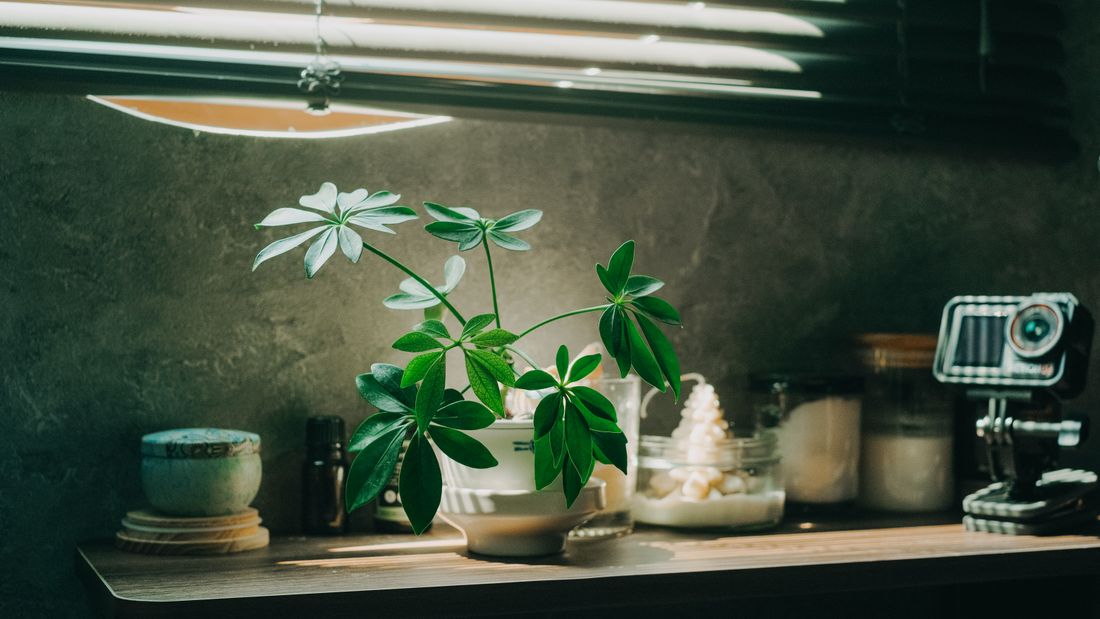
Turn the pot a quarter each time you water. This is good advice and it works: the plant reaches in a new direction, the old reach relaxes, and over a couple of months it evens out.
What rotation does not do is add any light. If the plant is also stretching (long bare gaps between leaves, new leaves arriving smaller and paler than the old ones) then rotation just distributes a shortage evenly. You get a symmetrical plant that is still short on light. Stretching is a separate signal about how much light there is, and it is worth reading before you settle for rotating.
The two symptoms answer different questions. Leaning tells you which direction the light comes from. Stretching tells you there is not enough of it. A plant can do either, or both, and the fix is different in each case. If it is not leaning and not growing, the spot is still worth ruling out first.
| Leaning | Stretching | |
|---|---|---|
| What it reads | Which direction the light comes from | How much light there is |
| What the plant is doing | Growing faster on its shaded side | Reaching, with long bare gaps between leaves |
| What fixes it | Rotating, once the spot is right | Moving closer to the window. Rotating adds nothing |
| If you only fix this one | A straight plant in a spot that is still too dim | A well-lit plant still reaching toward one side |
Will it straighten back up?
Partly, and slower than you would like. Young flexible growth reorients within a week or two of the light changing. Stem that has already thickened and hardened stays bent, permanently. So the bend you have now is mostly kept, and what changes is everything that grows after you act.
This is why the order matters. Sort out the spot first, then rotate on a schedule, then stake or prune if you still need to. Doing it the other way round is how people spend a season straightening a plant that keeps re-leaning, because nothing about its situation changed.
What to do, in order
- Note which way it leans before you move anything. That direction is free information about your room, and you lose it the moment you rotate the pot.
- Check the spot rather than estimating it. Eyes adapt, which makes them close to useless for comparing two places in the same room. The bookshelf opposite the window reads far darker than it looks.
- Move it if the reading is short, and move it properly. A step is not a move. A metre is.
- Then rotate, a quarter turn at each watering, so the reach spreads around the plant instead of piling up on one side.
- Stake only for the mechanical cases, the weak stem and the loose roots. Staking a light lean hides the reading without changing anything.
Check the position before you stake anything
No phone to hand? The shadow test gets you the tier with nothing at all.
Species that lean noticeably
Some plants are simply more expressive about it.
- Chinese money plants (Pilea peperomioides) are the classic case, which is why nearly every care sheet for them mentions rotating.
- Jade, aloe and other succulents lean because their stored weight makes any bend obvious.
- Snake plants lean late and dramatically, usually once the whole plant has grown tall in a spot that never had much light to begin with, and by then a stake is treating the symptom.
None of that changes the diagnosis. It changes how early you notice. A Pilea will tell you about a lopsided spot within weeks. A snake plant will let the same spot go unremarked for a year, which is a good argument for checking a spot rather than waiting for a plant to report on it.
By GrowSpot · Published August 3, 2026 · Last updated August 30, 2026
