Search this and you get the same sentence everywhere: it needs more light. Google’s own summary of the question puts it well. Rooms that feel cosy to a person often don’t carry enough energy for a tropical plant to build a large, split leaf. That is true. It is also unusable, because nobody follows it with the only thing that would help: is the spot you already have bright enough, or isn’t it?
This page answers the question in that order. Rule out what you can measure, before you start guessing at what you can’t.

Worth a try
It can work here with a little care.
A little dim, but workable
Comfortable temperature
Humidity suits it
Airflow suits it
Why are my Monstera leaves not cracking?
Two extension services attach the holes to the light in so many words, and both put it the same way round: too little light and the perforations do not appear. The rest attach them to age or to wind. The wind explanation is the one worth following, because a botanical garden in the table says nobody has tested it and a field study in the same table did — and the measurement went against it.
| Published by | What it says about the holes | In its own words |
|---|---|---|
| hort.extension.wisc.edu | Light, explicitly | “It can be grown under florescent light, but will not develop the leaf perforations when light is inadequate.” |
| hort.extension.wisc.edu | What it wants | “Monstera does best in bright light in summer and direct sun in winter.” |
| extension.psu.edu | Age | “Juvenile leaves are small, green, and mostly entire (uncut). As the leaves mature, they become very large, glossy green, and perforated or cut—pinnatifid.” |
| extension.psu.edu | And light again | “Select a site near a sunny window where it can receive bright light but not direct sun. It will get ‘leggy’ in lower light.” |
| hort.extension.wisc.edu | Why they might exist | “The fenestrations (holes in the leaves) theoretically are a way of allowing high winds to pass through the large leaves without tearing them.” |
| botanicalgarden.berkeley.edu | Nobody has tested it | On the adaptive function: there are several hypotheses and “no direct experimental studies have been completed to determine the functions they actually serve.” |
| hgic.clemson.edu | Too little light, no perforations | “They will not develop the interesting perforations in their leaves if the light level is too low.” |
| homegarden.cahnr.uconn.edu | 3–6 hours of direct sun | “Monstera prefers partial shade with direct sunlight for 3-6 hours daily.” |
| plants.ces.ncsu.edu | The same band, put at 2–6 hours | “Partial Shade (Direct sunlight only part of the day, 2-6 hours)” |
| digitalcommons.usf.edu | The wind explanation, tested | “Holes in Monstera leaves were not found to have a very large impact on the degree of wind damage that a plant endures, and the presence of holes was found to actually increase the level of herbivory on a given leaf.” |
| homegarden.cahnr.uconn.edu | Attach it and the leaves grow | “Once vines have successfully attached, leaf size typically increases drastically.” |
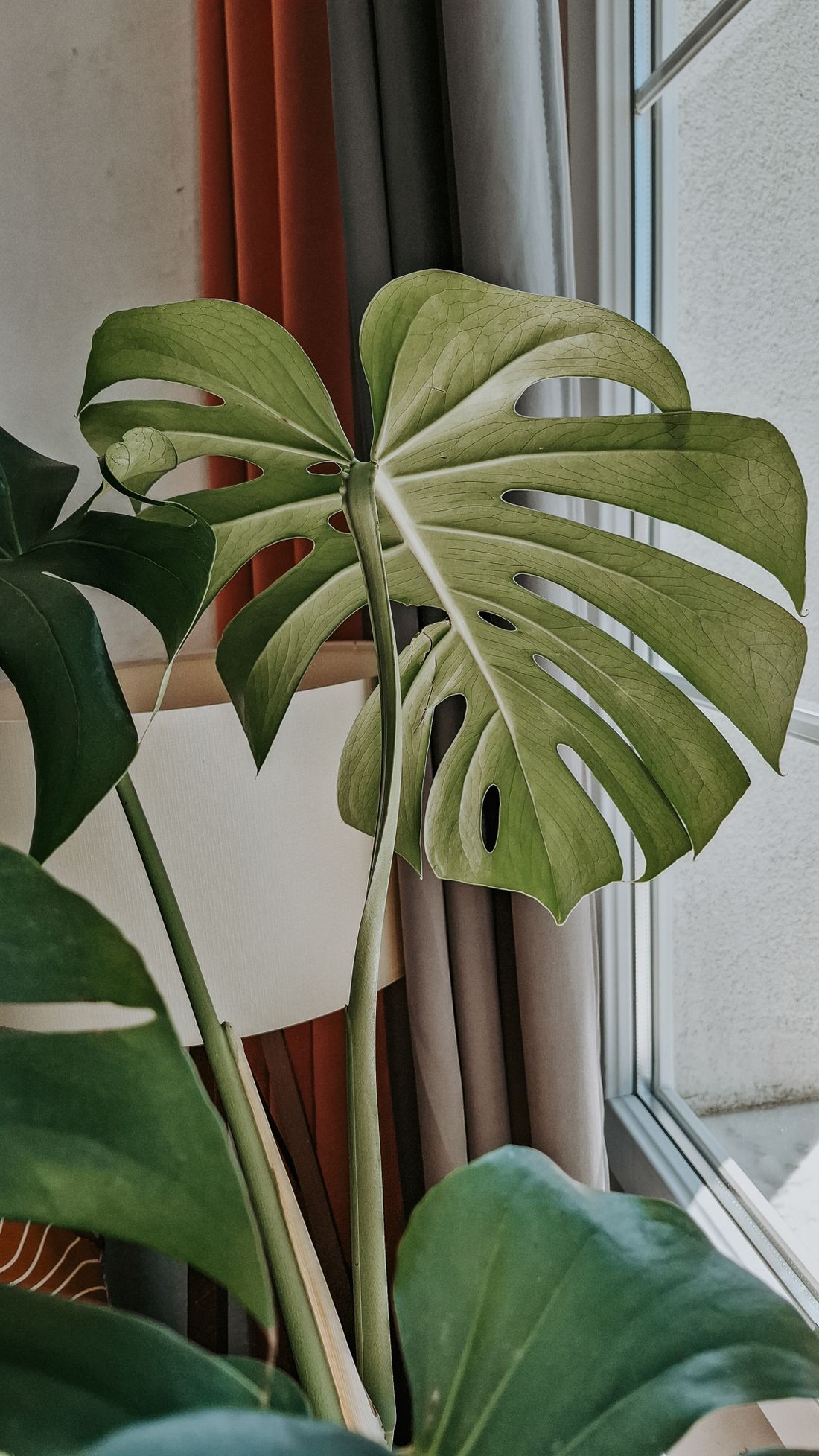
There are three causes that actually account for most cases, and they are not equally likely for your plant.
- It is too young. A juvenile Monstera deliciosa makes solid, heart-shaped leaves on purpose. Fenestration arrives with maturity, after the plant has put out a run of progressively larger leaves. If yours came home small and every leaf so far has been entire, this is the most likely answer and nothing is wrong.
- It is short on light. Splits are expensive. The plant builds them out of the energy the leaf can collect, so a plant in a dim spot tends to hold at small, solid leaves rather than push out big holed ones.
- It has nothing to climb. In the wild it is a climber, and climbing is what triggers the mature leaf form. A plant left to sprawl on a shelf often stays in its juvenile shape for longer than one on a pole.
Age and support you already know the answer to by looking. Light is the one where everyone (including us, before we measured) is guessing.
How long does it take for Monstera leaves to split?
Usually a couple of years from a young plant, and it is gradual rather than a switch: first a leaf or two with a notch, then partial slits, then the full fenestrated shape as each new leaf comes out larger than the last. The size progression is the signal worth watching. If new leaves are arriving the same size as the old ones, or smaller, the plant is not building up to anything: and that is when light is worth checking rather than waiting out.
How to encourage Monstera leaves to split
The standard advice is “move it somewhere brighter.” The problem is that human eyes are hopeless at this. They adjust so smoothly that a spot with a fraction of a window’s light still reads as a bright room.
So here is what an ordinary living room actually measures. Clear day, around midday, same hour for every spot, phone laid flat at roughly pot height:
| Spot | Reading |
|---|---|
| At the bright window | 20,000 lux |
| 1 m from the window | 15,000 lux |
| 2–3 m away, in window shade | 3,500 lux |
| Middle of the room | 570 lux |
| Darker side of the room | 119 lux |
| The dark corner | 18 lux |
The middle of that room is under 3% of the window. It is also exactly where a large statement plant tends to get placed, because that is where there is floor space. A Monstera on that spot is not in a bright room in any sense the plant recognises. It is in a room with a bright window in it, several metres away. The full six-spot walkthrough is here.
Two practical consequences:
- Metres matter more than compass directions. Moving the pot from the middle of the room to a metre off the glass is a far bigger change than swapping which window it sits by.
- Indoors is already a big discount. Readings on our own balcony ran 19,000–21,000 lux; an indoor spot right beside the window read 6,000. The glass takes a cut before the room takes the rest.
What does a stressed Monstera look like?
Worth separating from “not splitting,” because they are different problems with different answers. A plant that is merely under-lit usually looks fine and simply stalls: small solid leaves, long bare stretches of stem between them, growth leaning hard toward the window. Nothing is dying; nothing is happening either.
Yellowing, browning, drooping and soft stems are a different conversation. Those point at water and roots far more often than at light, and a brighter spot will not fix them. If that is what you are seeing, light is not your first suspect.
Rule out the position before you change anything
No phone to hand? The shadow test gets you the tier with nothing at all, and the ten-second method covers how to read a spot properly.
If the position in question is a south-facing window, the distances are scored on their own page: only the sill itself comes back flagged, and one metre back gets the same verdict as three. The east-window distances are on theirs, and they reach further back than most advice allows. A west window reaches further again, about three metres before the first flag.
By GrowSpot · Published July 29, 2026 · Last updated August 30, 2026
