Ask this question and the answers arrive in different units:
- Six to twelve hours a day. Hours, with no intensity attached.
- Five to eight hours of dappled light. Fewer hours, plus an adjective.
- Twelve to sixteen hours under a lamp. Hours again, measured against hardware you would have to buy first.
- As much bright indirect light as the plant can possibly get. A direction with no end to it.
- 5,000 to 7,000 lux for a young plant. The only one you can hold up against a particular spot.
Near the top of the results sits a post from someone who has read all of these, titled with the complaint that the answers keep conflicting, and the first reply predicts it will collect more of the same. The lux figure is the one worth testing, because a number can be wrong in a way that hours and adjectives cannot.

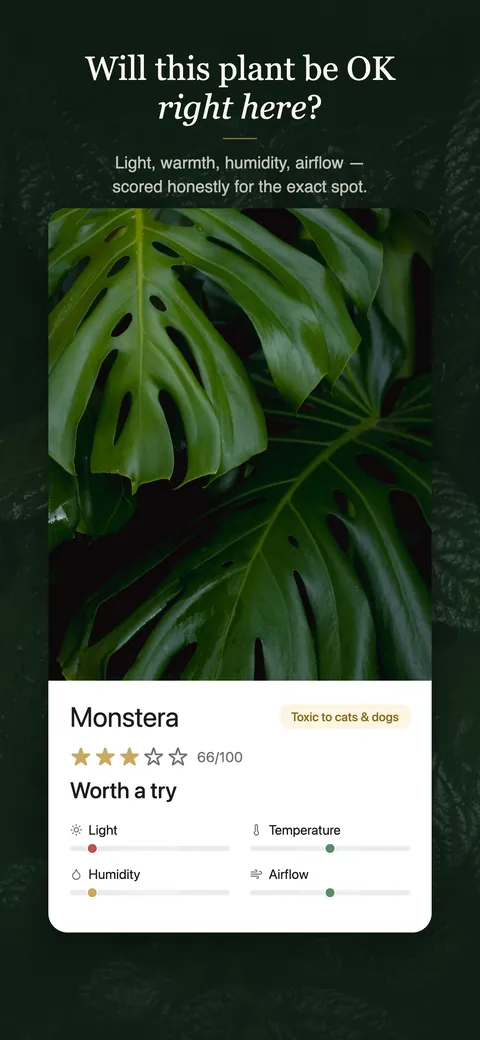
Worth a try
It can work here with a little care.
A bit bright, but workable
Comfortable temperature
Humidity suits it
Airflow suits it
Ten spots, scored
Before our own scoring says anything: we gathered every published figure we could find for a monstera. 9 of them, from 5 separate sources, in 3 different units. They are reproduced below exactly as each source writes them, and nothing here is converted.
| Who publishes it | What it says a monstera needs | What the figure is |
|---|---|---|
| theplantrunner.com | 800–2,000+ lux | Standard foliage plants (pothos, Philodendron, Monstera deliciosa …) — a general band, not a single-species figure |
| theplantrunner.com | 1,500–5,000 lux | Light-hungry aroids & Ficus divas (Fiddle Leaf Fig, variegated Monstera) |
| growlightmeter.com | 8 – 12 PPFD / DLI | Monstera |
| houseplantjournal.com | 100 FC (20 µmol) foot-candles | minimum indirect light level |
| houseplantjournal.com | 200 FC (40 µmol) foot-candles | good indirect light level |
| houseplantsnook.com | 50–100 foot-candles | chart fc level |
| houseplantsnook.com | 200–400 foot-candles | chart fc level |
| soltech.com | around 288–325 PPFD / DLI | Monstera FAQ — large / extra-large plant PPFD |
| soltech.com | 80–500 PPFD / DLI | Monstera — Photone's published PPFD range, cited by Soltech |
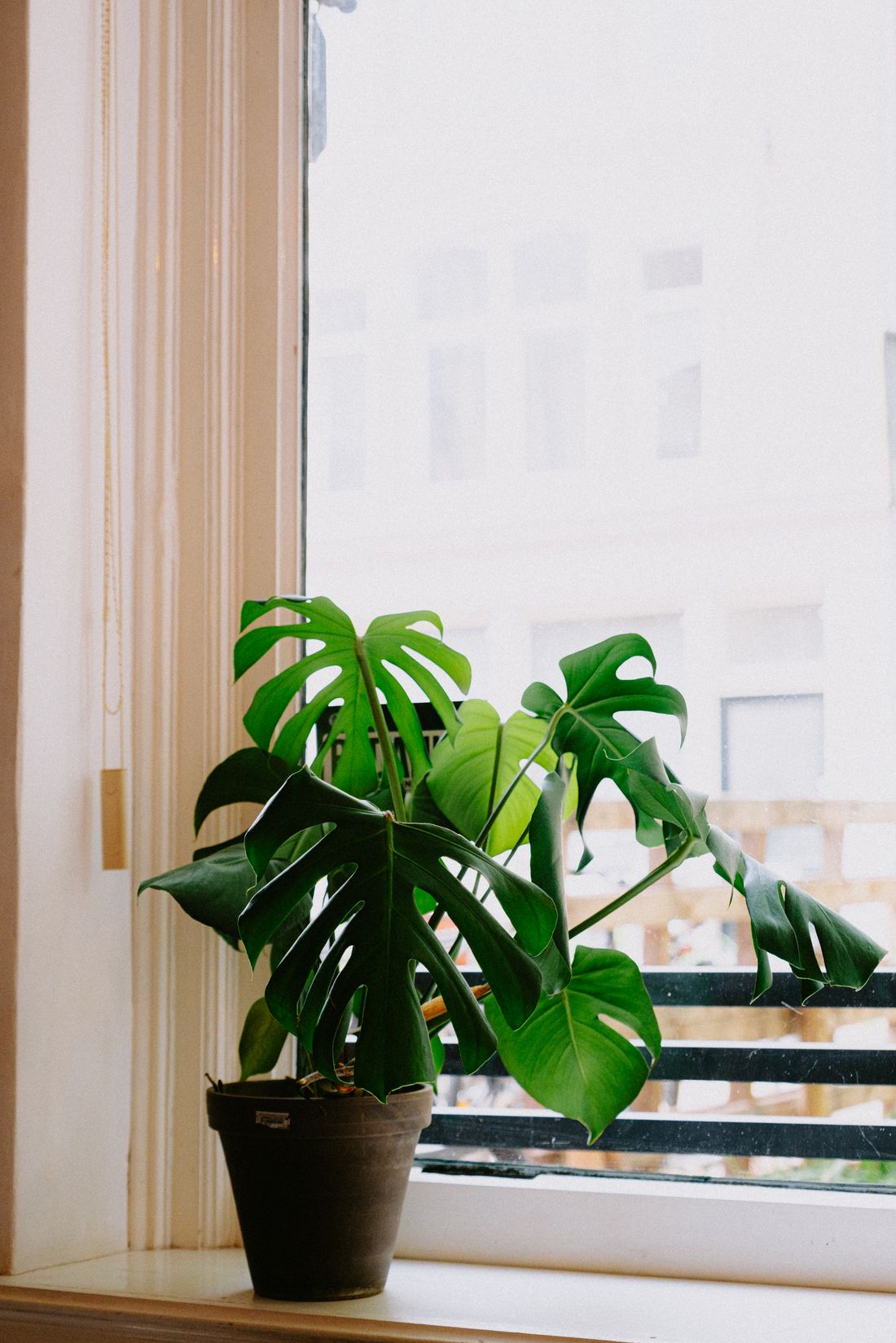
These are our estimates for indoor spots on a clear day, scored by the same engine that runs in the free spot checker, with temperature, humidity and airflow set to the plant's own preferences so that the only thing changing between rows is light.
Every row, one plant each (10)
| Spot | Estimated light | What the light is doing | Verdict |
|---|---|---|---|
| South sill, against the glass | 13,000 lux | A bit bright, but workable | Worth a try, 67/100 |
| 1 m in from a south window | 10,000 lux | Just the right amount of light | Great fit, 99/100 |
| West sill | 7,800 lux | Just the right amount of light | Great fit, 100/100 |
| East sill | 6,500 lux | Just the right amount of light | Great fit, 100/100 |
| 1 m in from an east window | 5,000 lux | Just the right amount of light | Great fit, 100/100 |
| North sill | 3,640 lux | Just the right amount of light | Great fit, 100/100 |
| 1 m in from a north window | 2,800 lux | Just the right amount of light | Great fit, 99/100 |
| 2 m in from a north window | 1,764 lux | A little dim, but workable | Worth a try, 68/100 |
| 3 m in from a north window | 1,111 lux | A little dim, but workable | Worth a try, 65/100 |
| A corner 4 m from any window | 125 lux | Too dim here | Not the best fit right now, 45/100 |
The published range is correct and too narrow to use
Take the 5,000 to 7,000 lux figure to the table. Both ends land on a full hundred, so nothing about it is wrong. But the light reads as just right from 2,800 lux and stays that way past 10,000, which means the published range describes roughly a quarter of the band where this plant is comfortable.
Both the published range and our band are lux figures about rooms that nobody in the argument has measured, which is why we also publish 204 readings taken at real spots: indoors their middle half runs 420 to 6,200 lux, wide enough to hold most of the disagreement.
That matters because of what a narrow range makes you do. A reader who takes 5,000 to 7,000 as the requirement will look at a north sill reading 3,640 and conclude it falls short. It does not. It scores a full hundred, the same as the east sill nearly twice as bright. Told the wider truth, that reader keeps a perfectly good spot instead of buying a lamp for it.
Where it actually stops, at both ends
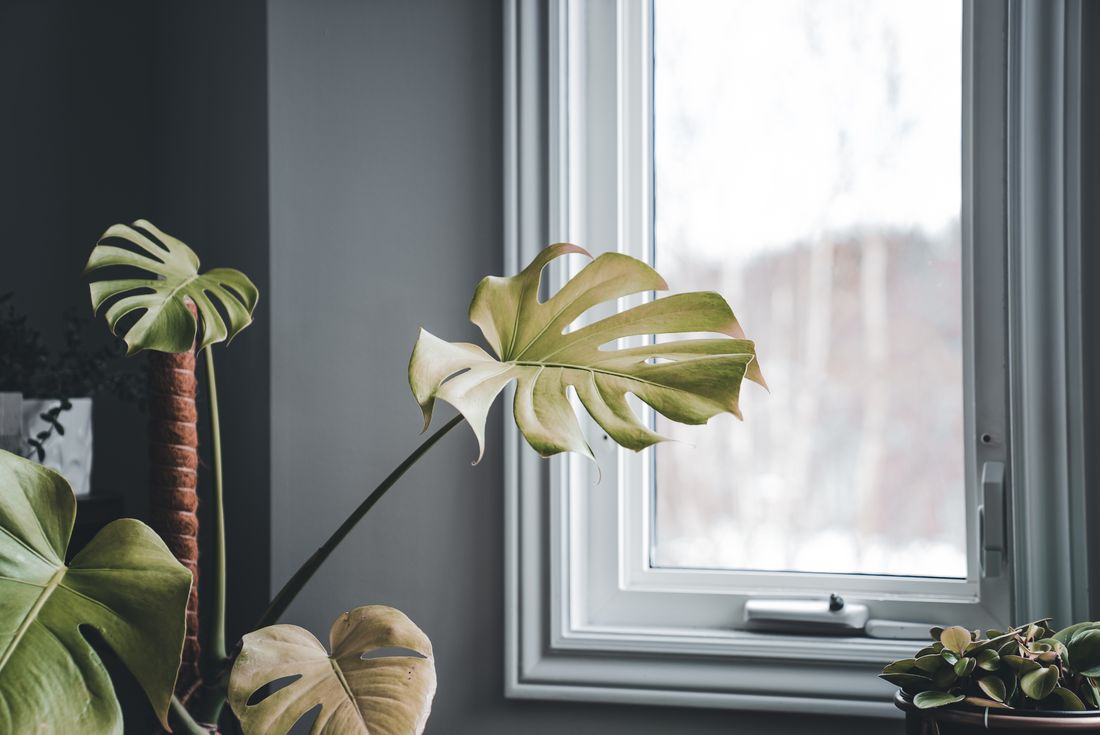
The flagged rows at either end are the content of this page, because everything between them is the same answer.
Too bright: pressed against south glass at 13,000 lux, the light reads as bright rather than ideal. Not dangerous, and not a reason to move the plant to another room. One metre back from that same window is a great fit at 99, so the correction is a metre.
Too dim: a north window holds full marks to about a metre in, then drops to flagged at two metres and stays there. A corner four metres from any window is not enough at all. The dim edge sits at a different distance for every orientation, which is easiest to see by standing in one place and changing the wall the window is in:
| The window it is three metres from | Estimated light | Verdict |
|---|---|---|
| North window | 1,111 lux | Worth a try, 65/100 |
| East window | 1,984 lux | Worth a try, 69/100 |
| West window | 2,381 lux | Great fit, 99/100 |
| South window | 3,969 lux | Great fit, 100/100 |
Three metres is flagged as dim from a north or an east window and comfortable from a west or a south one. That is the same shape our monstera in a north window page finds from the other direction, and the south-window page covers the bright edge in more detail.
The number is not the answer, and here is the proof
A south sill at 13,000 lux scores 67 for a monstera. On our jade plant page the identical spot, at the identical reading, also scores 67. The pothos page refuses the same sill at 45, and the fiddle leaf fig page gives it 100.
The two verdicts have nothing in common. The monstera is flagged because the light is on the bright side of what it wants. The jade is flagged because the light is on the dim side of what it wants. Same window, same lux, same score out of a hundred, opposite problems, and opposite fixes: move the monstera back a metre, move the jade outdoors.
That is the case against reading light figures on their own. A reading describes a place. Whether the place works is a question about the pairing, and there is no lux value you can memorise that answers it for every plant you own.
The advice to summer it outside
It circulates every year and it is aimed at the wrong plant. Take the same south exposure with and without the glass: at the window, 13,000 lux and a score of 67; on a balcony at 45,000 and outdoors at 80,000, 42 both times.
The window is doing useful work here rather than getting in the way. This plant evolved under a canopy, and an unshaded balcony hands it several times more light than its band tops out at, which is the reverse of the situation a jade is in.
What to do with a spot you already have
The practical version: if your monstera is anywhere between a north sill and a metre back from a south window, light is not your problem, and whatever is bothering the plant is something else. If it sits against south glass, pull it back an arm's length. If it is more than a metre into a north room, it is on the dim side, and the symptom to watch for is the one on our page about fenestration, where new leaves come in without holes.
If you would rather check the exact place the pot sits, the free spot checker reads it in your browser, and you can lay the phone down where the plant would go.
By GrowSpot · Published August 12, 2026 · Last updated August 30, 2026
