No houseplant lives long-term without natural light, so the honest answer for a windowless room is a grow light. A ceiling light gives about 300 lux. The middle of the indoor spots people have measured is 566 lux, and even that clears the floor of only the low tier, home to about 5% of our care library. A measured dark corner at 18 lux scores 39 out of 100.
An interior office, a basement den, a windowless bathroom, a room that borrows a little light from a doorway. A couple of hours of ceiling light a day is a starvation ration, not a light diet. But “no window” isn’t a dead end, it just changes the answer from a plant to a setup.

Not the best fit right now
The plant's fine, this spot just isn't a match.
Too dim here
Comfortable temperature
Humidity suits it
Airflow doesn't suit it
Light is a deal-breaker here. The other three cannot make up for it.
Can plants grow in a room with no windows?
The published definitions of low light name this room, and one of them names the level below which it stops being a light question.
| Published by | The figure | In its own words |
|---|---|---|
| extension.arizona.edu | Beyond eight feet | “Low Light: areas more than eight feet from windows as in the center of a room, a hallway or an inside wall.” |
| extension.msstate.edu | 8 or 10 feet | “It is difficult to grow plants in dimly lit areas more than 8 or 10 feet from windows.” |
| extension.msstate.edu | Under 50 fc | “Usually, an intensity of less than 50 foot-candles will not sustain plant life for very long.” |
| extension.psu.edu | 100 footcandles | “a common baseline for low light is 100 footcandles.” |
| extension.msstate.edu | 1 to 3 feet | “For best results, most plants grown under artificial light must be grown within 1 to 3 feet from the light source.” |
| hgic.clemson.edu | 100 ft-c × 12 hours | “About 100 ft-c for 12 hours per day are necessary simply to maintain plant quality for one year, and at least 200 ft-c for 12 hours per day are necessary for new growth to occur.” |
| hgic.clemson.edu | Hours can stand in for brightness | “It is possible to make up for lack of sufficient light by increasing the time or duration that the plant is exposed to light.” |
| hortnews.extension.iastate.edu | 6 to 12 inches from the foliage | “Fluorescent fixtures should be 6 to 12 inches from the foliage.” |
| hortnews.extension.iastate.edu | 10 to 16 hours a day | “For home gardeners, it is best to have light on for as little as 10 hours and no more than 16 hours a day.” |
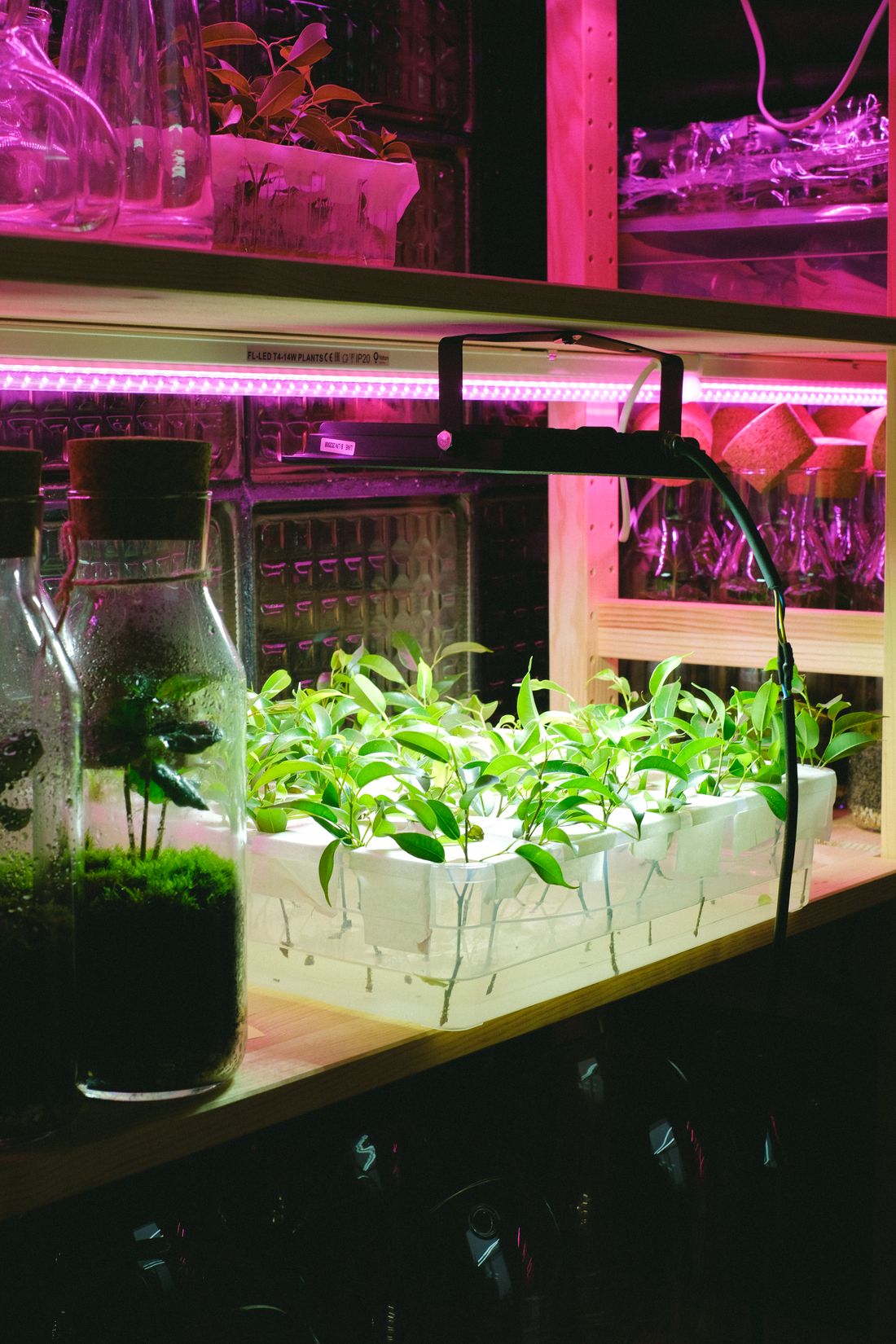
- A grow light on a timer. This is the real answer. It turns a windowless room into a legitimate plant spot, runs itself on a timer, and modern ones look like ordinary lamps or clip-on fixtures. With one, almost any plant on this site becomes possible.
- A rotation. Keep two plants and swap them weekly: one on display in the windowless room, one recovering in a bright room. The spot always looks planted; no single plant slowly starves.
- Preserved or faux greenery. No shame in it. A good preserved arrangement beats a live plant in slow, guilt-inducing decline.
Do grow lights actually work?
Yes, and the reason is scale rather than magic. A grow light is simply the only household fitting designed to put out light in the quantity a leaf needs instead of the quantity an eye needs.
The gap is easy to underestimate until you see daylight written down.
| Spot | Reading |
|---|---|
| At the bright window | 20,000 lux |
| 1 m from the window | 15,000 lux |
| 2–3 m away, in window shade | 3,500 lux |
| Middle of the room | 570 lux |
| Darker side of the room | 119 lux |
| The dark corner | 18 lux |
That is what a lamp in a windowless room is standing in for. Such a room has none of that daylight term at all — whatever it gets comes from the fittings overhead, and we have never put a meter under one, so we will not print a reading for it.
Three things decide whether one works for you. Distance, because light falls away sharply and a fixture a metre above a plant is doing a fraction of what it does at thirty centimetres. Hours, because a plant needs a long stretch daily and a timer is what makes that happen rather than good intentions. And your own tolerance, since the strongest fixtures are the ones people quietly stop using in a living room.
Running cost is usually the smallest part of the decision. A small fixture of the kind that lights one or two plants draws in the range of a household bulb, not a heater, and it runs for part of the day rather than all of it.
Can more hours make up for a dimmer room?
Almost every published answer for a windowless room arrives as a number of hours: leave the ceiling lights on eight, ten, twelve hours a day. Hours are the part of this problem that is easy to change, so that is the part the advice reaches for. It is worth doing that arithmetic, because light arrives as quantity multiplied by time, and only one of those two has a ceiling of twenty-four.
| What is lighting the plant | Lux | Hours | A day’s worth |
|---|---|---|---|
| Middle of the indoor readings people measured | 566 | 8 | 1.00 |
| Ceiling light, the usual advice | 300 | 12 | 0.80 |
| Ceiling light, left on around the clock | 300 | 24 | 1.59 |
Run the ceiling light for the twelve hours the advice suggests and the plant gets about 80% of one ordinary indoor day. Leave it on all twenty-four — no night, which plants also need — and it passes one. So hours do close the gap to a typical indoor spot, and that is the uncomfortable part: the typical indoor spot is dim. 566 lux clears the floor of the low tier and no other. A schedule can make a windowless room as good as an ordinary indoor spot; only a fixture can make it a bright one, because only a fixture raises the lux column.
Where the line actually sits
“Enough light” sounds vague until you walk one plant up the ladder. Here is a ZZ plant — the classic windowless-office survivor — carried through six light levels, three of them measured in a real living room and three declared for the fixtures people actually buy:
| What the room gives it | Light | What the light is doing | Verdict |
|---|---|---|---|
| Dark corner of a windowed room, measured | 18 lux | Too dim here | Not the best fit right now, 39/100 |
| Darker side of a living room, measured | 119 lux | A little dim, but workable | Worth a try, 58/100 |
| Typical office ceiling light, declared | 300 lux | A little dim, but workable | Worth a try, 62/100 |
| Middle of a bright living room, measured | 570 lux | Just the right amount of light | Worth a try, 65/100 |
| Small grow light 30 cm up, declared | 2,000 lux | Just the right amount of light | Worth a try, 65/100 |
| Strong grow light, close, on a timer, declared | 5,000 lux | Just the right amount of light | Worth a try, 65/100 |
Read the two ends. At 18 lux — a real measured corner — even a ZZ fails the light check outright. But its workable range starts lower than the myth-busting usually admits: by 119 lux it scrapes in, and from 570 lux the light column reads just right. That is the whole case for a small grow light: 30 cm above the leaves it lands the plant in the same band as the middle of a bright living room, every day, on a timer, regardless of weather or season. The score plateaus at 65 for a different reason — the still air of a closed room, which no lamp fixes and a cracked door does.
What to skip
The tough-plant myth survives on a delay. A plant in real darkness doesn’t collapse; it runs down stored reserves, holding its shape while adding nothing new. That’s why offices are full of ZZ plants that “do fine”, right up until they don’t. Slow decline reads as tolerance. The delay is also what makes an empty building unforgiving: a classroom over the long holidays spends weeks running that reserve down with nobody in the room to notice.
The shortlist itself isn’t wrong — it’s what the lists claim for it. Here are the usual five under a held 300 lux of ceiling light, the level a lit office actually delivers at desk height:
| The plant under the ceiling light | What the light is doing | Verdict |
|---|---|---|
| ZZ plant | A little dim, but workable | Worth a try, 62/100 |
| Snake plant | A little dim, but workable | Worth a try, 62/100 |
| Golden pothos | A little dim, but workable | Worth a try, 61/100 |
| Cast iron plant | A little dim, but workable | Worth a try, 62/100 |
| Peace lily | A little dim, but workable | Worth a try, 61/100 |
- “Low light” plants as a fix. Even snake plants and ZZ plants need some light. “Low light” means a dim spot with a window, not a windowless room. Here’s what that phrase really covers.
- Hoping a bright bulb is enough. Ordinary room lighting, however bright it looks to you, doesn’t deliver the intensity a plant needs. A purpose-made grow light does.
If there’s even a little daylight, check it first
“Windowless” is often not quite true. A doorway onto a bright hallway, a glass-panelled door, a shaft borrowed from the next room: these put a spot at the bottom of the scale rather than off it, and the difference decides whether you need hardware at all. The worked example above shows the shape of it. That ZZ plant scores 39 with comfortable temperature and humidity; what fails is the light a doorway can’t deliver, plus the still air a closed room tends to hold.
The commonest version of “not quite true” is an office desk: the same ZZ plant that scores 39 here scores 94 three metres from an east window. Worth settling which of the two you have before buying a lamp.
So before buying anything, find out which case your room actually is. Describe the spot to the free spot checker (the nearest window it borrows from, whether sun ever reaches it) and it scores the spot for a plant you pick, in the browser, nothing to install. If light is the one thing that fails, a grow light fixes precisely that.
Published July 23, 2026 · Last updated October 3, 2026
