The bathroom-jungle idea rests on one true fact (bathrooms are the most humid room in the home) and one quiet omission: they’re often also the darkest. A frosted window, or no window at all, caps what can live there far harder than the humidity can help.
So the honest first question isn’t “which plants like bathrooms?” It’s “how much light does your bathroom actually have?”

Worth a try
It can work here with a little care.
Just the right amount of light
Comfortable temperature
Humidity suits it
Airflow doesn't suit it
Do bathroom plants need sunlight?
The lists sell this room on its humidity and then sort it by its window, in that order, on the same page.
| Published by | What it says | In its own words |
|---|---|---|
| bobvila.com | The humidity is the reason | “Indoor plants grow better in the higher humidity of a bathroom.” |
| bobvila.com | But the window sorts it | “If you have tons of natural light coming through a large, south-facing bathroom window, you’ll want light-loving plants”, and “For a bathroom with a north-facing window, add low-light plants instead.” |
| bobvila.com | With no window at all | “Adding plants in a bathroom with no natural light is doable with only a few select plants or as a part-time plant home for a few days at a time.” |
| livelyroot.com | Even the tolerant ones | “Even no light bathroom plants need some form of brightness to keep growing”, and they “do best with low artificial light rather than darkness.” |
| extension.arizona.edu | Where low light starts | “Low Light: areas more than eight feet from windows as in the center of a room, a hallway or an inside wall.” |
| extension.msstate.edu | And where it stops | “Usually, an intensity of less than 50 foot-candles will not sustain plant life for very long.” |
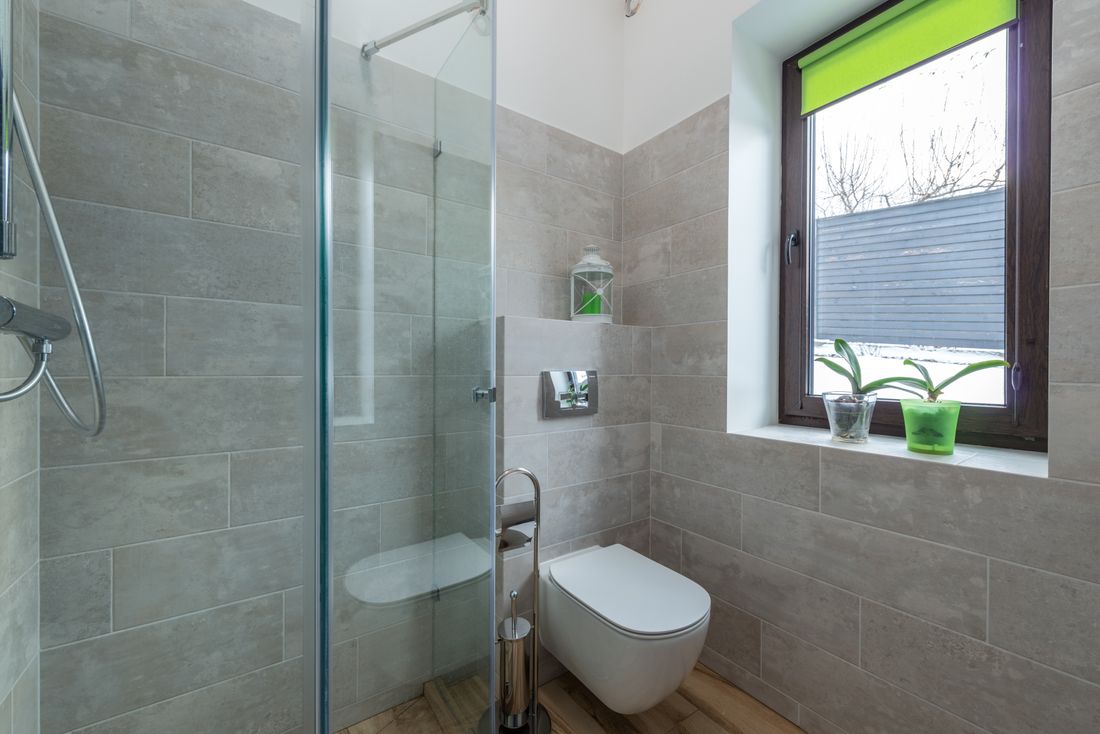
They need light. Whether any of it arrives as direct sun matters much less than how much lands on the shelf in total, and a bathroom is the room where those two questions come apart hardest. Frosted glass, a small high window and a light well all scatter light rather than block it, so a bathroom can look bright and still deliver very little where the pot sits.
Some numbers to hang that on.
| Spot | Reading |
|---|---|
| At the bright window | 20,000 lux |
| 1 m from the window | 15,000 lux |
| 2–3 m away, in window shade | 3,500 lux |
| Middle of the room | 570 lux |
| Darker side of the room | 119 lux |
| The dark corner | 18 lux |
That was not a bathroom, and the room’s orientation was never recorded, so treat none of it as a bathroom reading. The useful part is the shape: the fall between the window and the rest of the room is enormous, and a bathroom is mostly “the rest of the room.” A shelf above the toilet, across from a small frosted window, is doing well to sit in the same band as that 570 reading.
The second thing worth knowing is that a ceiling light does almost nothing for this. Room lighting is built for human eyes, which cope with a tiny fraction of daylight, so a fitting that makes a bathroom feel bright to you is still nowhere near what a leaf needs, and it’s only on while you’re in there.
Two very different bathrooms
With a real window: a legitimately good plant room. Shower humidity plus even modest window light suits exactly the plants that struggle in dry living rooms. Frosted glass diffuses rather than blocks. The sill can still be a decent bright-indirect spot.
Orchids are the usual reason people try this, and the bathroom is solving a real problem for them: on a living-room east sill the same orchid slips from a great fit to worth a try once the heated air drops to 30%, with the light unchanged.
Windowless (or a tiny lightwell): artificial light for an hour or two a day isn’t a light diet, it’s a starvation ration. Inside the shower itself the same rule bites harder, and no amount of steam gets round it.
Real options there: rotate plants weekly with a bright recovery spot, add a small grow light on a timer, or use preserved greenery and spend your plant budget on a spot that can support life, the same logic as a dark corner.
What genuinely works (window required)
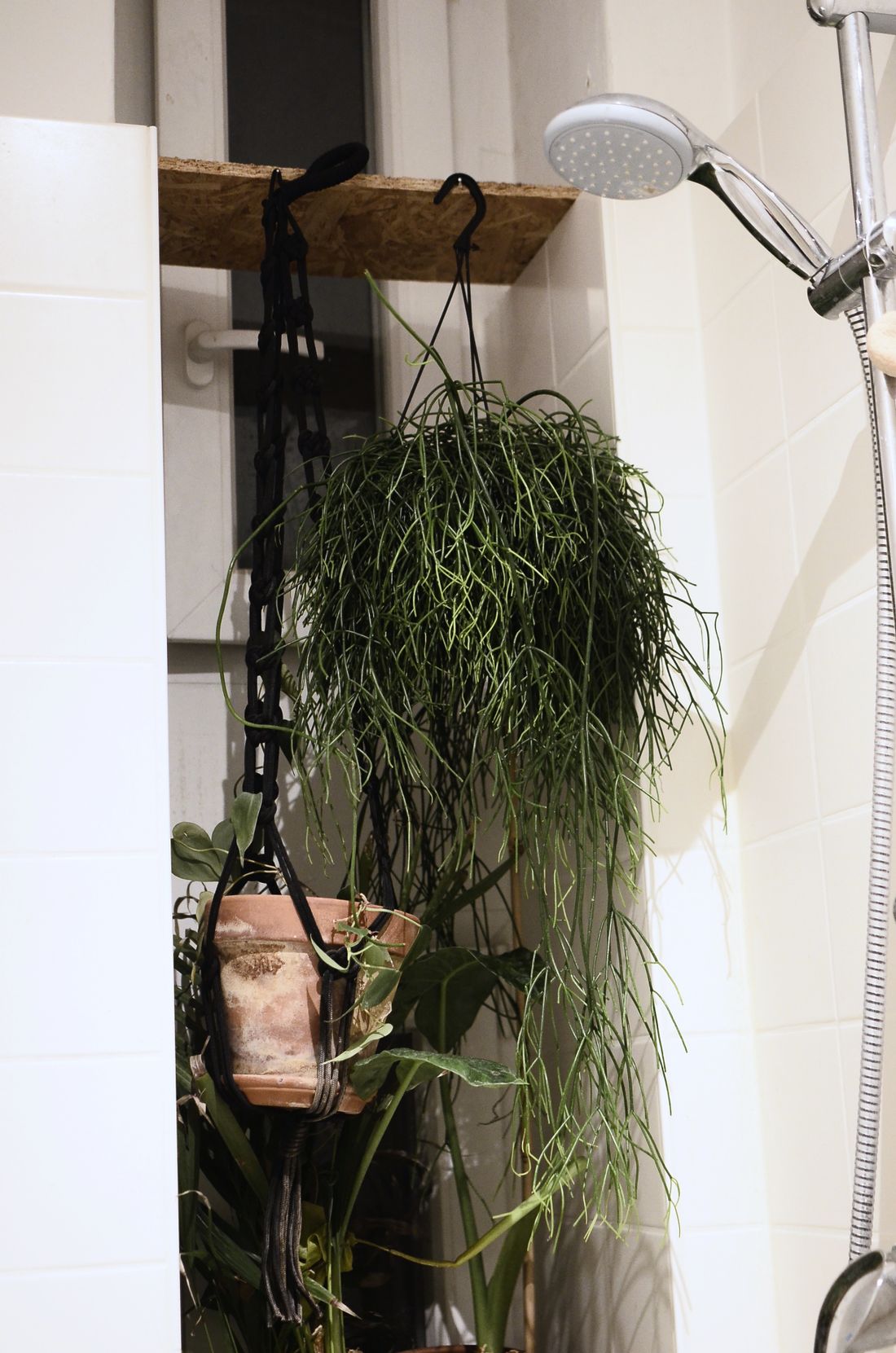
Loves the humidity + light
 Ferns: Boston & bird’s nest; their dream room
 Pothos
 Peace lily
 Calathea / prayer plants: humidity fixes their crispy edges
For dimmer-but-not-dark baths
 Snake plant: tolerates rather than loves it
 ZZ plant: same deal
What won’t work here (honestly)
- Succulents & cacti: humidity works against them and bathroom light is rarely enough. Wrong room on both axes.
- Anything in a windowless bathroom, long-term. “Low light plant” never means “no light plant.” The setups that do work without a window are a lamp and a timer, not a hardier plant.
- The shelf far from the little window. The light drop-off doesn’t care how small the room is.
Do bathroom plants help with humidity or mold?
Not in any amount you would notice. A few pots release roughly the water you give them, spread over days; a shower releases its share in minutes, and the extractor fan moves more than either. If damp or mold is the problem, ventilation and heat are the levers; plants are decoration that happens to enjoy the conditions.
The relationship runs the other way, and that part is real. Ferns, calatheas and other thin-leaved tropicals crisp at the edges in a dry living room and stay soft in a bathroom, because the humidity there is genuinely closer to what they evolved in. That’s a good reason to keep one in a bathroom with light, and none to keep it in a bathroom without.
The same plants have comfort bands starting at 60%, the top of the range recommended for the building itself. That is why they are worth moving rather than buying a humidifier for, and it is the argument on the ideal humidity page. The Boston fern also hangs: the cat-safe hanging page scores it on one east-window bracket beside the other safe trailers.
Airflow deserves a mention here, because bathrooms sit at both extremes. A sealed one with the door shut and no fan holds still, damp air, which is where fungus gnats and stem rot start. One with a strong extractor swings from steam to bone dry several times a day. Neither is fatal, but it means “bathroom” on its own doesn’t tell you the conditions; the specific spot does.
By GrowSpot · Published July 23, 2026 · Last updated August 30, 2026
