Hallway plant lists have a look to them. Tall, narrow, architectural: a kentia palm by the coat hooks, a fiddle leaf fig at the turn of the stairs, a bird of paradise making an entrance. The plants are chosen for the shape of the space, which is the one thing about a hallway that has nothing to do with whether a plant can live in it.
The shape that matters is different. A corridor is a long room with its light at one end, and often not even that: the window is in the stairwell, or above the front door, or there is none and the light is whatever the bedrooms leak through doors that are usually closed.

Not the best fit right now
The plant's fine, this spot just isn't a match.
Too dim here
A little cool, but workable
Humidity suits it
Airflow isn't quite ideal
Light is a deal-breaker here. The other three cannot make up for it.
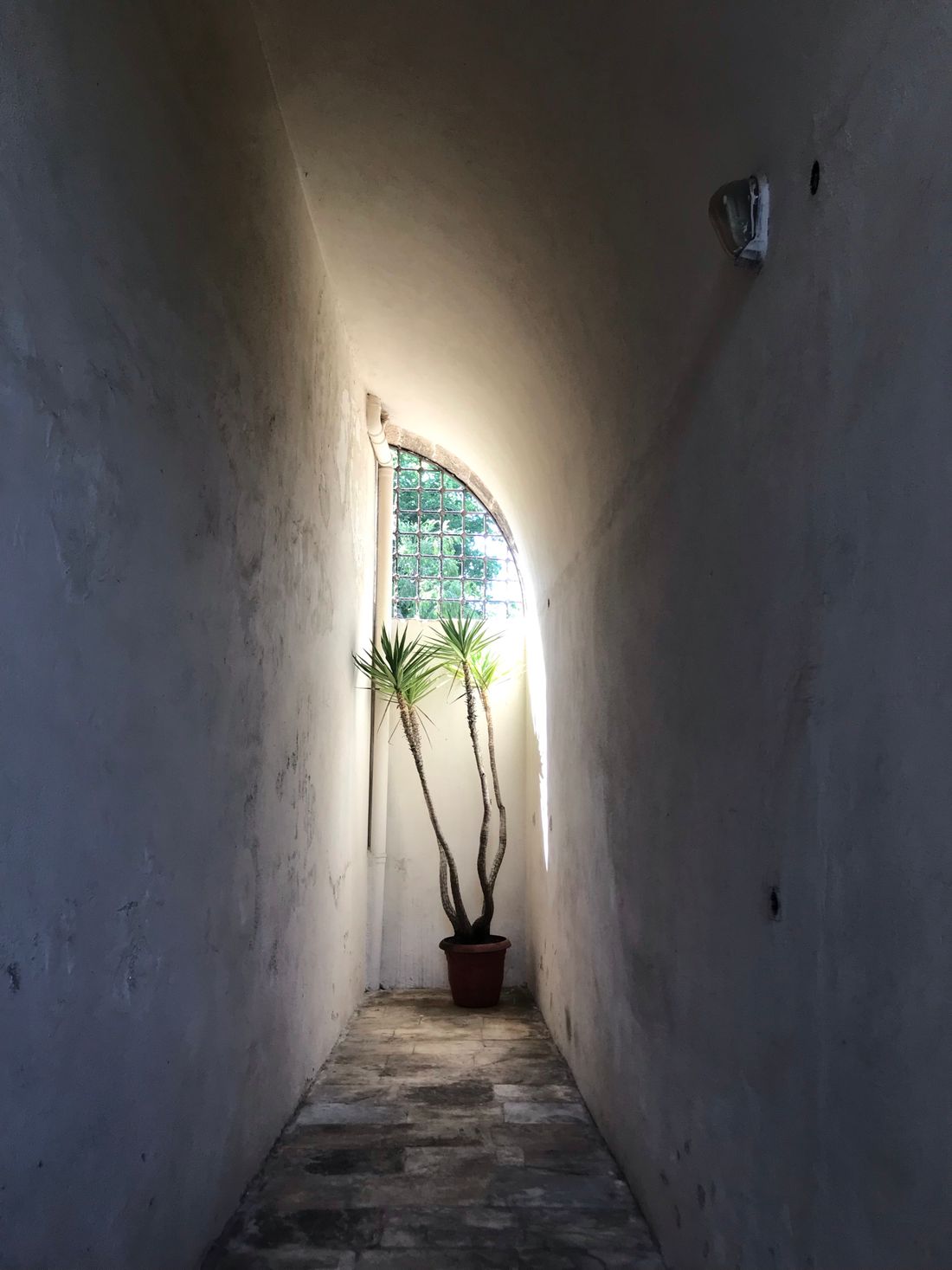
What the hallway lists actually recommend
Here are seven names taken straight off the front-page hallway lists, put three metres along a corridor from the window at its end — a hall table, roughly, in a hall with a window:
| The plant the lists name | What the light is doing | Verdict |
|---|---|---|
| Kentia palm | A little dim, but workable | Worth a try, 60/100 |
| Areca palm | Too dim here | Not the best fit right now, 38/100 |
| Bird of paradise | Too dim here | Not the best fit right now, 41/100 |
| Rubber plant | Too dim here | Not the best fit right now, 40/100 |
| Fiddle leaf fig | Too dim here | Not the best fit right now, 38/100 |
| Dragon tree | A little dim, but workable | Worth a try, 62/100 |
| Umbrella plant | A little dim, but workable | Worth a try, 62/100 |
Four of the seven do not clear it, and they fail for one reason held in common: the areca palm, the bird of paradise, the rubber plant and the fiddle leaf fig are all high-light plants. They are on hallway lists because they are tall and shapely and photograph well in a narrow frame. Nothing about that shape helps them here.
The three that hold on — kentia palm, dragon tree, umbrella plant — sit a band lower, and they are the ones worth taking from those lists. Note that even they land in the sixties rather than anywhere comfortable. This is a hall table with a window at the end of the hall, which is the good version of this room.
A corridor runs out of light at about six metres
Walk one of the survivors away from that window, down the length of the hall, and the light falls from 3,640 lux against the glass to 2,800 at one metre, 1,111 at three and 420 at six. The verdict follows it down: worth a try for the first three metres, and not a fit at all from six.
The first metre is free and the sixth is not. Somewhere around six metres the corridor bottoms out, and past that point the extra distance costs nothing more because there is nothing left to take. Halls in flats are frequently longer than six metres, and the far end of one is not a dim spot — it is the windowless case wearing a window at the other end of it.
That distance is not our idea. Four extension services define where a room stops being lit, and one of them names a hallway in the definition.
| Published by | Where low light starts | In numbers |
|---|---|---|
| extension.arizona.edu | More than eight feet | “Low Light: areas more than eight feet from windows as in the center of a room, a hallway or an inside wall.” Its low band is “low, 25–75 fc”. |
| extension.msstate.edu | 8 or 10 feet | “It is difficult to grow plants in dimly lit areas more than 8 or 10 feet from windows.” |
| extension.msstate.edu | 1,000 fc, then 100 a few feet in | How fast it goes: Not a floor but a falloff, from the same source: “The intensity of the light can drop from 1,000 to 100 foot-candles in the distance of only a few feet.” |
| extension.illinois.edu | 75 foot-candles | Its low band is “Low Light (75 foot candles)”, reached at “North window: a few feet away” but only at “South window:15-20 feet away”. |
| extension.psu.edu | 100 footcandles | “a common baseline for low light is 100 footcandles.” The same author measured a snake plant’s spot “as low as 25-foot candles in mid-morning”. |
| extension.msstate.edu | Below 50 fc | Where it stops being a light question at all: “Usually, an intensity of less than 50 foot-candles will not sustain plant life for very long”. |
This is the number to have before you buy anything: how many metres is it from the plant to the nearest glass? Not to the nearest doorway, and not to the light fitting.
The one thing a hallway has that other dark rooms don’t
Hallways connect things. Front door, back door, stairwell, every room in the house — which means a corridor almost always has air moving through it, in a way a spare bedroom or a basement does not. That turns out to matter more than it sounds. The same spot as the table above, with six plants that never appear on a hallway list:
| The plant on the hall table | What the light is doing | What the airflow is doing | Verdict |
|---|---|---|---|
| Cast iron plant | Just the right amount of light | Airflow suits it | Great fit, 100/100 |
| ZZ plant | Just the right amount of light | Airflow suits it | Worth a try, 67/100 |
| Snake plant | Just the right amount of light | Airflow suits it | Worth a try, 68/100 |
| Heartleaf philodendron | Just the right amount of light | Airflow suits it | Worth a try, 67/100 |
| Peace lily | Just the right amount of light | Airflow isn't quite ideal | Worth a try, 63/100 |
| Golden pothos | Just the right amount of light | Airflow suits it | Worth a try, 67/100 |
The cast iron plant scores full marks, and it is the only plant on either table that does. Its light band starts low enough that a corridor middle is genuinely enough, 18 °C is the middle of its comfortable range, and the through-draught that a hallway always has is exactly the airflow it prefers. Four dimensions, four hits. Almost nowhere else in a house does that happen by accident.
It is also the plant Victorian houses were full of, in hallways, for reasons nobody was measuring at the time. The other five here are the usual low-light crew and they do fine — they simply do not get the bonus, because still air suits them just as well.
What genuinely works
A hall with a window at the end
 Cast iron plant: the one spot in a house where all four dimensions land at once
 ZZ plant
 Snake plant
 Heartleaf philodendron
 Peace lily
 Golden pothos
Worth taking off the usual lists
 Kentia palm
The second column is short on purpose. Of the seven tall architectural plants those lists name, three are defensible choices for a lit hallway, and the fiddle leaf fig is not among them.
What won’t work here (honestly)
- Anything sold as a statement plant. Fiddle leaf fig, bird of paradise, rubber plant, areca palm: all four are high-light plants, and all four are on hallway lists for how they look in a narrow space.
- The far end of a long hall. Past six metres you are not choosing a plant for a dim corridor, you are choosing one for a room with no useful daylight, and the honest shortlist there is much shorter.
- Counting the ceiling light. Hall lights are on for the few minutes somebody is walking through. Even a hallway that feels bright to you is dark for most of the day, and the fitting contributes almost nothing at pot height.
- Ignoring the front door in winter. The draught that helps a cast iron plant is also cold, repeatedly, all winter. If the spot is within a metre of an outside door, the question stops being about light and becomes a cold-tolerance question.
Measure the far end, not the doorway
Every score above comes out of the same engine that runs the free spot checker, applied to a described corridor rather than a measured one: we hand it a window direction, a distance, a temperature, a humidity and an airflow, and it returns the verdict. The lux figures are estimates derived from that description, not readings taken in anyone’s hall. Yours will differ most in whether the doors along it stand open, which is the one input none of this arithmetic can see — and in a hallway it is a large input.
Which is the case for reading the actual spot rather than the room. Stand where the pot will stand, not in the doorway where the light is: the free spot checker estimates it from your window direction and distance, in your browser, with nothing to install.
Published August 19, 2026 · Last updated August 30, 2026
