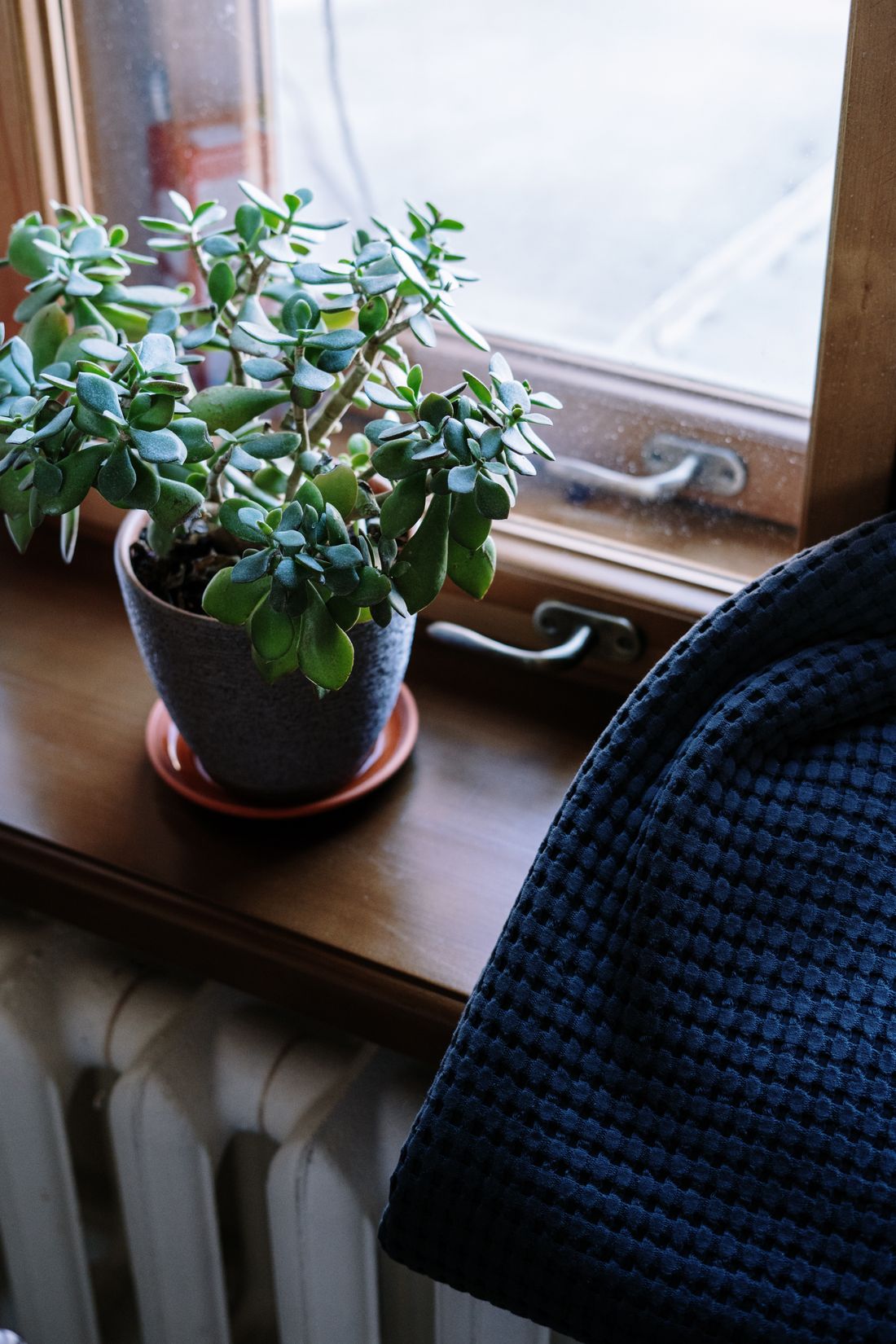
The short answer: it will live and it will not thrive, and the part worth knowing is that there is nowhere in the room to move it. A north window reads about 3,640 lux against the glass and the engine scores a jade 40/100 there. A metre back is 39. Two metres is 39, three metres is 38. The whole room is one answer. What changes it is a different window rather than a different spot: the same jade on an east sill scores 59, a west sill 60, a south sill 63.
The summary above the results is honest about this one. A jade can survive in a north-facing window, it says, but it will not thrive, it will stretch, and you should think about a grow light. Guides underneath agree, and add that the soil stays wet longer in low light, which raises the risk of rot.
We agree with all of it. What the scoring adds is the part that never gets said: in a north room, placement cannot rescue this plant, because there is nowhere in that room that is meaningfully brighter than anywhere else for a plant with this appetite.

Not the best fit right now
The plant's fine, this spot just isn't a match.
Too dim here
Comfortable temperature
A little humid, but workable
Airflow isn't quite ideal
Light is a deal-breaker here. The other three cannot make up for it.
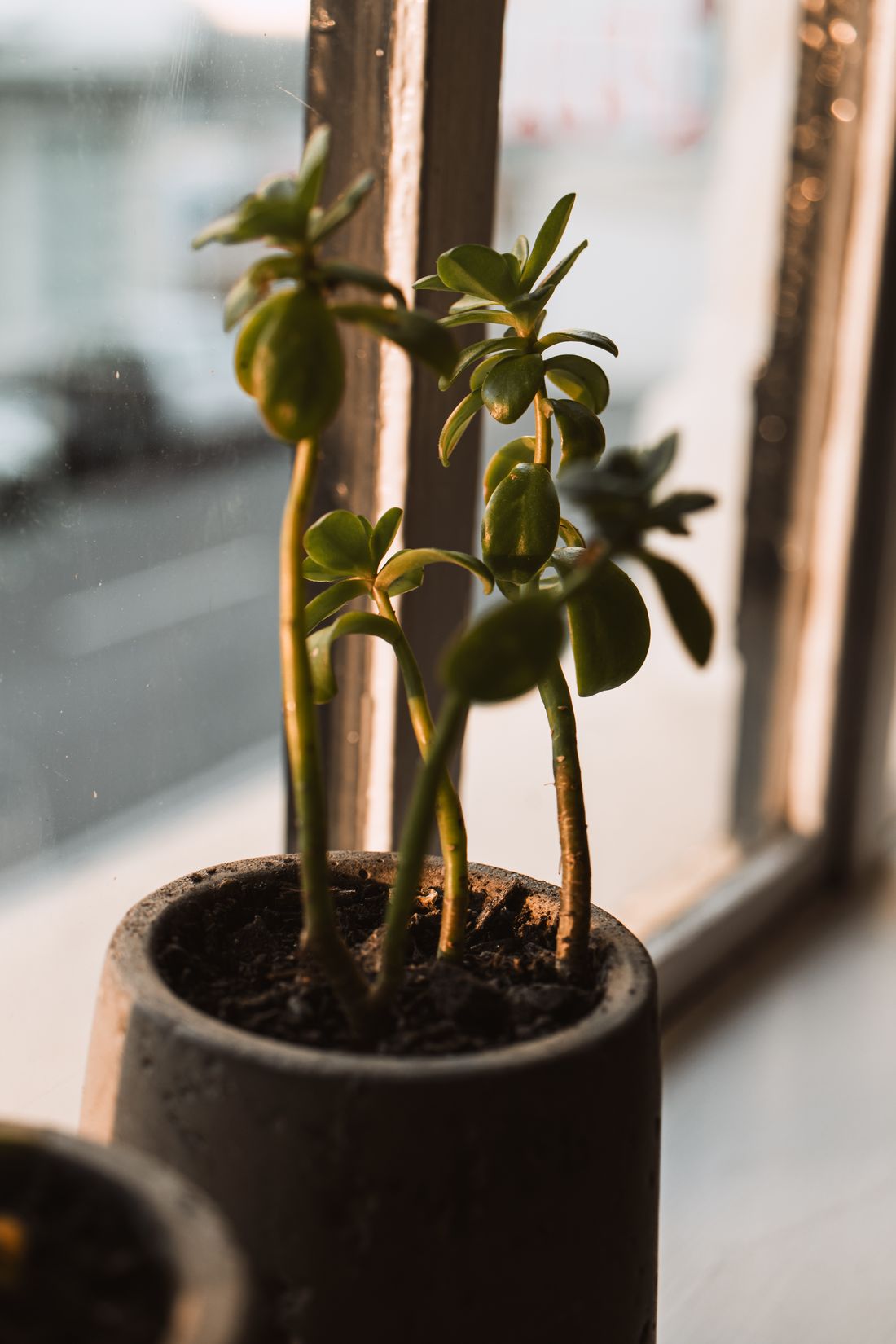
Can a jade plant grow in a north-facing window?
Before our own scoring says anything: we gathered every published figure we could find for a jade plant. 4 of them, from 3 separate sources, all in the same unit. They are reproduced below exactly as each source writes them, and nothing here is converted.
| Who publishes it | What it says a jade plant needs | What the figure is |
|---|---|---|
| extension.arizona.edu | 150–1000 foot-candles | listed under the heading "High Light (150–1000 fc)" |
| houseplantjournal.com | 200 FC (40 µmol) foot-candles | minimum indirect light level |
| houseplantjournal.com | 400 FC (80 µmol) foot-candles | good indirect light level |
| houseplantsnook.com | 400–800 foot-candles | chart fc level |
It can survive there and it will not do well: 40/100 pressed against the glass and 38/100 three metres back, with light failing at every one of those distances rather than merely being flagged. It is also the most cold-tolerant plant on our temperature comparison, comfortable down to 10 °C, so a cold north room is one thing this particular plant is not bothered by.
The same publishers say something plainer when they are not giving numbers.
| Published by | What it says | In its own words |
|---|---|---|
| hgic.clemson.edu | Full sun, or a south window | “Like many succulent plants, jades prefer the full sun or bright filtered light of a south-facing window.” |
| hort.extension.wisc.edu | Four or more hours of direct sun | “Jade plant does best with four or more hours of direct sun, but they will survive in bright, indirect light.” |
| plantfinder.mobot.org | Bright, with afternoon shade | “Plants need bright light, but appreciate some afternoon shade.” |
| ag.purdue.edu | Strong sun reddens the edges | “Although it can adapt to medium to high light conditions, it frequently develops red edges around the leaves in strong, direct sunlight.” |
| planttalk.colostate.edu | 65–75 °F by day, 50–55 at night | “Jade plants require day-time temperatures between 65 and 75 degrees Fahrenheit, and night-time temperatures between 50 and 55 degrees.” |
Four of those five put this plant in direct sun or name a south window outright. A north room has no direct sun at any distance, which is why the scores below do not move: there is nothing in the room to walk towards.
Two points across an entire room is the finding. On every other page in this series the useful answer is a distance, because moving the plant changes the verdict. Here the brightest point available already sits below what this plant needs, so nothing downstream of it can pass. A south window buys back three of those metres and still does not clear the bar, which is easier to see when all four orientations are scored side by side.
The numbers by distance
| Distance from the glass | Estimated light | What the light is doing | Verdict |
|---|---|---|---|
| 0.3 m, against the glass | 3,640 lux | Too dim here | Not the best fit right now, 40/100 |
| 1 m back | 2,800 lux | Too dim here | Not the best fit right now, 39/100 |
| 2 m back | 1,764 lux | Too dim here | Not the best fit right now, 39/100 |
| 3 m back | 1,111 lux | Too dim here | Not the best fit right now, 38/100 |
They barely move, and none of them is a fit: 40/100 at the glass, 39/100 at a metre, 39/100 at two metres and 38/100 at three. This is a plant whose comfortable band was set by open sun, and a north window is the one orientation that never delivers any. If your north window is unusually large or high up, the free checker will score your actual spot rather than this worked example.
The same jade in a south window
Same plant, same room conditions, different glass: 63 out of 100 on a south sill, falling to 40 by three metres in. The south-window scoring is here.
The comparison is worth running all the way round the house, because the answer is the same shape at every wall:
| The window it is sitting in | Estimated light | Verdict |
|---|---|---|
| North window | 3,640 lux | Not the best fit right now, 40/100 |
| East window | 6,500 lux | Worth a try, 59/100 |
| West window | 7,800 lux | Worth a try, 60/100 |
| South window | 13,000 lux | Worth a try, 63/100 |
Not one of the four windows produces a good fit for this plant on its own sill. The three bright ones are barely distinguishable from each other — south 63/100, west 60/100, east 59/100 — so the common advice to shift it to a south-, west- or east-facing window is one option rather than three, and it ends in a worth-a-try rather than a good fit. The best available seat in a normal home is a south sill, and a south sill is still only worth a try. That is the finding, and it is a more useful one than a north-window verdict on its own.
Read those two pages together and the shape of the thing is clear. Three metres into a south room scores the same as a north window does anywhere. The label on the room is doing almost none of the work. The distance is doing all of it, and in a north room there is no distance that helps.
What stretching looks like before it looks bad
Leggy is the word every guide uses, and it describes the end state rather than the early one. It arrives in a fixed order, and the first step is the one worth catching:
- The spacing opens up. The gap between one pair of leaves and the next gets longer than the gap below it. Nothing else has changed yet.
- New leaves come in smaller and thinner than the ones under them, which is the plant spending less on each one.
- The stem starts to lean toward the window and stops holding the leaves upright.
None of that reverses. A stretched section stays stretched, and the fix is to cut back to good growth and let it regrow somewhere brighter. Leggy houseplants goes through how to tell stretching apart from the other reasons a plant leans.
The stem tilting toward the glass is the same signal read from another angle: a lean is a ratio between two sides of the plant, not a light level.
The wet soil problem is downstream of the light
The guides that mention rot in a north window are describing the end of a chain rather than a separate problem. Less light means less photosynthesis, less photosynthesis means the plant draws less water, and a pot that used to dry out in ten days now takes three weeks. Nothing about the watering changed. The plant’s appetite did.
For a succulent that is the dangerous version of low light, and it arrives faster than the stretching does. A jade in a dim room watered on the schedule that suited it in a bright one is sitting in wet soil most of the time, and soft translucent leaves with a mushy base is the outcome people usually blame on overwatering. It is overwatering. The reason it started is the window.
The practical version: in a north room, water this plant by weight or by feel rather than by calendar, and wait until the pot is genuinely light.
If north is the only window you have
Three options, honestly ranked.
- Accept a slow, stretched plant and prune it. It will live for years. It will not look like the ones in the photographs.
- Add a grow light. This works, and it is outside what we can measure honestly. A phone sensor reads a narrow slice of what a plant uses, and under artificial light that gap gets wider, so we would rather say we cannot assess it than print a confident number.
- Put a different plant in the window and move the jade to a friend’s south sill. A north window is a genuinely good spot for several plants. A ZZ plant is comfortable in one at every distance, and the north window guide has the rest.
The third option is worth putting numbers on. Walk a jade and a ZZ plant back from that same north glass together and neither answer moves: the jade is not a fit at any of the four distances and the ZZ is a great fit at all four.
This window is not a gradient for either plant: it is simply the wrong window for one of them and a comfortable one for the other, everywhere in the room.
Published August 10, 2026 · Last updated August 30, 2026
