Scored for a Fascinator prayer plant at 22 °C and 50% humidity, an east window comes back 91 out of 100 on the sill, at one metre and at two, dropping to 66 only at three metres. What holds the score below 100 at every distance is humidity, not light.
This search returns something close to unanimity. Near an east or north-facing window, says a nursery. Near east or north-facing windows, says a garden supplier. In front of a north, or near an east facing window is great, says another. A plant care site tells you to move it closer to an east-facing window if it is not getting enough light. Every one of them is answering with a compass direction.
Scored across four dimensions, the light at an east window is comfortable at every distance from the glass out to two metres. The dimension that comes up short is humidity, and it comes up short at all of them.

Great fit
This plant should be happy in this spot.
Just the right amount of light
Comfortable temperature
A little dry, but workable
Airflow suits it
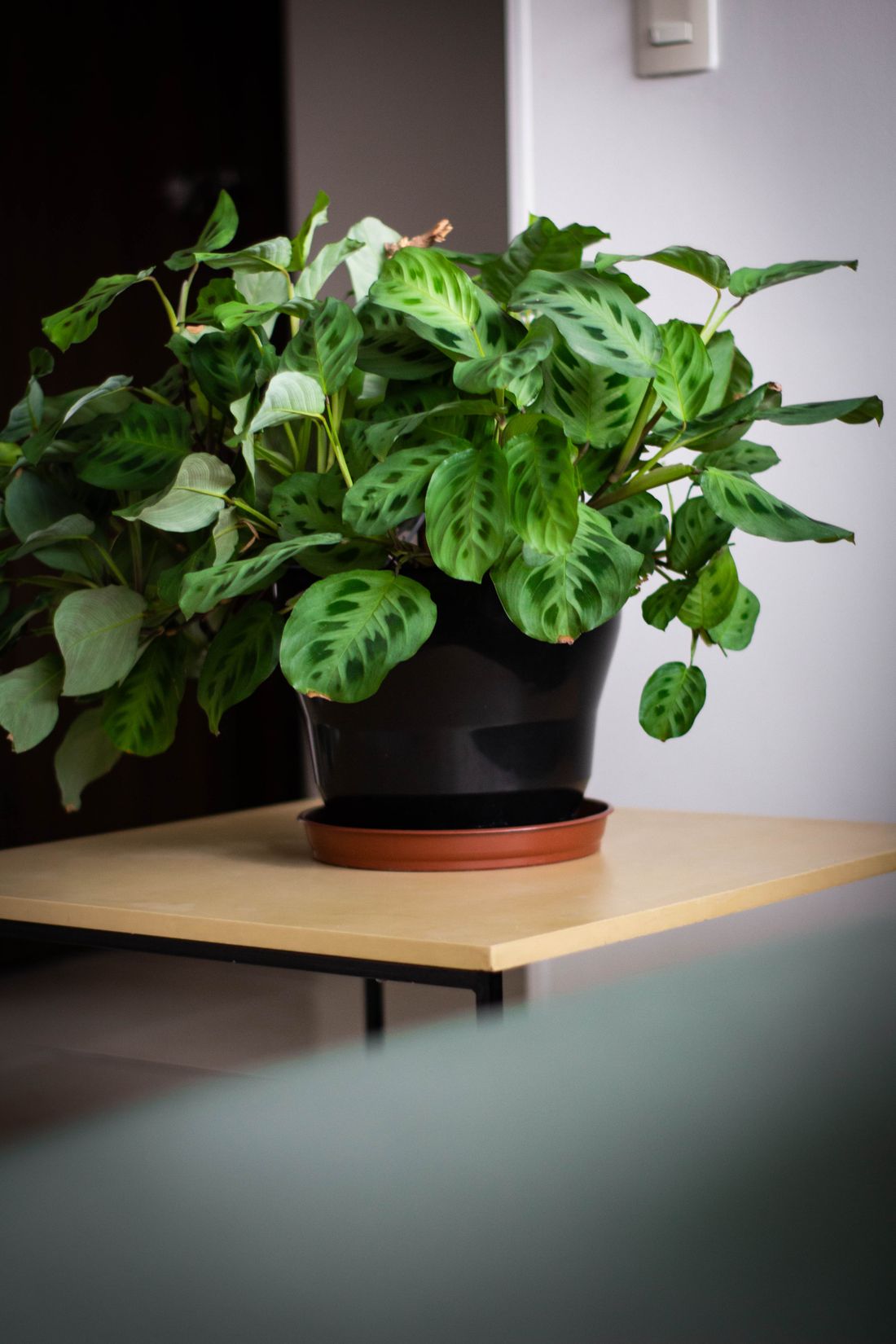
Is an east window right for a prayer plant?
Before our own scoring says anything: we gathered every published figure we could find for a prayer plant. 3 of them, from 2 separate sources, all in the same unit. They are reproduced below exactly as each source writes them, and nothing here is converted.
| Who publishes it | What it says a prayer plant needs | What the figure is |
|---|---|---|
| houseplantjournal.com | 100 FC (20 µmol) foot-candles | minimum indirect light level |
| houseplantjournal.com | 200 FC (40 µmol) foot-candles | good indirect light level |
| houseplantsnook.com | 100–200 foot-candles | chart fc level |
Yes, and it is not close: 91/100 against the glass, at one metre and at two metres alike. The advice to keep it on the sill or within a foot or two is not wrong so much as needlessly tight — those three distances score the same, so you have a two-metre shelf to choose from rather than a ledge. From the glass out to two metres the light dimension sits inside the band, and the only reason the score is not a hundred is a different dimension entirely.
Those are the sources that answer in numbers. Most of what is published about this plant is not a number at all, and what those sources say is worth reading next to the figure that is.
| Published by | What it says | In its own words |
|---|---|---|
| fieldreport.caes.uga.edu | 5,000–8,000 foot-candles, east window | “Footcandle readings at these windows can reach 5,000-8,000.” |
| libguides.nybg.org | A shady window, or a sheer curtain | “The exceptional leaf color fades in the sun, so keep plants in partial shade, for instance, a shady window or protected from the strongest light by a sheer curtain.” |
| missouribotanicalgarden.org | Bright, but no strong direct sun | “It performs well in a soil-based potting mix and with bright indoor light but no strong direct sun.” |
| plants.ces.ncsu.edu | Low to medium light | “This plant tolerates low to medium light. It is intolerant of direct sunlight or low humidity.” |
| libguides.nybg.org | Humidity well above 50% | “Keep a simple hygrometer near the plant to check that the humidity is staying well above 50%.” |
The first row is the one to be careful with. Five thousand foot-candles is more than fifty thousand lux, and the sill scored above reads 6,500. Both can be true of different houses on different days, which is why this page scores a spot rather than a compass direction.
At three metres light finally gets flagged too. So the placement advice on the first page of results is correct, it is just answering a question that was not the binding one.
| Distance from the glass | Estimated light | What the air is doing | What the light is doing | Verdict at 50% humidity |
|---|---|---|---|---|
| 0.3 m, against the glass | 6,500 lux | A little dry, but workable | Just the right amount of light | Great fit, 91/100 |
| 1 m back | 5,000 lux | A little dry, but workable | Just the right amount of light | Great fit, 91/100 |
| 2 m back | 3,150 lux | A little dry, but workable | Just the right amount of light | Great fit, 91/100 |
| 3 m back | 1,984 lux | A little dry, but workable | A little dim, but workable | Worth a try, 66/100 |
The estimated light falls to under a third of the figure at the glass, and only on the last row does the light dimension itself get flagged. The humidity flag is on all four, because moving a pot toward or away from a window does almost nothing to the moisture in the air around it.
Those light figures are estimates rather than meter readings. The humidity is the input we held at 50%, which is a fairly typical indoor figure.
A pothos at the same window has the opposite shape: its lowest score is the one against the glass and its highest is at the back of the room, with light the only dimension that ever flags.
What the humidity is worth in points
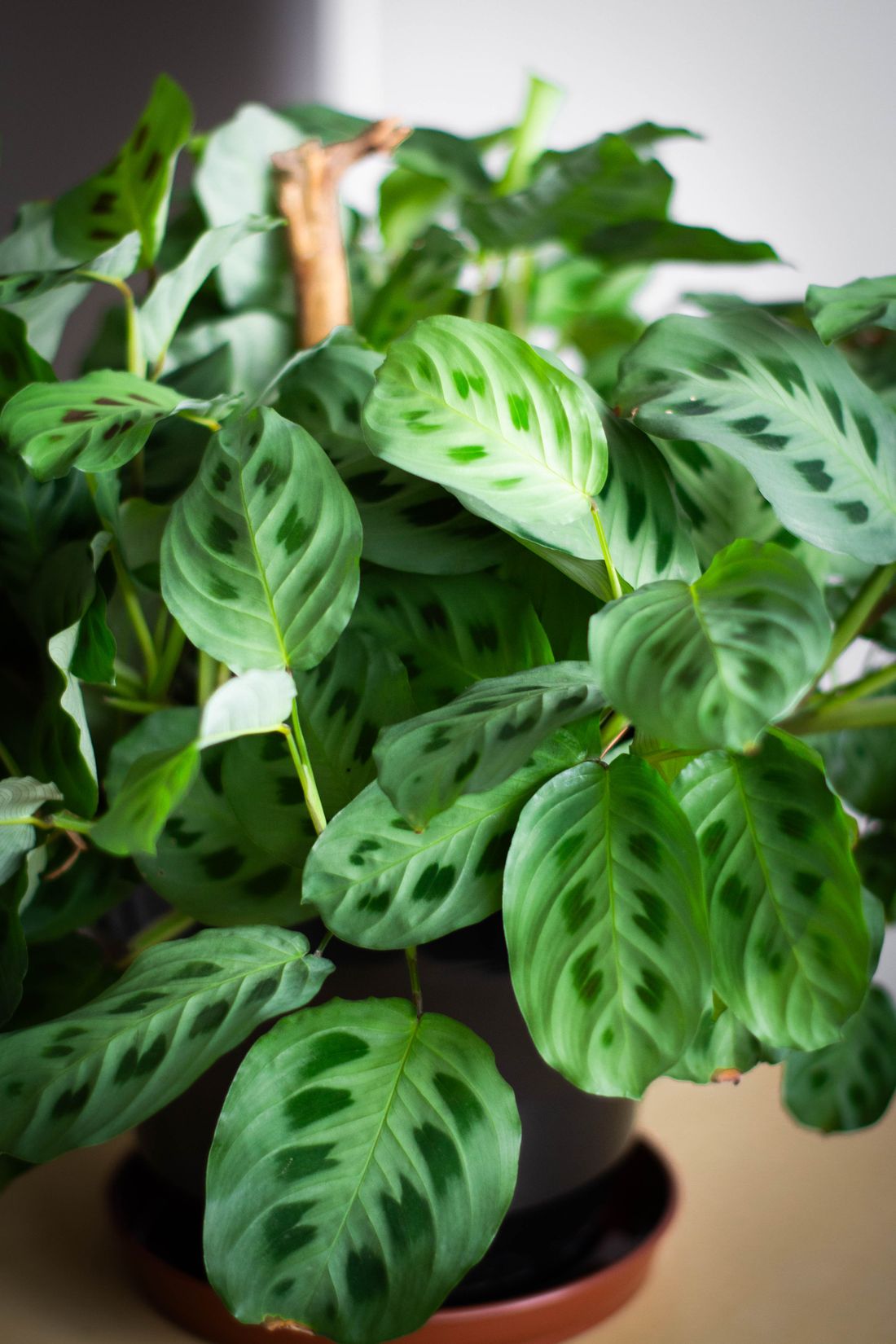
The missing points are all one dimension: 91/100 at 50% humidity, with light, warmth and airflow all inside their bands. Hold the spot still at one metre from the same east window and move only the humidity, and it runs a good fit at 45%, then great fits from 50% upward, climbing the whole way to 65.
| Distance from the glass | Fascinator prayer plant | Burgundy rubber plant |
|---|---|---|
| 0.3 m against the glass6,500 lux | 91/100 | 98/100 |
| 1 m back5,000 lux | 91/100 | 67/100 |
| 2 m back3,150 lux | 91/100 | 64/100 |
| 3 m back1,984 lux | 66/100 | 47/100 |
Our care baseline puts this plant’s comfortable range at 60% to 80%. Everything below 60% is the plant coping rather than thriving, and a heated room in winter can sit in the thirties.
This is the only dimension in this series where the fix is cheap and does not involve moving furniture. Nothing about the window changes; the air around the pot does.
The humidity figures above stop at 45%, and the step below it is much larger than any step above it. At 40% the same spot falls to 66 out of 100 and humidity changes from a flag to a fail, which is covered on our page about the ideal humidity for houseplants, along with why no single level in a home can suit this plant and a jade at once.
Distance costs its neighbours far more than it costs this one: a rubber plant at the same window runs from 98/100 down to a fail across those three metres.
There is one room where those nine points come free and a different dimension becomes the problem: in a bathroom the humidity is the easy part and the light usually is not.
Crispy edges are the humidity telling you
The humidity, not the sun — and that matters because the standard response to crisp edges at a bright window is to move the plant back, which does nothing to the air and eventually costs light: 91/100 at the glass, at one metre and at two, then 66/100 at three. Prayer plants are famous for browning at the leaf edges, and it is the single most common complaint about them. It gets blamed on tap water, on watering rhythm, and on too much sun, and any of those can do it.
But the plant is asking for 60% and most rooms are not offering it, so dry air is the standing explanation before the others are worth investigating. A plant that browns at the edges while sitting in genuinely good light, in a room you would describe as comfortable, is usually telling you about the air rather than the window.
Air that is moving is a separate complaint from air that is dry, and this plant registers both. The airflow numbers show what a strong draught costs it. Plants that tolerate cold drafts follows that thread across seven plants and shows the other thing a draft carries, which is the cold.
What actually raises it
The measures that work are the unglamorous ones, and one popular measure does not work at all.
- Grouping plants together raises the humidity in the pocket they share, because they are all transpiring into the same bit of air.
- A tray of damp pebbles under the pot does the same on a smaller scale, as long as the pot sits on the pebbles rather than in the water.
- A humidifier is the only measure that reliably moves a whole room, and in a dry winter it is the difference between coping and comfortable.
- Misting does not do it. The effect lasts minutes and the plant needs it for months. It is the most recommended fix and the least effective one.
- Keep it out of the airflow from a vent, radiator or air conditioner. Moving air strips the humid pocket a plant builds around itself, which is why the airflow dimension exists at all.
That last one is worth putting a number on, because it is the dimension people never think to check. On the same spot the plant is a great fit in light air at 91 out of 100, a good fit in still air and in medium air at 85, and only worth a try in a strong draught at 62.
Note that the worst of those is not the stillest one. This plant wants a little movement and no more, so a sealed corner and a draughty one are both worse than the spot in between. That is the difference between a plant that tolerates dry air and one that is quietly losing the pocket of humid air it makes for itself.
A prayer plant is one of several that colour up beside a morning beam rather than in it, and the east window guide sorts the rest by where at the glass they go.
It is one of the pet-safe ones
The ASPCA does not list prayer plants as toxic to cats or dogs, which puts them in a small group along with spider plants among the common houseplants people ask about.
That matters for this plant in particular, because the low tables and grouped arrangements that help with humidity are exactly the placements a cat can reach.
That is a shorter list than it sounds. Most of what gets recommended for dim rooms is not on it: ZZ plant, peace lily, heartleaf philodendron and Chinese evergreen are all listed as toxic.
The room is not the spot
| Spot | Reading |
|---|---|
| At the bright window | 20,000 lux |
| 1 m from the window | 15,000 lux |
| 2–3 m away, in window shade | 3,500 lux |
| Middle of the room | 570 lux |
| Darker side of the room | 119 lux |
| The dark corner | 18 lux |
That room’s orientation was never recorded, so those are not east-window figures and we are not presenting them as any. The reason it belongs here is the contrast: light falls a thousand-fold across one room while humidity barely moves across the same distance. Two dimensions of the same spot, behaving nothing alike, which is why reading one and inferring the other does not work. The thousand-fold figure comes from light measured point by point across one room.
Published July 31, 2026 · Last updated August 30, 2026
