Ask this question and the answers come back from an odd crowd: grow-equipment shops, hydroponics channels, and forum threads about fan placement. They all say yes, and they are right. What none of them ask is the question that actually decides anything, which is how the air already moves at the spot your plant stands in. A lived-in room with a door that opens is not a sealed grow tent, and treating the two the same is how people end up aiming a fan at a plant that never needed one.

Worth a try
It can work here with a little care.
Just the right amount of light
Comfortable temperature
Humidity suits it
Airflow doesn't suit it
What the whole dataset says
Houseplant advice barely mentions air movement. The people who grow plants indoors for a living run fans continuously, publish the spacing, and put a speed on it.
| Published by | What it says air movement does | In its own words |
|---|---|---|
| ipm.cahnr.uconn.edu | 20–40% higher | “In a dense canopy of foliage the relative humidity can be 20% – 40% higher than the air above it do to stratification. Continuous air circulation helps to reduce this stratification. This keeps the leaf temperature higher.” |
| ipm.cahnr.uconn.edu | Run continuously | “Fans are run continuously except when the exhaust fans are on.” |
| ipm.cahnr.uconn.edu | 1/15 horsepower | “The horizontal air flow (HAF) system gives good circulation and mixing with small fans (1/15 horsepower, 12" to 20" diameter).” |
| blog.uvm.edu | Equivalent conditions | “Circulation is important to ensure each square foot of growing space is getting roughly equivalent growing conditions.” |
| blog.uvm.edu | No dead spots | “HAF’s push the air around the growing area and should ensure that there are no areas without some air flow.” |
| blog.uvm.edu | Every 20 to 50 feet | “it is generally recommended to place HAF fans every 50 feet along the length of flow”, and with dense planting “a maximum distance between HAF fans of 20-30 feet is more appropriate.” |
| blog.uvm.edu | Not on its own | “If you circulate without ventilation, you run the risk of having conditions in the structure growing overly hot and humid leading to plant stress and disease.” |
| umass.edu | 50 to 100 feet per minute | “It takes only four small fans to keep the air moving at 50 to 100 feet per minute in the above greenhouse.” |
| ask.ifas.ufl.edu | One air change per minute, summer | “A generally accepted minimum ventilation rate for temperature control in the summer is one air change per minute.” |
| ask.ifas.ufl.edu | Two to three per hour, winter | “Ventilation requirements of greenhouses in winter are generally on the order of two to three air changes per hour.” |
| ipm.ucanr.edu | Indoors, disease is the exception | “Disease only occasionally plays an important role in the indoor life of a houseplant, provided it was healthy when purchased or obtained.” |
| rhs.org.uk | Still air is the thing to avoid | “Avoid sheltered places, such as against walls or fences, where the air is likely to be still” |
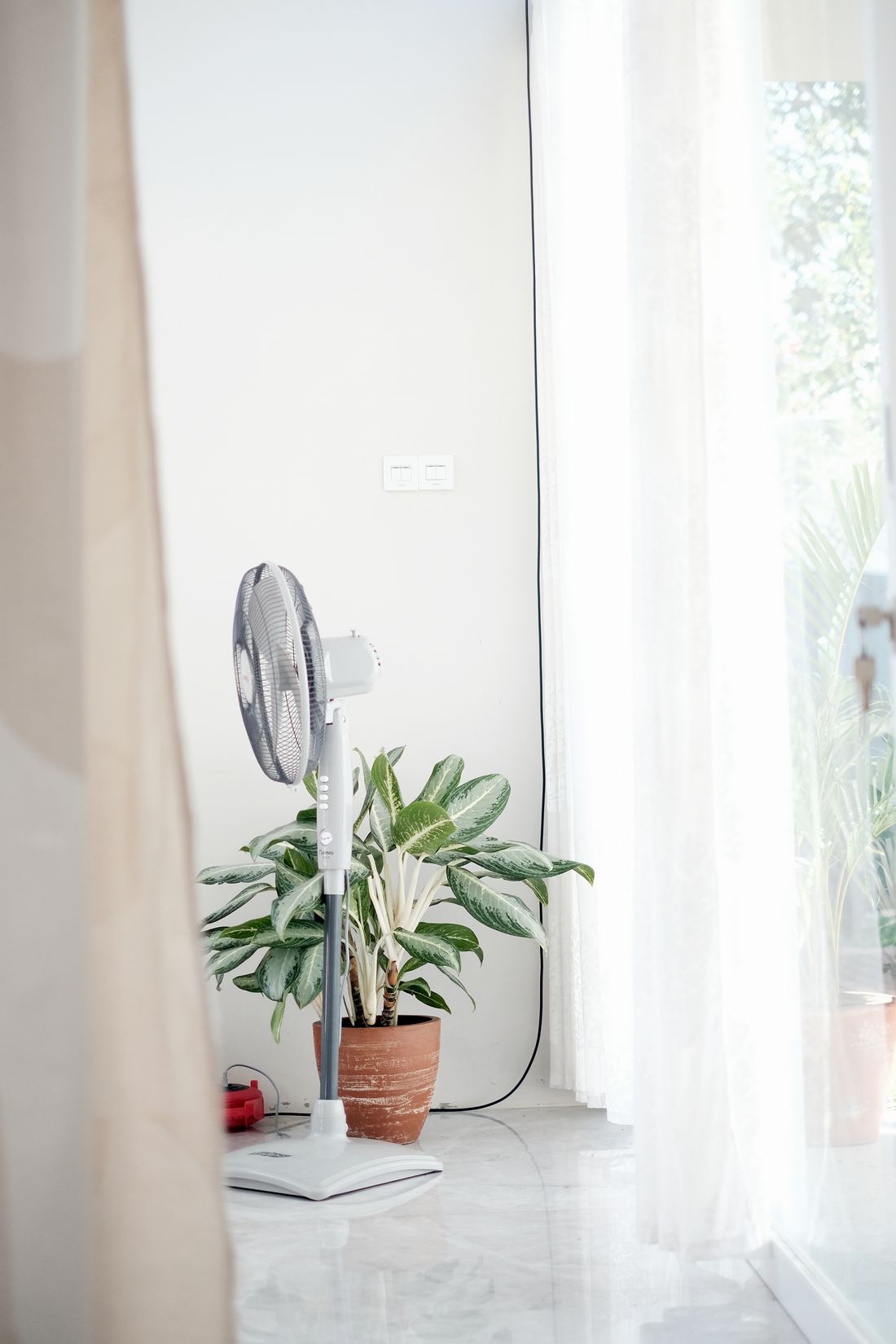
Our care data holds an airflow preference for every species it covers, on a three-step scale: light, medium or strong. The count that prefers still air is zero. Not rare, zero, which makes still air the one condition the entire dataset agrees on. From there the agreement ends: about two thirds simply want medium, the unremarkable drift of a normal occupied room, and the rest split between light movement and strong. Equipment is the answer for almost none of that; a door that opens covers the middle of the distribution.
Where the failure sits for most plants
The scale has two ends, and most plants fail at the still end. Here is a monstera on a spot where light, warmth and humidity are all right, scored four times with nothing changing but the air.
| How the air moves at the spot | What the airflow is doing | Verdict |
|---|---|---|
| Still air | Airflow doesn't suit it | Worth a try, 65/100 |
| Light air | Airflow isn't quite ideal | Great fit, 93/100 |
| Medium air | Airflow suits it | Great fit, 99/100 |
| Strong air | Airflow isn't quite ideal | Great fit, 93/100 |
One failing row, and it is the row where nothing moves. This is the case the fan advice is built on, and for this plant it is fair: behind a closed door, in unmoving air, a third of the score is gone before any visible symptom shows up. The fix does not have to spin, though. The rows either side of the failure are “light” and “medium”, which is what the room does on its own once air is allowed through it.
And where it sits for the quieter minority
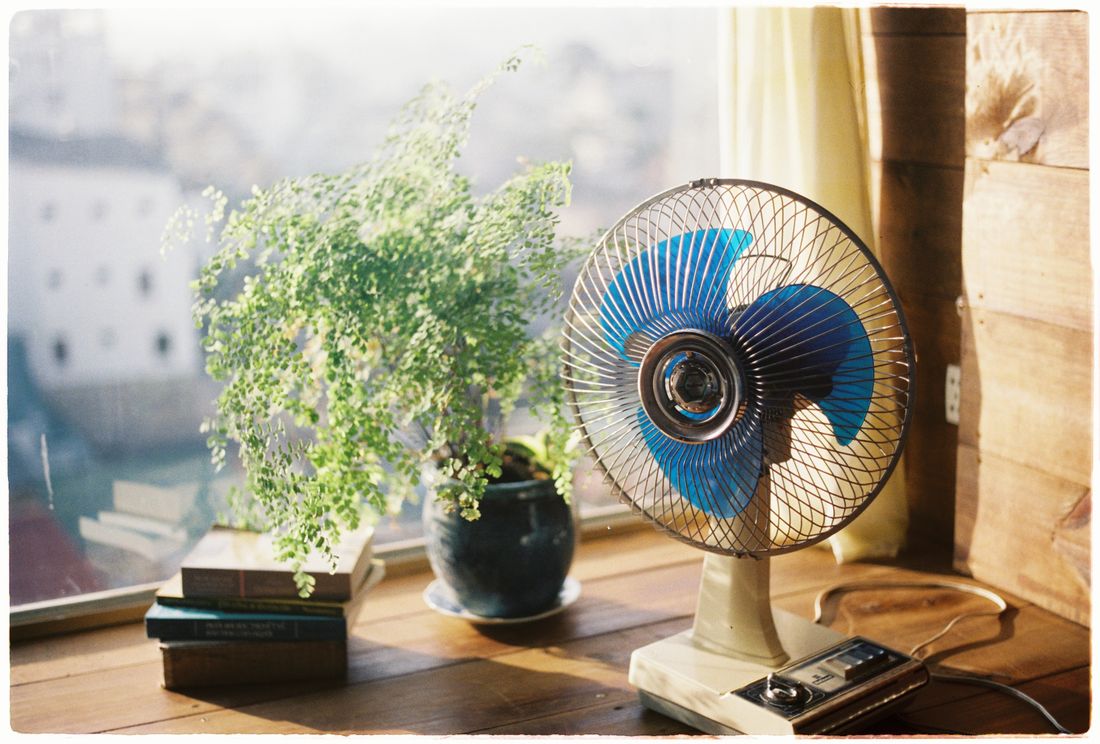
Now the same four rows for a peace lily, one of the minority that prefer light movement. A shower cubicle is where still air costs the most: running the fan is worth more there than changing the plant.
| How the air moves at the spot | What the airflow is doing | Verdict |
|---|---|---|
| Still air | Airflow isn't quite ideal | Great fit, 93/100 |
| Light air | Airflow suits it | Great fit, 99/100 |
| Medium air | Airflow isn't quite ideal | Great fit, 93/100 |
| Strong air | Airflow doesn't suit it | Worth a try, 65/100 |
The failure has moved to the other end of the table. Still air costs a peace lily a caution; a strong draught costs it a third of its score. Put those two tables side by side and the question stops being “does my plant need airflow” and becomes “which end of this scale does my spot sit on”, and that second question has a different answer at a sealed office desk than a hallway shelf.
The numbers people quote are from another world
The figure that circulates in growing forums is a fan speed across the canopy, and for a packed grow tent it is sensible. Set it against the only other airflow number in this house:
| The number | Where it comes from |
|---|---|
| 0.2–0.5 m/s | Grow-tent fan advice, for air across the canopy |
| 10.8 m/s | Beaufort force 6, where our own outdoor wind alert fires |
Indoor circulation and outdoor wind are different problems; a wall retires one of them completely. The remaining indoor risks are narrower: the air right at a radiator or vent, and the cold kind of draught, which fails plants on temperature before it fails them on movement.
One boundary before you buy anything: the airflow in our scoring is the one you describe, on that same three-step scale, not a reading from an anemometer we don’t have. What the score adds is the half you can’t look up: whether the plant you have in mind is one that fails in still air or one that fails in a draught. Describe the spot to the free spot checker (window, distance, how the air moves) and it answers for that plant, in the browser, nothing to install.
By GrowSpot · Published August 15, 2026 · Last updated August 30, 2026
