Search this and the first page hands you five or six percentages. Stacked up they look like a field that cannot agree on a basic fact. Read the sources themselves and something more useful appears: most of those numbers are not answering the same question.
| What it says | Who is saying it | What it is describing |
|---|---|---|
| 60% to 70% | The top result, in its opening line | What plants want |
| 40% to 60% | The same page, further down | What plants want |
| 40% to 60% | The summary at the top of the results, sourced to a company selling humidifiers | What plants want |
| 30% to 60% | A university extension article, quoting an engineering standard | What buildings are meant to sit in |
| 70% to 90% | A university plant service | The climate these plants come from |
The bottom two rows are not recommendations for your living room at all. One is a building standard and the other is a description of a rainforest, quoted to explain why a heated home feels alien. Both articles also note what homes actually measure in the heating season, which is below 30 per cent, and under 10 in a dry climate.
Separate them out and the genuine recommendations cluster fairly tightly, roughly 40 to 70 per cent. Twenty points at the low end is a real disagreement but not a chaotic one. The trouble is elsewhere.

Worth a try
It can work here with a little care.
Just the right amount of light
Comfortable temperature
Too dry here
Airflow suits it
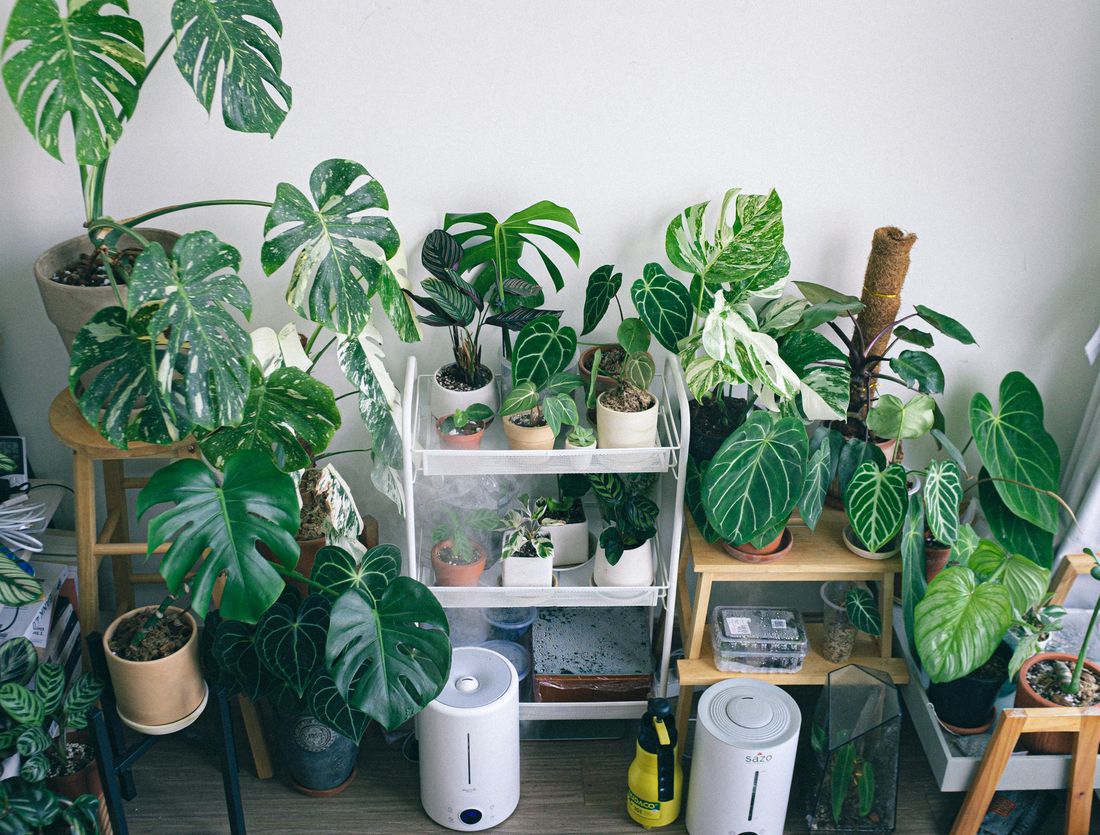
The card above is a prayer plant a metre from an east window in a heated room. The light there estimates at 5,000 lux, which is well inside what this plant asks for, and the temperature and the airflow suit it too. The spot still comes back at 65 out of 100. Humidity alone does that, and there is nothing to correct in the other three dimensions because nothing in them is wrong.
One boundary to keep in view: we estimate indoor humidity rather than measure it. Light is the dimension we measure, by laying a phone down at the spot; humidity is worked out from local weather adjusted for being indoors. A cheap hygrometer will beat us at reading the room. What it cannot do is tell you which of your plants that reading rules in and which it rules out.
What the plants actually ask for
These are the same eight plants used on our page about the minimum temperature for houseplants, each with the comfortable humidity band our care data holds for it. As with temperature, these are not survival limits. They are the range in which the plant is not being asked to cope.
| Plant | Comfortable humidity |
|---|---|
| Sunset Jade | 20% to 40% |
| Bird's Nest Snake Plant | 30% to 50% |
| ZZ plant | 30% to 50% |
| Ocean Spider Plant | 40% to 60% |
| Swiss cheese plant (Monstera) | 40% to 60% |
| Golden pothos | 40% to 60% |
| Peace lily | 50% to 70% |
| Fascinator Prayer Plant | 60% to 80% |
No single level suits all eight
On temperature, these same eight plants share a band, and the shape of that is worth seeing before the humidity version of the same question:
| Hold the room at | Left outside | Inside its band |
|---|---|---|
| 10 °C | Bird's Nest Snake Plant, ZZ plant, Swiss cheese plant (Monstera) and 3 others | 2 of 8 |
| 13 °C | Bird's Nest Snake Plant, ZZ plant, Swiss cheese plant (Monstera) and 3 others | 2 of 8 |
| 16 °C | None | 8 of 8 |
| 21 °C | None | 8 of 8 |
| 27 °C | None | 8 of 8 |
| 29 °C | Ocean Spider Plant, Fascinator Prayer Plant | 6 of 8 |
| 30 °C | Sunset Jade, Bird's Nest Snake Plant, Ocean Spider Plant and 4 others | 1 of 8 |
| 33 °C | Sunset Jade, Bird's Nest Snake Plant, ZZ plant and 5 others | 0 of 8 |
Eleven degrees in which every one of them is inside its range. One thermostat setting genuinely serves the lot, and the argument on that page is about how badly the published advice is labelled rather than about the plants.
Humidity has no such band. The highest floor in the table is 60 per cent, for the prayer plant. The lowest ceiling is 40 per cent, for the jade. The floor is above the ceiling, which means the overlap is not small. It is empty. There is no percentage at which both of those plants are inside their comfortable range, and no compromise available, because a compromise requires something to divide.
Now the same count, asked of humidity:
| Hold the room at | Left outside | Inside its band |
|---|---|---|
| 30% | Ocean Spider Plant, Swiss cheese plant (Monstera), Golden pothos and 2 others | 3 of 8 |
| 40% | Peace lily, Fascinator Prayer Plant | 6 of 8 |
| 45% | Sunset Jade, Peace lily, Fascinator Prayer Plant | 5 of 8 |
| 50% | Sunset Jade, Fascinator Prayer Plant | 6 of 8 |
| 55% | Sunset Jade, Bird's Nest Snake Plant, ZZ plant and 1 other | 4 of 8 |
| 60% | Sunset Jade, Bird's Nest Snake Plant, ZZ plant | 5 of 8 |
| 65% | Sunset Jade, Bird's Nest Snake Plant, ZZ plant and 3 others | 2 of 8 |
The column never reaches eight, or seven. It peaks at six, twice, and it dips in between. Forty and fifty are the two best settings on offer, and forty-five, the value sitting between them, is worse than either: it is above the jade's ceiling and below the peace lily's floor at the same time. Aiming for the middle is worse than aiming at either end of it, which is not something a single recommended percentage can express.
That is the reverse of what we found on temperature. There the published figures spread eleven degrees while the plants spread six, so which article you read mattered more than which plant you owned. Here the recommendations spread twenty points and the plants spread forty. The advice is roughly right and still cannot be followed, because the thing it is describing does not have a single value.
The building has a ceiling of its own
The building has published figures too, and they are lower than the plant ones. The rows that decide how a house is actually run are the two about people.
| Published by | The figure it gives | For whom |
|---|---|---|
| lancaster.unl.edu | 70–80% | “For plants, humidity requirements vary by species, but generally 70-80% is best.” |
| extension.unh.edu | 40–60% | “Most houseplants (excluding cacti, succulents and a few others) prefer a relative humidity range of 40-60%”, with tropicals at “70-80%”. |
| yardandgarden.extension.iastate.edu | 40 to 50 percent | “Many houseplants prefer a relative humidity of 40 to 50 percent.” |
| lancaster.unl.edu | 30–50% | For people, on the same page: “The Mayo Clinic recommends indoor humidity stay between 30-50% for human health and comfort”. |
| greenhome.osu.edu | 35%–50% | “35%-50% relative humidity is considered the comfortable range”, with “a relative humidity between than 25-60% is desirable” for the building itself. |
| extension.psu.edu | 30% to 60% | ASHRAE’s range as quoted: “indoor relative humidity (RH) be maintained between 30% and 60%”, against which “indoor relative humidity levels can easily fall below 30%” in winter. |
| ndsu.edu | 30 to 40 percent | “The recommended humidity level during the winter months is 30 to 40 percent”, because “A relative humidity above about 40 percent increases the potential for condensation on windows and other cool surfaces.” |
| yardandgarden.extension.iastate.edu | 10 to 20 percent | What a heated home actually reads: “the humidity level in many homes during the winter months may be only 10 to 20 percent.” |
The standard quoted in that extension article puts indoor relative humidity between 30 and 60 per cent for the building. The prayer plant's comfortable range starts at 60. Its floor is the building's ceiling.
So the standard advice, which is to run a humidifier until the tropical plants stop crisping, asks you to hold an entire room at the top of the range recommended for the house, or past it. The tension is visible in the search results themselves: alongside the articles telling you to raise humidity, the questions box asks whether 70 per cent indoors is too high, and the top answer in one community thread on the same question is to set the humidity to suit the people who live there.
None of that is an argument against humidifiers. It is an argument against treating one room-wide number as the fix, when what you have is two or three plants that want more than the room should be asked to give. The same counting, run against the standard dry-air list, is what the plants-for-dry-air page does: at 30% only five of its eleven regulars stay inside their bands.
Which is why the answer is the spot
Homes are not one humidity. A bathroom after a shower and a kitchen with something on the hob are genuinely damper than the living room, which is the whole premise of our bathroom plants guide, along with the catch that those rooms usually have the worst light in the house. A jade wants the opposite: the driest, brightest place you have. The same split shows up in the watering, because room humidity is one of the four inputs to the evaporation maths, and what that maths does and does not use decides how far the interval moves with it. A laundry room is the sharpest version of that, in either direction.
Move only that one input and leave the window, the distance, the warmth and the airflow exactly where they are: the plant is worth a try at 30% and at 40%, and a great fit at 50%, 60% and 70%.
Ten points of humidity between the last worth a try and the first great fit, nothing else touched, and the verdict changes. The 50 per cent setting is the worked example on our prayer plant in an east window page, reached from the other side.
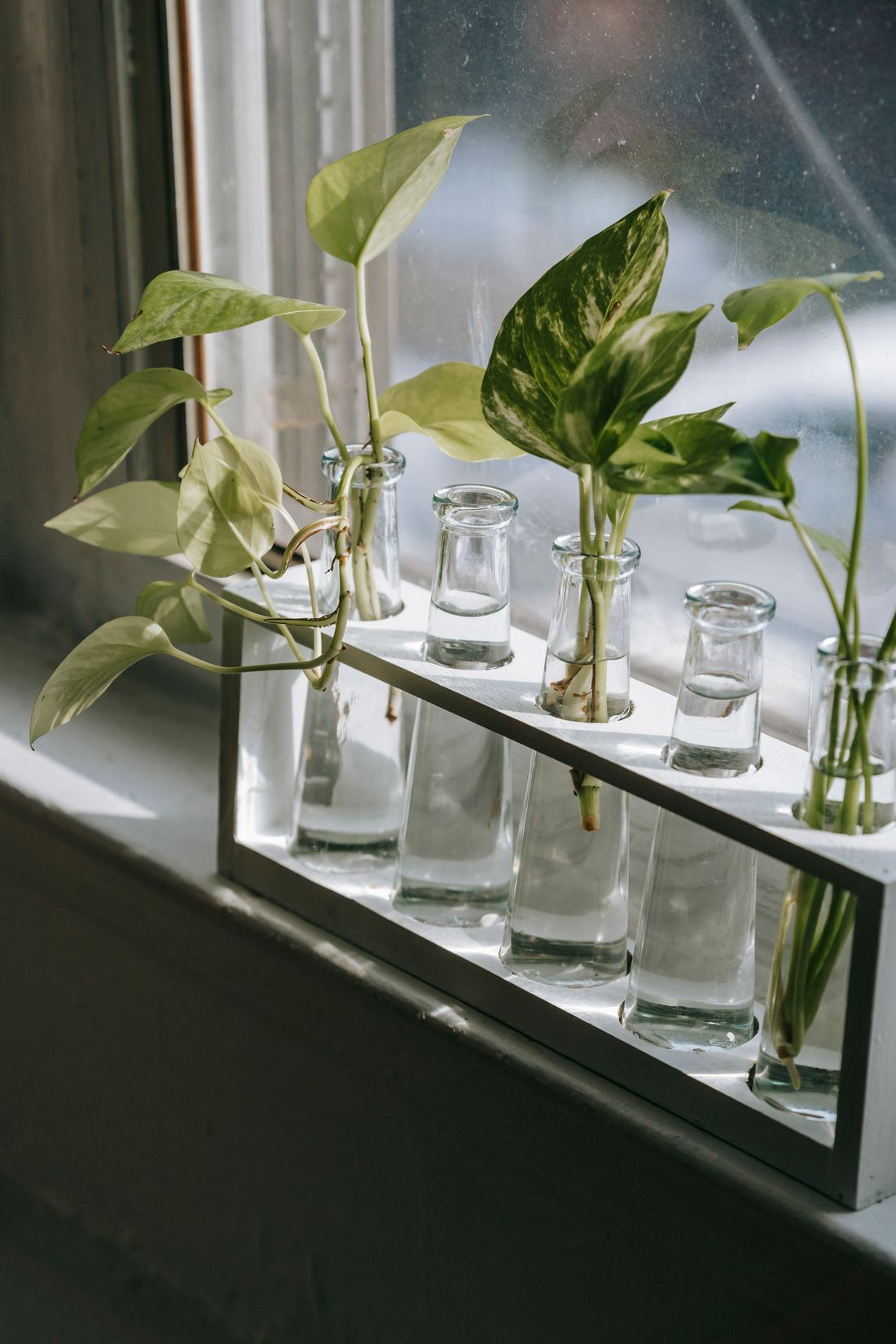
Now hold that 40 per cent reading and change the plant instead. The prayer plant is too dry and the peace lily is a little dry, both landing on worth a try; the monstera and the snake plant are a great fit; and the jade, whose air suits it perfectly, is not a fit at all for another reason entirely.
<p>That is what an empty overlap looks like when you meet it in a room rather than in a table. The jade is the one worth reading twice: the air suits it perfectly and it is still not a fit at all, because an east window a metre back is a losing argument for a jade whatever the humidity does.</p> The jade is the one worth reading twice: the air suits it perfectly and it is still not a fit at all, because an east window a metre back is a losing argument for a jade whatever the humidity does.
The neighbouring condition
Moving air is the neighbouring condition, and it is a target rather than a scale: too little costs a plant as much as too much. Plants that tolerate cold drafts works through it.
By GrowSpot · Published August 13, 2026 · Last updated August 30, 2026
