Scored at 22 °C and 50% humidity, a parlor palm on an east sill comes back 67 out of 100 with the light flagged as a bit bright; one metre back it is 99, and two and three metres back it is 100. The flagged spot is the sill, not the far side of the room.
The advice on this pairing has the opposite problem to most of the pairings we have scored. It does not disagree with itself. It agrees almost perfectly, and stops one word short of being useful.
Six sources, read in the order they appear:
- A retailer’s care blog: an east or north window is the ideal spot.
- A grow-light company: the same, adding that morning sun is mild enough not to burn the leaves.
- A gardening site: an east window is good, and steer away from a south one.
- A home magazine: reaches an east window and moves straight on to soil and drainage.
- A video guide: low to medium light, and names a north window.
- The automated summary above all of them: repeats the consensus and then goes further than any single source, recommending the windowsill itself, or within a foot or two of it, on the grounds that this beats a dark corner.
One source out of six says something different. It says to place the plant near a north window, or a few feet back from an east or west one. That clause is the only distance anywhere on the page, and it is the part our table agrees with.
So we scored it. Same plant, same east window, four distances, nothing changing from row to row except how far back the pot sits.

Worth a try
It can work here with a little care.
A bit bright, but workable
Comfortable temperature
Humidity suits it
Airflow suits it
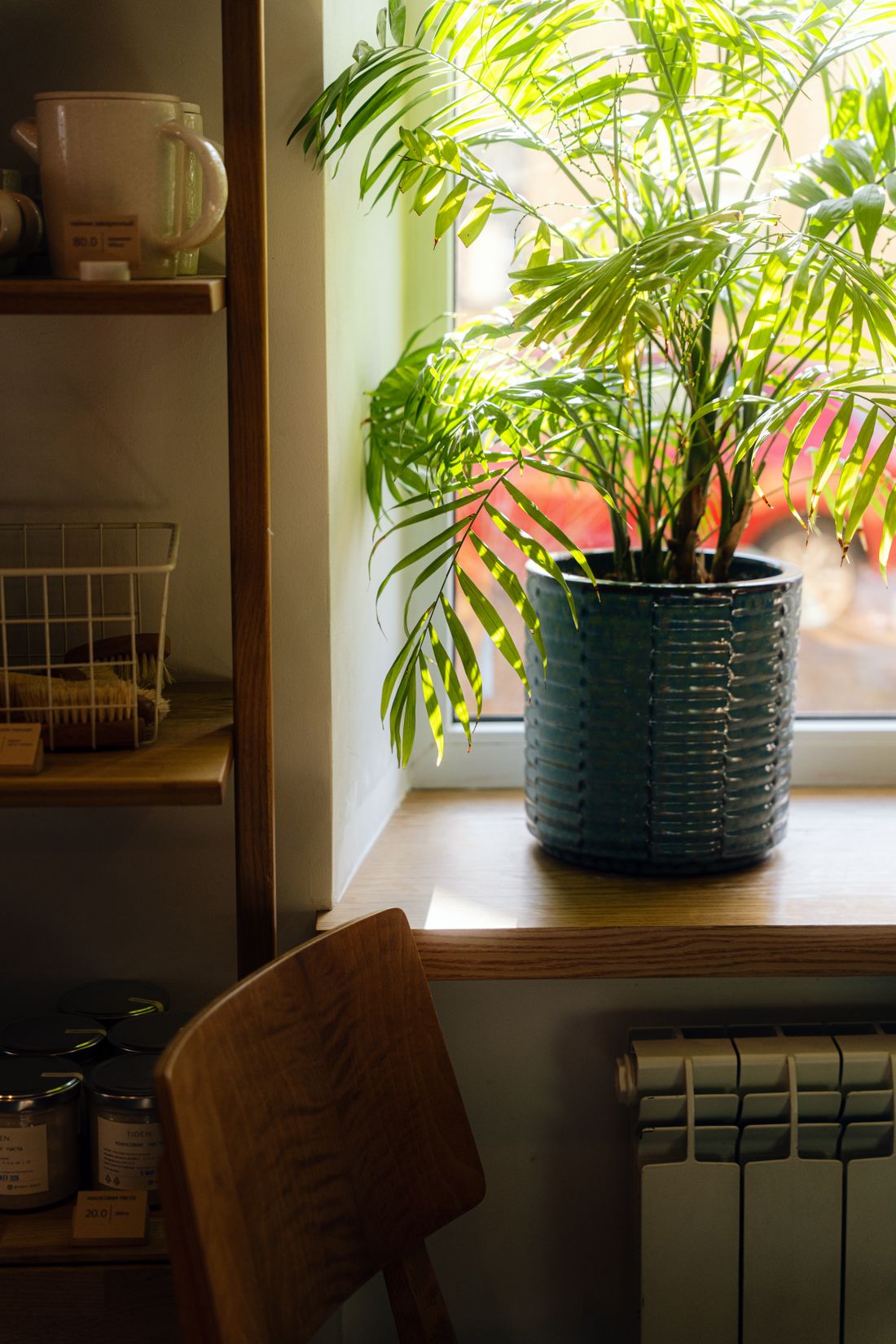
The recommended spot is the flagged one
Before our own scoring says anything: we gathered every published figure we could find for a parlor palm. 5 of them, from 4 separate sources, in 2 different units. They are reproduced below exactly as each source writes them, and nothing here is converted.
| Who publishes it | What it says a parlor palm needs | What the figure is |
|---|---|---|
| growlightmeter.com | 6 – 12 PPFD / DLI | Parlor Palm |
| extension.arizona.edu | 25–75 foot-candles | listed under the heading "Low Light (25–75 fc)" |
| houseplantjournal.com | 100 FC (20 µmol) foot-candles | minimum indirect light level |
| houseplantjournal.com | 200 FC (40 µmol) foot-candles | good indirect light level |
| houseplantsnook.com | 100–200 foot-candles | chart fc level |
Of the four positions, the sill is the only one the score flags. Right against the glass the plant scores 67 and the light dimension is flagged. One metre back it scores 99. Two metres back, 100. Three metres back, 100.
The direction of that flag matters more than the flag. It is not raised because the sill is dim. It is raised because 6,500 lux is more light than this plant is built to use, and every step further into the room brings the reading closer to what it wants rather than further from it.
| Distance from the glass | Estimated light | What the light is doing | Verdict |
|---|---|---|---|
| 0.3 m, against the glass | 6,500 lux | A bit bright, but workable | Worth a try, 67/100 |
| 1 m back | 5,000 lux | Just the right amount of light | Great fit, 99/100 |
| 2 m back | 3,150 lux | Just the right amount of light | Great fit, 100/100 |
| 3 m back | 1,984 lux | Just the right amount of light | Great fit, 100/100 |
Those light figures are estimates rather than meter readings, built from the window direction, the distance and typical clear-day conditions. If you want the number for your own window rather than a typical one, the free spot checker will read it: set the phone down where the pot would go and let it measure.
Too much light, on a plant sold for having low light needs
The care baseline we hold for this species puts it in the low light band. That label is what sends it to the shelf next to the ZZ plants and the cast iron plants, and it is why so much of the writing about it is about surviving gloom. The label is accurate. What it hides is that a plant with low light needs sitting in an east window is not short of light at the sill. It has slightly more than it wants, and the surplus is the reason the score is 67 instead of 100.
This is the ordinary way a label and a spot come apart. The label describes the plant on its own. The score describes the plant and the position together, and the position is where the answer lives. Anyone can tell you a parlor palm suits an east window. Which part of the east window is a different question, and the spot is what answers it.
The same window, the opposite plant
Put a rubber plant at the identical four positions in the identical east window, and a golden pothos beside it, and the first two rows change places:
| Distance from the glass | Parlor palm | Burgundy rubber plant | Golden pothos |
|---|---|---|---|
| 0.3 m against the glass6,500 lux | 67/100 | 98/100 | 65/100 |
| 1 m back5,000 lux | 99/100 | 67/100 | 93/100 |
| 2 m back3,150 lux | 100/100 | 64/100 | 94/100 |
| 3 m back1,984 lux | 100/100 | 47/100 | 94/100 |
The first two rows are a straight swap. After that the mirror stops and the curves simply part: the rubber plant stays flagged from one metre on and fails outright at three, while the parlor palm is still holding a full hundred and the pothos is holding a flat 94 to the back of the room. The rubber plant version of this page is here, and the pothos one is here.
One window, three plants, three shapes, and the sill that is the best of the four spots for one of them is the lowest-scoring of the four for another. A list of plants for an east window cannot carry that, because a list is answering a question about the window and the question you actually have is about a corner of your floor. The east window guide covers which plants suit the direction; the distance is the part that decides it.
None of those three shapes is guessable from the compass direction, which is the part a direction-based list has to leave out.
What the table does not cover
Our worked example puts the air at 22 °C and 50% humidity, and at those figures the temperature, humidity and airflow dimensions are all in band at every distance. That is a mild-day answer, and it is also why the light dimension is the only one moving in the table above. Take the mild day away and the three-metre spot stops being a hundred: it is a great fit at 21 °C and 99 at 27, but only worth a try at 30 and at 16, and not a fit at all at 33 or at 10.
Note that the band edges are a slope rather than a wall: sixteen degrees is inside this plant’s stated 13 °C to 27 °C range and still costs it a third of the score, because the scoring treats the last few degrees before a limit as coping rather than comfort.
The sill is where that bites. A pane of glass on a cold night can put the air against it under the bottom of the range while the rest of the room stays comfortable, and the same sill can sit over the top of it on a hot morning. Neither is visible in a table that holds the air steady and moves only the pot, which is the argument for measuring the spot you have rather than reading a table about a spot like it.
The same distance at a different wall
Nor does a distance table say what the same distance is worth at a different wall. A metre back from a north window this plant is a great fit, and so is a metre back from the east one — but a metre back from the west or the south window it is only worth a try.
A north window scores this plant exactly as well as the east one it is named for, and the two brighter walls score it worse. That is the opposite of the ordering most shortlists imply, and it is the clearest single reason to score a spot rather than sort by compass direction.
It is also one of the cat-safe options
The ASPCA lists Chamaedorea elegans as non-toxic to cats and dogs, which is worth knowing here because the plants that survive well back from a window and the plants that are safe around a cat are not the same set. This one is in both. We scored the cat-safe options against distance, and this plant was one of two that kept scoring in a corner four metres from any window, the other being the cast iron plant. That page and this one are looking at the same property from different ends: there, it is why the plant survives the corner; here, it is why the corner is not a compromise.
What too close looks like on this plant
A parlor palm with slightly too much light does not collapse. It gets tired-looking in ways that are easy to blame on watering.
- The green goes pale and flat. Deep green is what this plant looks like in the light it prefers. A washed-out, yellowish cast across the whole plant, rather than on individual leaves, is usually the light rather than the feed.
- Tip burn on the fronds nearest the glass. Dry brown tips have several causes, but when they appear on the side of the plant facing the window and not the side facing the room, the position is the thing that changed.
- It dries out faster than the label suggests. More light and a warm pane mean more water used and more water lost, so a watering schedule that suited the plant across the room will run short at the sill.
- Fronds bleach rather than stretch. Stretching is the other failure, and it points the other way. Long gaps and thin new growth mean too little light, so the two problems are worth telling apart before moving anything.
The room is not the spot
We put a phone down in six places in one bright living room, all six inside the same hour:
| Spot | Reading |
|---|---|
| At the bright window | 20,000 lux |
| 1 m from the window | 15,000 lux |
| 2–3 m away, in window shade | 3,500 lux |
| Middle of the room | 570 lux |
| Darker side of the room | 119 lux |
| The dark corner | 18 lux |
That room’s orientation was never recorded, so those are not east-window figures and we are not presenting them as any. What carries across is the shape of the fall, and it is the reason this pairing works out so comfortably: most of the light in a room is gone within the first couple of metres, and a plant that is happiest a little below the brightest reading has that whole stretch of floor to sit in. The six readings are here, and how far a plant can live from a window takes the same question across the other three directions.
By GrowSpot · Published August 12, 2026 · Last updated August 30, 2026
