Search this and two different lists come back wearing the same title. One names plants that tolerate dry air. The other names plants that supposedly fix it, sold as living humidifiers. This page is only about the first question, because that is the one our data can answer: the AI answer box currently opens with snake plant, ZZ plant and pothos, the longer lists add spider plant, English ivy, rubber plant and a peace lily, and each of those species carries a comfortable humidity band in our curated care data. So instead of repeating the list, we counted it.

Worth a try
It can work here with a little care.
Just the right amount of light
Comfortable temperature
Too dry here
Airflow suits it
How the usual list holds up
Eleven regulars, one question per row: at this humidity, how many of them are inside their own band? At 30%, the level a heated room actually reaches in winter, the answer is five. The six outside include most of what the lists lead with. Pothos wants 40% or more. So do spider plant, English ivy and rubber plant. A peace lily wants 50, which leaves it short by 20 points in the room the list was written for.
| Hold the room at | Left outside | Inside its band |
|---|---|---|
| 25% | ZZ plant, Golden pothos, Spider plant and 4 others | 4 of 11 |
| 30% | Golden pothos, Spider plant, English ivy and 3 others | 5 of 11 |
| 35% | Golden pothos, Spider plant, English ivy and 3 others | 5 of 11 |
| 40% | Peace lily | 10 of 11 |
| 50% | Jade plant, Aloe vera, Ponytail palm | 8 of 11 |
Two rows of that table deserve a second look. At 40%, ten of the eleven are back inside. And at 50%, the count falls to eight, because the fix itself starts evicting: jade, aloe and ponytail palm top out at 40%, so the humidifier bought for the peace lily pushes the three toughest plants on the list out of their band. The humidity page reaches the same wall from the other side: there is no single number the whole list can share.
The five that cope split in half
The plants that genuinely shrug at 30% are jade, aloe, ponytail palm, snake plant and ZZ plant. Buy one because it tolerates your dry air, and the question that decides where it lives has already changed: in our data the first three want the brightest light we score, and the last two are comfortable in low light. Same tolerance, opposite windows.
| The plant in that dim spot | What the light is doing | Verdict |
|---|---|---|
| Jade plant | Too dim here | Not the best fit right now, 45/100 |
| Aloe vera | Too dim here | Not the best fit right now, 45/100 |
| Ponytail palm | Too dim here | Not the best fit right now, 45/100 |
| Snake plant | Just the right amount of light | Great fit, 100/100 |
| ZZ plant | Just the right amount of light | Great fit, 99/100 |
That is one dim spot, two metres into a north-facing room, with all five plants comfortable in its dry air. The verdicts split 45 against 100 on light alone. Dry air narrows your list; it never places the plant. Distance from the window goes on doing that.
What dry air costs a plant that minds it
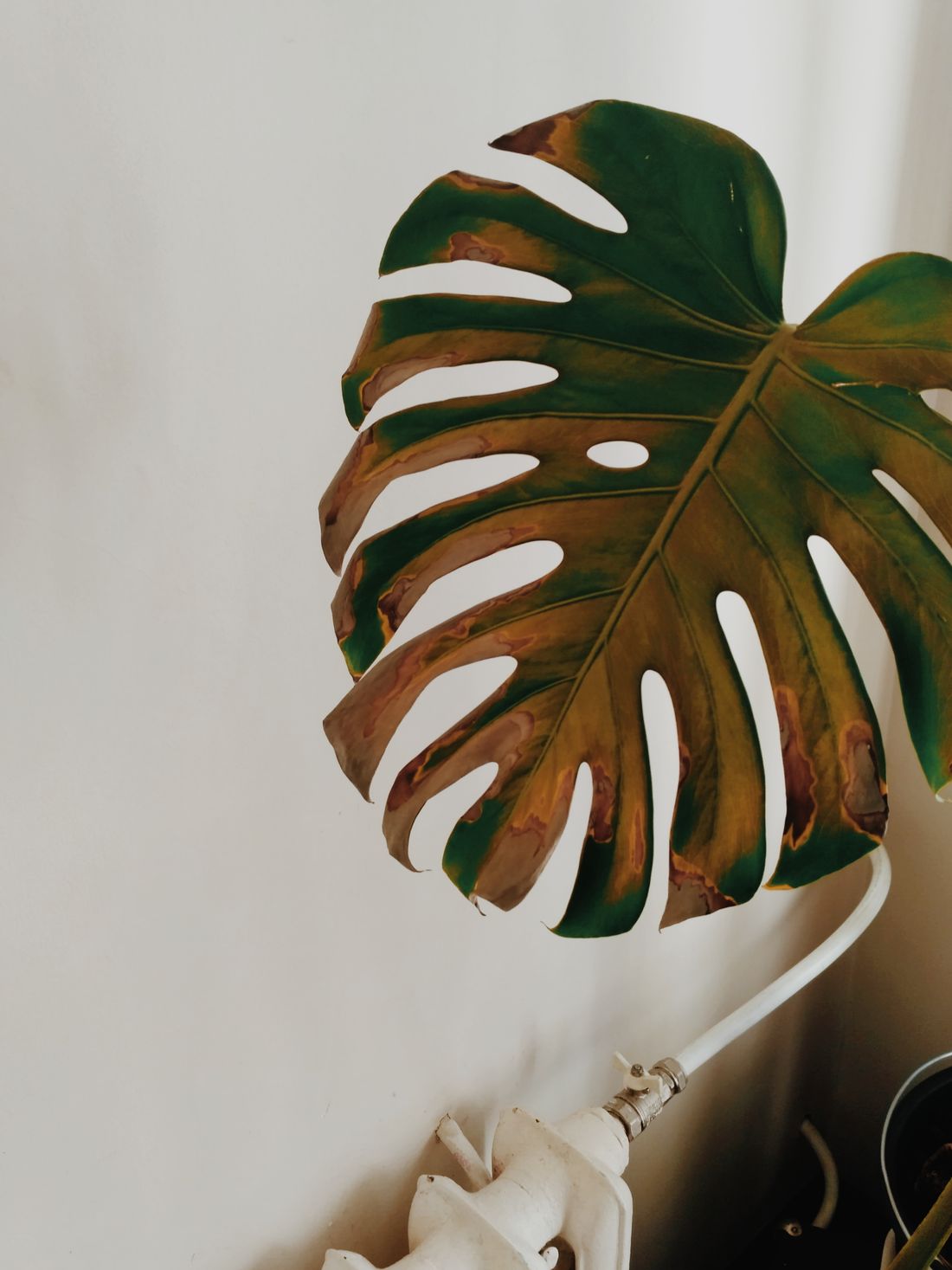
For the six that fell off the list, the cost is not cosmetic. Take the peace lily from the card above, on a sill where the light is already right, and change nothing but the air: it is a great fit at 50% and at 40%, and only worth a try at 30% and at 25%.
From 50% down to 30%, that spot falls from a great fit to only worth a try with the light never moving. Winter makes this worse in an ordinary way: heating dries a room to almost exactly the level where the peace lily stops being a great fit, which is why this page and the radiator page keep describing the same January. A vented dryer does the same thing to a much smaller room on a much shorter timescale, which is why a laundry room is often drier than the rest of the house rather than damper.
The published answer to “how much does a houseplant need” is not one number either. Four extension services give it, and the band runs from 40% to 80% depending on who you ask — while two of them say plainly that the thing everyone does about it does not work.
| Published by | What it says plants need | On misting and trays |
|---|---|---|
| yardandgarden.extension.iastate.edu | 40 to 50 percent | “Many houseplants prefer a relative humidity of 40 to 50 percent.” |
| extension.unh.edu | 40–60% | “Most houseplants (excluding cacti, succulents and a few others) prefer a relative humidity range of 40-60%”, while “tropical species thrive at higher ranges of 70-80%”. |
| lancaster.unl.edu | 70–80% | “For plants, humidity requirements vary by species, but generally 70-80% is best.” The same page puts the human range at 30–50%. |
| extension.psu.edu | Above what a heated home gives | “most indoor plants benefit from a humidity level higher than what is typical for a home heated in winter”, where “indoor relative humidity levels can easily fall below 30%”. |
| yardandgarden.extension.iastate.edu | Misting: no | “Misting houseplants is not an effective way to raise the relative humidity. Plant foliage dries quickly after misting.” And: “Misting would have to be done several times a day to be effective.” |
| lancaster.unl.edu | Misting: no | “Misting plants is not an effective solution. You would need to mist plants on a very frequent basis, every few minutes, to make any real difference in overall air humidity levels.” |
| yardandgarden.extension.iastate.edu | Grouping: yes | “Grouping plants together is an easy way to raise the humidity level. The water evaporating from the potting soil, plus water lost through the plant foliage, will increase the relative humidity.” |
| extension.unh.edu | Trays: a little | A pebble tray “can provide a small benefit for humidity”, with the effect “maximized when used with multiple plants and in rooms with low air circulation”. |
The other half of the search
The living-humidifier lists answer a different question, and we are not scoring it: our data holds what each plant asks of the air, not how much moisture it returns to a room. If the air itself is the problem, a machine fixes it and a plant decorates it.
One boundary before you rearrange anything: we estimate indoor humidity rather than measure it, working it out from local weather adjusted for being indoors. A hygrometer will beat us at reading your room. What it cannot do is what this page just did: tell you which plants a dry reading rules out, and which it doesn’t touch. To ask about the exact spot you have in mind, describe it to the free spot checker (window, distance, the plant) and it scores that spot for that plant, in the browser, nothing to install.
By GrowSpot · Published August 15, 2026 · Last updated August 30, 2026
