The honest answer to this question is that it depends, and every page on the first results screen says so before handing you a range of days anyway. Seven to fourteen days for most houseplants. Two to three weeks for succulents. Less in winter.
The extension services do not publish a number of days at all. What they publish instead is a test, and they do not agree on how deep to push your finger.
| Published by | What it says to do instead of counting days | How deep to check |
|---|---|---|
| extension.umd.edu | Two inches | “Test the soil with your finger to a depth of about two inches.” And on schedules: “Plants should not be watered on a schedule, but rather should be watered when they need it.” |
| extension.uconn.edu | About an inch | “Stick your finger into the potting mix and feel for moisture about an inch below the surface.” And: “Instead of watering plants by the calendar, check them frequently to evaluate their moisture needs.” |
| hgic.clemson.edu | To the first joint | “Stick your finger into the mix up to the first joint; if it is dry at your fingertip it needs water.” Its whole rule: “The rule-of-thumb is to water when necessary.” |
| extension.umd.edu | Weigh the pot | A second test on the same page: “Lift the plant, pot and all, to check its weight change. The plant with dry potting medium will weigh much less than the plant which still has ample water.” |
| hgic.clemson.edu | Knock on the pot | A third: “Rap the side of the pot with the knuckles or a stick. If the sound is dull, the soil is moist; if the sound is hollow, water is needed.” |
| hgic.clemson.edu | 62 to 72 °F | The one number any of them does give: “Do not water with hot or cold water. The water temperature should be between 62 and 72 °F.” |
| extension.uconn.edu | Until it runs out | “Apply enough water so that after about a minute, excess water will be observed seeping out of the drainage holes.” And: “Light watering encourages poor root growth.” |
Those ranges are averages of other people's homes. What is worth having is the size of each thing that pushes your plant away from the average.

Worth a try
It can work here with a little care.
A little dim, but workable
Comfortable temperature
Humidity suits it
Airflow isn't quite ideal
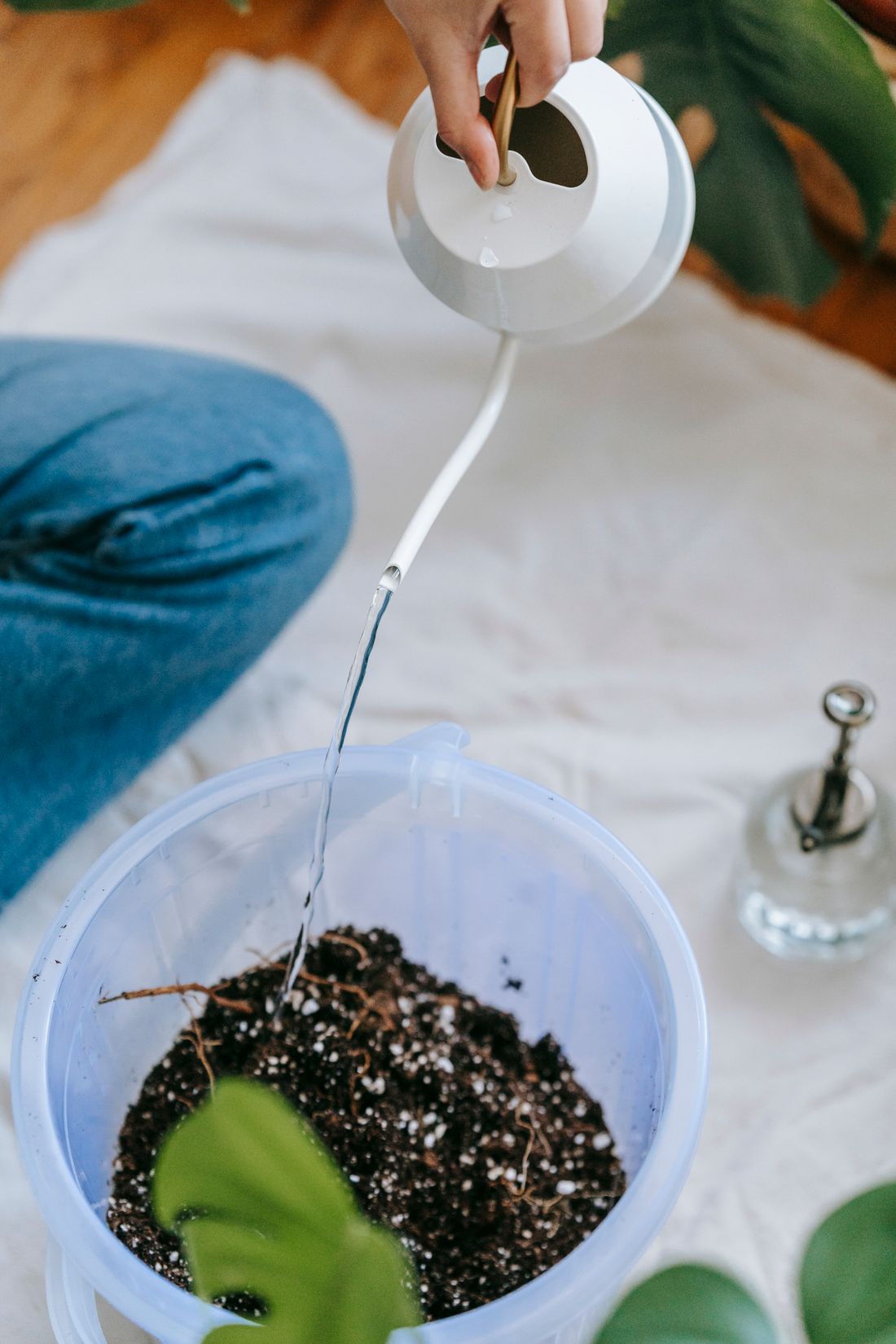
What actually moves the number
GrowSpot works out watering as an account rather than a schedule: the pot fills when you water, evaporation spends it down, and the next check lands when the account runs low. Three factors scale the spending rate, and because they multiply, their ranges are worth reading together:
| What moves the drying rate | How far it can move it | Why it is bounded |
|---|---|---|
| The season, through evaporation demand | ×0.5 to ×2.5 | Clamped at both ends, so one freak week cannot run away with it |
| What the pot is made of | ×0.9 to ×1.15 | Terracotta breathes; a cachepot around the nursery pot slows it down |
| What the mix is made of | ×1 to ×1.25 | A gritty cactus mix gives the water less to hold on to |
| All three at once | ×0.45 to ×3.59 | A spread of 8 times between the two extremes |
The season is the big one, and it is bounded on purpose. Evaporation demand is worked out from temperature, humidity, wind and cloud using the standard reference-crop method agronomists use for irrigation, then clamped so that a single freak week cannot double a plant's schedule on its own.
Read the bottom row as the practical claim of this page: the same plant, in the same room, can sit at either end of an eight-fold spread. If your plant is not on a seven-day cycle, that is the first thing to suspect. A plant just home from a shop starts at the slow end of that spread.
Two things the advice leans on that our maths does not
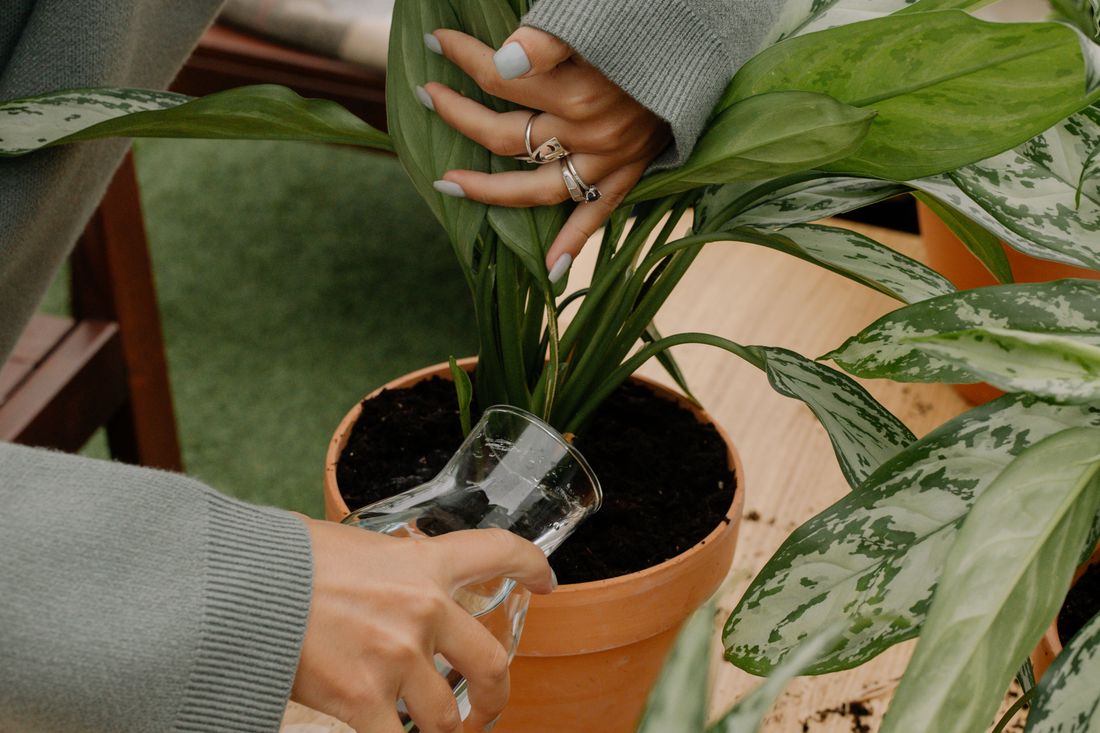
Two variables appear near the top of every answer to this question. One of them cancels out in the arithmetic, and the other one we deliberately do not use:
| What most watering advice leans on | What GrowSpot does with it | Why |
|---|---|---|
| How bright the spot is | Not used at all | The evaporation maths runs on temperature, humidity, wind and cloud. There is no light term in it. |
| How wide the pot is | Cancels out of the interval | A 12 cm pot and a 30 cm pot come out at the same number of days: a bigger pot holds more water and spends proportionally more of it. |
| Rain, for a plant indoors or on a covered balcony | Not counted | Rain only pays into the account for plants standing in the open. |
| Rain, for a plant standing outside | Counted, by pot opening | What lands in the pot mouth is subtracted from what it owes. |
Pot width is the interesting one, because the popular version is not exactly wrong, it is answering a different question. A bigger pot does hold more water, so it takes a larger drink. It also holds a bigger plant with more leaf area spending that water. Both sides scale together, so the volume goes up and the interval stays put.
The light one is a limitation rather than a finding. Brighter spots really do dry faster in the real world, and our watering model does not know that: it reads the weather and the container, not the sill. We would rather print that here than let you assume a number carries more than it does. The light check is a separate reading, and it is the one that decides whether the plant grows at all.
What the model treats your room as
An indoor plant is not standing in the weather, so feeding it the outdoor forecast would overstate its thirst every summer afternoon. Before the maths runs, the outdoor day is converted into a room, and the conversion is severe: a 34 °C day with a 26 °C night becomes a room running 26.7 to 24.3, and a 4 °C day with a −3 °C night becomes 11.8 to 9.7. Whatever the sky does, the swing the model gives the plant is about two to three degrees.
None of that is a measurement of your home; it is a standing assumption. What it prevents is the failure mode where a cold snap outside quietly stretches an indoor plant's schedule for a week.
Using this on your own plant
Check the pot, not the calendar: the interval is a different number in January and in July. If you have just moved a plant into terracotta, or repotted it into a grittier mix, expect it to want water sooner without anything being wrong. That same signal is the one people read as a root problem, which is why the repotting page spends a section pulling it apart.
If the plant is struggling rather than merely thirsty, water is usually downstream of something else. In winter it is almost always the light dropping while the watering stays the same, and the fastest way to separate the two is to read the spot with the free spot checker, no download.
The multipliers above are read out of our watering model rather than from a trial, and the model is calibrated against our own plants and their watering history. Reference evaporation follows the standard FAO-56 method. We do not publish a base number of days for individual species, because those values were machine-filled rather than curated.
By GrowSpot · Published August 15, 2026 · Last updated August 30, 2026
