Stop in October, start again in March. That is the answer at the top of the results, and it is repeated by nurseries, forums and the summary above them all. It is good advice in the place it was written for.
It is also close to unanimous. Four extension services give the same window, whether they name a month or just a season, and every one of them gives it in northern-hemisphere names.
| Published by | When it says to stop | When it says to start |
|---|---|---|
| extension.unh.edu | October | “This means putting away the fertilizer from October until the spring.” It starts again at “March is a good time to start fertilizing”. |
| homegarden.cahnr.uconn.edu | October | “Houseplants respond to fertilizer during periods of active growth. This is usually from March until October.” |
| extension.umd.edu | September | “Fertilize from March through September”, and “During the winter months, indoor plants don’t need fertilizer because reduced light and temperature result in reduced growth.” |
| yardandgarden.extension.iastate.edu | No month given | “Fertilization is generally not necessary during the winter months as most houseplants are not growing during this time”, and feeding runs “in spring and summer when plants are actively growing”. |
| extension.unh.edu | Every 1–3 months | On frequency: “most houseplants will benefit from an application once every 1 – 3 months depending on which formulation is being used.” |
| homegarden.cahnr.uconn.edu | Monthly | On the same question: “The labels on most water-soluble fertilizers recommend monthly applications.” |
GrowSpot cannot use it, because it has readers in both hemispheres and at every latitude, so the feeding decision had to be made out of things that can be measured anywhere. It ended up as two tests, and the plant has to pass both.

Worth a try
It can work here with a little care.
A little dim, but workable
Comfortable temperature
Humidity suits it
Airflow isn't quite ideal
The month is really a latitude
The first test is light, and the calendar-free version of it is day length: above eleven hours of daylight, the season is treated as one a plant can grow in. Day length is astronomy, so it can be worked out for anywhere from a date and a latitude, with no weather involved:
Read the Manila line against the advice we started with. Near the equator the daylight test is never failed, so "stop feeding in October" is not a mild simplification there, it is the wrong answer for every month of the year. Sydney fails it in the middle of the year rather than at the end, and the two northern lines are the only ones behaving the way the advice assumes.
Indoors, the same room has two answers
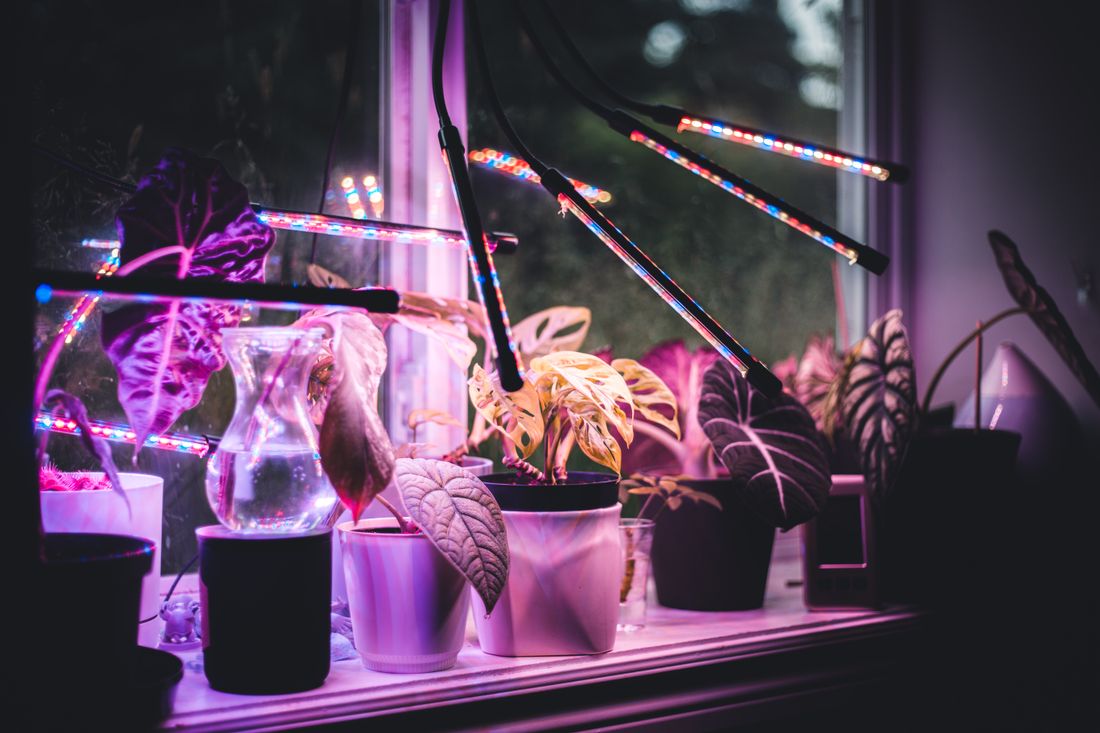
Day length is not the only way to pass the light test. A reading above 1,200 lux at the spot itself passes it too, which is how a plant under a grow light stays in growth through the winter. It is also how an ordinary bright windowsill does, because that bar is lower than people expect. Feeding is the only one of the four care checks that reads light, and the watering interval does not move with it. Hold the window and move only the distance:
That 1,200 is a threshold we score against rather than a reading we took, and it is a lower bar than it sounds: in the 204 readings behind our tiers, the indoor median sits at 2,349 lux.
The bar falls between two and a half and three metres in from a north window. That is the useful sentence on this page: on the same December day, in the same room, a plant on the sill is still growing by this test and the one by the back wall is not, and no calendar can tell them apart. Our page on how far from a window plants can live works that fall-off through in detail.
The whole test, including the part that outranks it
The second test is warmth: the average temperature has to sit above the minimum for that type of plant. And an active heat or cold alert overrides both, pausing feeding whatever the season and the sill say. Run the check itself and the shape comes out like this. A warm room with fourteen hours of daylight feeds. The same room with nine hours and 300 lux at the spot does not, and the same nine-hour day with 5,000 lux at the spot does. Twelve degrees stops it whatever the light is doing. A heat or cold alert stops it whatever everything else is doing.
The case worth pausing on is the one with no light reading taken at all. The plant is then treated as resting rather than growing, because the app will not assume a bar has been cleared on your behalf. That is the same reasoning behind the honest verdicts elsewhere on this site: an unread spot is unknown, not fine.
What to do with your own plants
Stop feeding when the plant stops growing, and take the two measurable halves seriously: is it warm enough, and is there enough light where the plant stands. If you have a bright sill and a heated room, some of your plants may not need a winter break at all, and the ones two metres behind them will. A plant that summers outdoors clears the light half wherever it stands.
Take a reading at the spot first, with the free spot checker if you would rather not install anything. If the plant is already unhappy, feeding is rarely the fix and four things change at once in winter. If you were also planning to move it into a bigger pot, that has a season and three other conditions of its own.
The thresholds here are read out of the growth check itself, and the light figures are estimates for an indoor position on a clear day, not meter readings from a real room. The minimum temperature is held per plant type, and we do not publish those figures, because they are working defaults rather than calibrated ones. Day length is exact and identical every year.
By GrowSpot · Published August 15, 2026 · Last updated August 30, 2026
