Kitchens have real advantages for plants (often a window, humidity from cooking, steady warmth) and one habit that undoes them: plants get put where there’s counter space, not where there’s light. A pot shoved into the dim corner by the kettle is in the same trouble as a plant anywhere else far from a window.

Worth a try
It can work here with a little care.
Just the right amount of light
A little warm, but workable
A little dry, but workable
Airflow suits it
Put it where the light is
Sort your kitchen by its window the way you would any room. The sunny sill is prime; the counter a step away is bright indirect; the far corner by the pantry is dim. A kitchen with no window at all reads the same as any windowless room: a lamp question, not a plant question. And herbs, the thing everyone wants on the counter, need serious sun rather than a shady shelf.
How short a kitchen sill is for basil
The kitchen herb garden is what most people want from a kitchen window, so it is worth scoring rather than asserting. We put sweet basil on every sill a kitchen could have, from a north-facing one to a south-facing one.
Not one of them is a good fit, and you can read the same plant as the last column of the three-herb table further down. The brightest sill in the house, south-facing at 13,000 lux, gets basil to a qualified yes, and the north sill is nowhere near. Basil turns a great fit at 15,000 lux, so the gap is not enormous: it is about another sixth on top of the best sill a kitchen can offer. A balcony rail, in our own paired readings, ran 19,000 to 21,000 lux against 6,000 just inside the window beside it. Outdoors clears the bar without trying; the glass is what stands between.
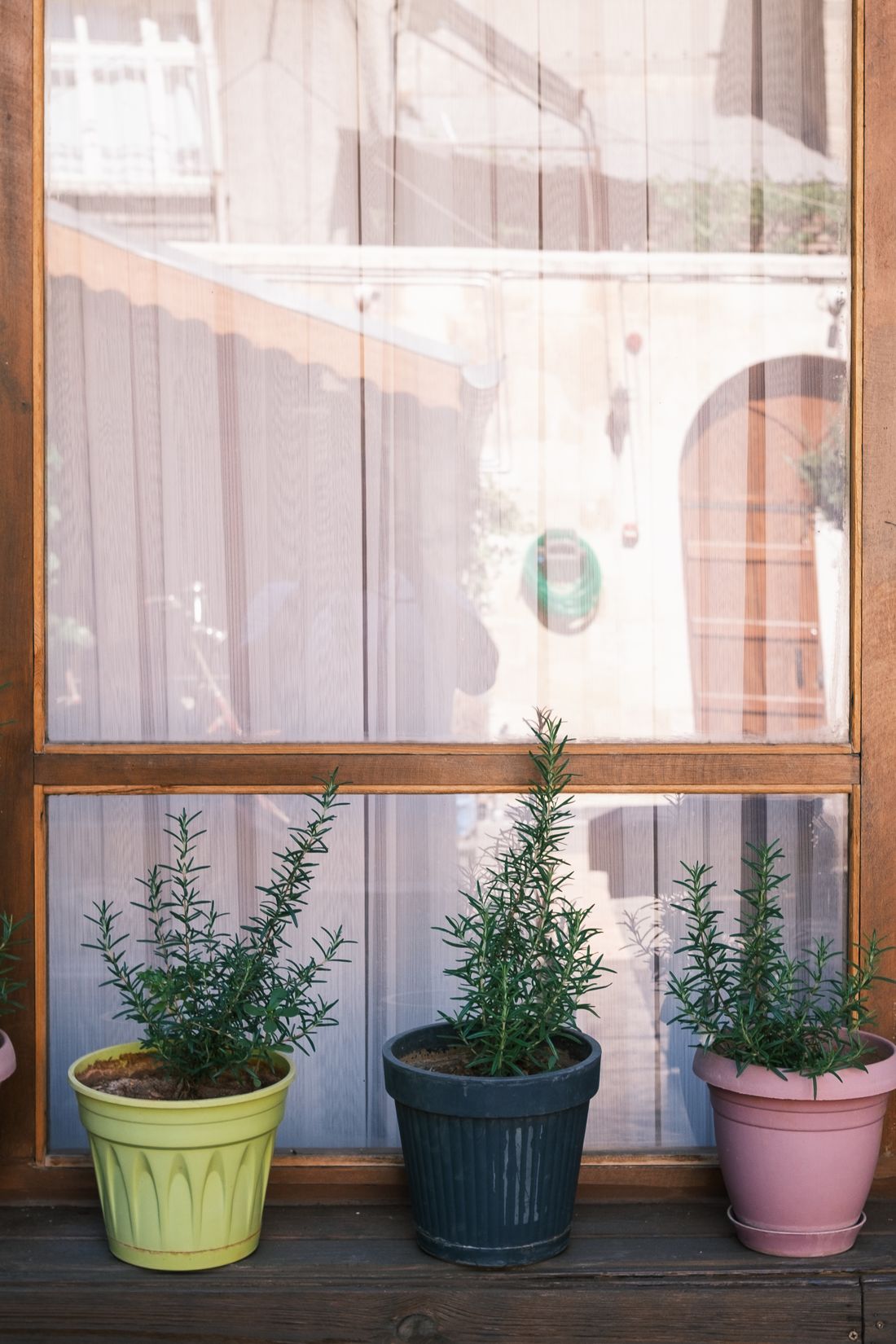
Asked the same question, the published answers mostly count hours of direct sun rather than name a window. Here they are as written: six hours or more is the common answer, with one source singling out a short list of herbs that tolerate less, and one that gives no number at all.
| Published by | What it asks for | As written |
|---|---|---|
| yardandgarden.extension.iastate.edu | About 8 hours | “Most herbs need around eight hours of direct light each day when grown indoors.” |
| yardandgarden.extension.iastate.edu | 6 hours at the low end | “Some herbs will tolerate as little as six hours of direct light a day but most want eight or more hours each day.” |
| yardandgarden.extension.iastate.edu | South, or bright east or west | “A south-facing sunny window is a great candidate, but a bright east or west-facing window can be good as well.” |
| extension.psu.edu | 6 hours | “Most herbs need 6 hours of direct sunlight.” |
| extension.psu.edu | 2 to 6 hours | The exceptions it names: “These herbs can tolerate low light levels and only need 2 to 6 hours of direct sunlight: Lemon balm, Chives, Cilantro”. |
| extension.psu.edu | Off the sill below 50 °F | “basil cannot survive temperatures lower than 50°F and should not be kept on windowsills during winter months”. |
| uvm.edu | 6 to 8 hours | “Do you have a window that receives direct sun for six to eight hours a day?” |
| extension.illinois.edu | At least 6 hours | “Most herbs will need at least six hours of direct sunlight every day.” |
| extension.illinois.edu | No number given | “High levels of light are necessary to ensure the plants do not get leggy and spindly.” |
Every lux figure on this page is estimated from a direction and a distance rather than measured in a kitchen. The measurements we do publish are a separate pile: 159 readings at 137 real spots, balconies among them.
The warmth and the steam are worth nothing here
The other half of that reading is what did not happen. Scored at 24 °C and 55% humidity, a warm steamy kitchen rather than a dry living room, and again at 21 °C and 45%, basil on those sills moves by a point at most and no verdict changes. The kitchen’s two genuine advantages are real, and for this plant they are worth zero points, because light is the thing that is short.
The aisle splits in two, and the window is not what splits it
Basil is not the whole herb rack, so we took three herbs off it and walked each across every sill a kitchen can have. Each is held at its own preferred warmth, humidity and airflow, so the only thing changing between the columns is the plant and the only thing changing down the rows is the light.
| The sill it is standing on | Estimated light | Peppermint | Parsley | Basil |
|---|---|---|---|---|
| North sill | 3,640 lux | Great fit (100) | Worth a try (65) | Not the best fit right now (46) |
| East sill | 6,500 lux | Great fit (100) | Great fit (98) | Worth a try (63) |
| West sill | 7,800 lux | Great fit (100) | Great fit (99) | Worth a try (64) |
| South sill | 13,000 lux | Worth a try (66) | Great fit (100) | Worth a try (68) |
Read across first. East and west give the same answer for all three, so the east-window question and the west-window one are a single question. South is the only row that reorders anything, and it does that by taking the mint down rather than lifting anybody up.
Then read down, which is where the useful shape is. The mint is at its best on the dimmest sill in the kitchen and gives ground on the brightest. The parsley wants one step more light than the mint and then holds everywhere it can get it. The basil never arrives at all, and the brightest sill in the house still leaves it short.
Notice what that does to the north sill. It is the best spot here for one of these plants and the worst for another, and the two sat side by side in the shop under one label. Sorting the rack by the window sorts on the wrong thing.
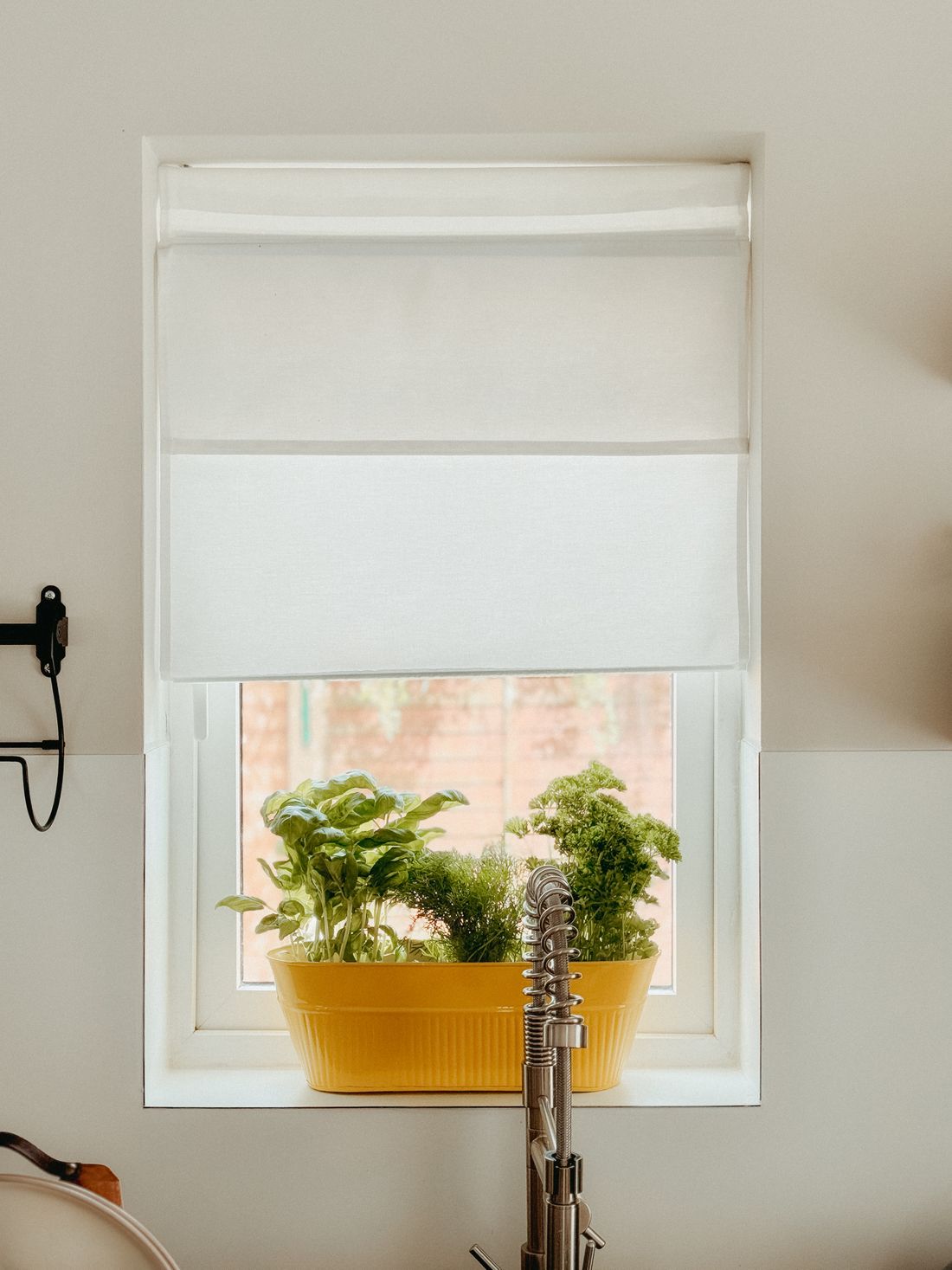
Basil is also not a special case. Five more of the same kind — thyme, rosemary, oregano, sage and dill — put on the south sill in that same warm steamy kitchen come back with basil’s own answer: all six worth a try, and not one of them better than that.
Six names, one verdict. That is not a coincidence repeated five times, it is a single light requirement that a kitchen window cannot meet, and the plants wearing it are most of the aromatic half of the rack.
So the shopping rule is short. If the herb is grown for a woody aromatic leaf, it is a full-sun plant and a kitchen window is not going to satisfy it: buy it anyway if you want it, keep it on the brightest sill you own, and expect it leggier than the supermarket pot it arrived in. If you want a herb that simply works next to the glass, buy the parsley, or one of the ones our care data files at the same light requirement: chives, coriander, lemon balm. And if your best sill faces north, buy the mint.
The corner by the oven is two different problems
The advice everyone gives about the appliance end of a kitchen is that the heat and the dry air are rough on a plant. We have taken that apart once already, on a radiator sill, and the answer there was that the heat was a bystander and the dryness did all the damage. A kitchen is the obvious place to check whether that carries over, because an oven is a radiator that also cooks. The same argument transfers to a laundry room, where the appliance is a dryer and the room around it is smaller.
So here is one counter beside a working oven: a metre in from an east window, the air at 28 °C, dried to 30%. Same spot for every plant, so anything that differs is the plant.
| The plant on the counter | What the warmth is doing | Verdict |
|---|---|---|
| Snake plant | Comfortable temperature | Great fit, 92/100 |
| ZZ plant | Comfortable temperature | Great fit, 91/100 |
| Peace lily | Comfortable temperature | Worth a try, 62/100 |
| Peperomia | A little warm, but workable | Worth a try, 62/100 |
| Spider plant | A little warm, but workable | Worth a try, 61/100 |
It does not carry over cleanly, and the way it fails to is the useful part. Two of the five never notice the appliance at all. Three land in the same band, and the middle column shows they did not get there the same way. The spider plant and the peperomia are marked warm: the heat is what took their points. The peace lily is marked comfortable at that same 28 °C and still only reaches 62, so something other than the warmth cost it, and on the radiator sill we isolated that plant against the dryness alone and watched it go out at 30% humidity, which is what this counter is holding.
One spot, five plants, and the cause changes underneath you. That is why “keep plants away from the oven” cannot be made into a rule that works: the rule has to name which plant it is talking about, and at that point it is no longer a rule.
Where the warmth actually starts to bite
Take the plant that lost on temperature and move only that, with the humidity back at an ordinary 45%, walking it from 21 °C up to 32.
Nothing at all happens through the range a kitchen normally lives in. The spider plant is still a great fit at 26 °C, as at 21, and the step down arrives at 27, which is not a warm kitchen. It is the strip of counter beside an oven that has been on for an hour. One degree is the entire distance between a fine spot and a demoted one, and one degree is a difference you cannot see, smell or feel with your hand.
Which is the argument for reading the spot rather than reasoning about the room. We can tell you the line sits between 26 and 27 °C for this plant; we cannot tell you how far along your counter you have to go to get under it, because that depends on your oven, your hood and how long dinner takes. That part has to be measured where the pot stands.
What genuinely works
Sunny kitchen windowsill
- Parsley, and the herbs our care data files beside it: chives, coriander, lemon balm
- Basil, thyme, rosemary and the other sun-herbs, with the tables above as the expectation: this is the best they get indoors, not a good fit
- Succulents
- A small citrus, if the sill is bright enough
Bright counter near the window
 Pothos
 Spider plant
 Peperomia
- Herbs still prefer the sill
What won’t work here (honestly)
- A herb garden on a dim counter. Basil in a shady kitchen goes pale and leggy within weeks. It’s the classic supermarket-basil death. Herbs need a genuinely sunny sill or a grow light.
- Assuming the appliance corner is one problem. Which half of that spot does the damage depends on the plant, as the table above shows: a peace lily against the oven end is held back more by the east light, which is a little bright for it, than by the dry air, a spider plant loses on the warmth, and a snake plant notices neither.
- Assuming steam makes up for the window. Rescored as a warm steamy kitchen and again as an ordinary dry living room, basil does not move at all. The kitchen’s two advantages are real conditions, and for a plant that is short on light they are worth nothing.
Check the counter, not the kitchen
A kitchen holds a bright sill, a workable counter and an appliance corner within about three metres of each other, and the two scored tables above answer for the sill and the oven-side counter separately because they genuinely are separate places. If you want it answered for your own counter rather than in general, the free spot checker estimates it from your window direction and distance, in your browser, and reads the warmth and the dry air at that place along with the light.
Every lux figure above is an estimate for an indoor position on a clear day, and every verdict comes from our own scoring, with the temperature, humidity and airflow declared in each caption rather than measured in your kitchen. The balcony pair is our own reading; the oven-side 28 °C at 30% is a figure we set and scored rather than one we logged beside a working hob. Care facts stated rather than scored are standard horticultural consensus.
By GrowSpot · Published July 23, 2026 · Last updated October 19, 2026
