On an east sill a Boston fern scores 91 out of 100, a great fit, with the air at 22 °C, 50% humidity and gentle movement. Its light there reads just right, and dated for latitude 40 it does on every day of the year. The nine points it’s missing belong to the air, which our scores still call a little dry at 50%.
Read on 28 November 2026, Google’s answer box rates an east window ideal for a Boston fern, its morning sun gentle enough not to scorch, and cites Gardener’s Supply. It puts the pot near the glass or a couple of feet back, and says to step back or hang a sheer if the tips yellow. Against brown, crispy fronds it asks for 50% humidity or more. Nothing on the first page gives a light level.
Our numbers put the weight elsewhere. The light here never reads bright for a fern, so stepping back buys nothing. Its 50% sits a few points above where the score falls off a cliff. And warmth, which the box never mentions, costs as much as dry air.

Great fit
This plant should be happy in this spot.
Just the right amount of light
Comfortable temperature
A little dry, but workable
Airflow suits it
Can an east window be too bright for a Boston fern?
No, and of the institutions that describe its light, one names this window outright:
| Who publishes it | What it says a Boston fern needs | When |
|---|---|---|
| plants.ces.ncsu.edu | Plant in bright, indirect light and warmth (60 to 70 degrees Fahrenheit). | As a houseplant |
| plants.ces.ncsu.edu | Dappled Sunlight (Shade through upper canopy all day) | One of its two light ratings |
| plants.ces.ncsu.edu | Deep shade (Less than 2 hours to no direct sunlight) | Its other light rating |
| hort.extension.wisc.edu | Boston fern is easily grown as a houseplant in medium bright light. | As a houseplant |
| hort.extension.wisc.edu | Indoors, position the plant in medium bright light, such as in an east facing window or behind a sheer curtain in south and west windows (or far enough from the window so the plant is not in direct sunlight). | Indoors, by window |
| hort.extension.wisc.edu | If growing outdoors, provide full or partial shade. | Outdoors |
| plantfinder.mobot.org | Site in bright indirect light with no direct sun. | As a houseplant |
| plantfinder.mobot.org | Tolerant of some shade. | As a houseplant |
| plantfinder.mobot.org | Part shade | Its sun rating |
That one is Wisconsin–Madison’s Extension, and our scores side with it. Dated for latitude 40, the sill’s light never leaves the fern’s band, from the short days around the December solstice to the stretch from 22 April to 20 August when the morning beam is at its strongest. The Missouri Botanical Garden would keep the fern out of direct sun altogether; on our scores that beam still sits inside the fern’s light. The light behind those verdicts is our model’s, worked out from the compass, the distance and the date for a cloudless sky; nobody laid a meter on that sill.
Moving back keeps it a great fit to 2.95 m on a clear day, so the box’s step back costs the fern nothing and gains it nothing on light. A Fascinator prayer plant shares the fern’s light and humidity bands in our care data, and its east-window page walks this window back a metre at a time. The fern’s light page has the band in lux and dates the deeper spots through winter.
How much humidity does a Boston fern need?
A great fit needs 48% or more, and the air only reads right from 60%. Here is the same sill with only the humidity changing:
| Humidity at the sill | What the air is doing | Verdict |
|---|---|---|
| 30% | Too dry here | Worth a try, 64/100 |
| 44% | Too dry here | Worth a try, 66/100 |
| 45% | A little dry, but workable | Good fit, 88/100 |
| 50% | A little dry, but workable | Great fit, 91/100 |
| 55% | A little dry, but workable | Great fit, 95/100 |
| 60% | Humidity suits it | Great fit, 99/100 |
| 64% | Humidity suits it | Great fit, 100/100 |
The drop is a cliff. At 45% the fern is a good fit at 88; at 44% its air reads too dry and the score falls to 66. Below that it hardly moves, 64 at 30%, so once the air is past the edge, drier costs little more. Above the edge the score keeps climbing: 91 at the box’s 50%, then 99 at 60%, where the air reads right, and 100 at 64%.
Those rows are inputs we set, not readings, and a cheap hygrometer will tell you which one your room is in. If it reads below 45%, the extension services on our dry-air page are blunt about the usual fixes: two say misting doesn’t raise humidity, and Iowa State says grouping plants does.
Does a warm room bother a Boston fern?
Sooner than it bothers most plants that want humid air. Here is the same sill at 50% humidity, read across room temperatures:
| Air temperature at the sill | What the warmth is doing | Verdict |
|---|---|---|
| 15 °C | Too cold here | Not the best fit right now, 42/100 |
| 17 °C | A little cool, but workable | Worth a try, 63/100 |
| 18 °C | Comfortable temperature | Great fit, 90/100 |
| 22 °C | Comfortable temperature | Great fit, 91/100 |
| 24 °C | Comfortable temperature | Great fit, 90/100 |
| 25 °C | A little warm, but workable | Worth a try, 64/100 |
| 28 °C | Too hot here | Not the best fit right now, 43/100 |
The fern is a great fit from 18 to 24 °C, about 64 to 75 °F. One degree past either end costs it more than 25 points: 63 at 17 °C and 64 at 25 °C. By 28 °C it’s down to 43. Here it parts from the Fascinator prayer plant, which shares its light and humidity bands and holds a great fit through 27 °C; most plants in our care data that want air this humid stay comfortable to 27 °C or warmer.
NC State’s 60 to 70 °F leans cooler: 70 °F, about 21 °C, sits mid-band, while 60 °F, about 16 °C, reads a little cool on our scores. Humidity can’t buy back a warm room either. At 25 °C the most humid air we tried still left the fern worth a try, which makes a radiator under the sill a double cost: it warms the air and dries it at once. Moving air counts too: a window or vent that stirs the air for most of the day drops the sill to a good fit.
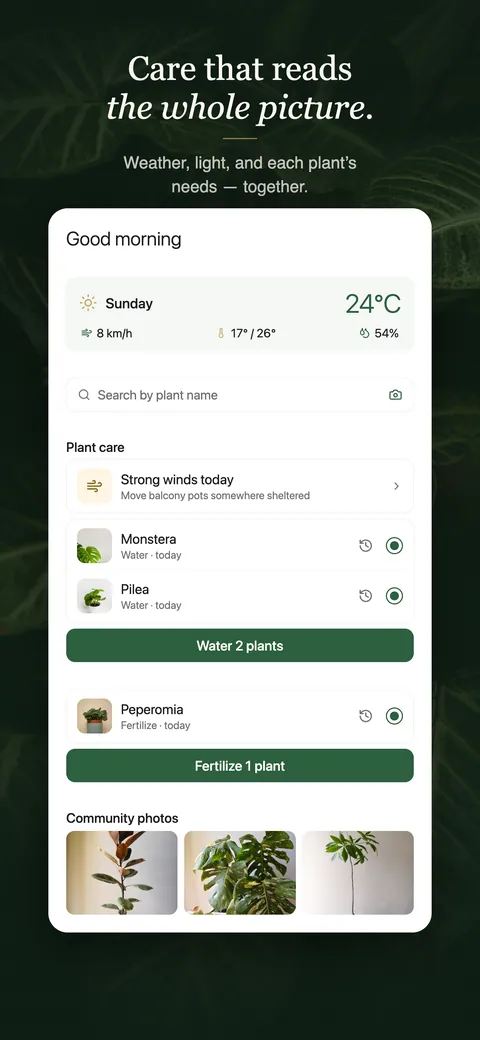
How do you read your own east sill?
Put a thermometer and a cheap hygrometer on the sill for a day before you move the pot for its light. Everything above holds one number still at a time on an open east window north of the equator; your sill moves both at once. At a north window the same fern runs out of light far closer to the glass, and in midwinter it has only about half a metre to work with. The east window guide sorts what else grows facing east, and the free spot checker will score the sill you actually have, using the weather outside it today.
Published November 28, 2026
