Right against north glass a Boston fern scores 91 out of 100, with the room at 22 °C, 50% humidity and the barely moving air it likes. The light there, about 3,640 lux on a clear day, reads just right, and it keeps reading that way to 1.70 m back. Whether that distance counts for anything is up to the air.
Read on 28 November 2026, the answer box at the top of Google’s results calls a north window ideal for a Boston fern and cites BabaBerry for that. It wants the pot on the sill or right next to it, since several metres back slows growth and droops the fronds, and asks for 50% humidity or more. No result on the first page puts a number on the light.
Our scores put numbers on both halves. “Next to it” stretches to 1.70 m, about five and a half feet, so several metres is well past the line. And the 50% matters more than the box lets on, because in dry air the line stops mattering: at 40% the sill is worth barely more than a spot three metres back.

Great fit
This plant should be happy in this spot.
Just the right amount of light
Comfortable temperature
A little dry, but workable
Airflow suits it
Is a north window bright enough for a Boston fern?
At the glass it is. The published advice is less help on this window; here is how the institutions put the fern’s light, word for word:
| Who publishes it | What it says a Boston fern needs | When |
|---|---|---|
| plants.ces.ncsu.edu | Plant in bright, indirect light and warmth (60 to 70 degrees Fahrenheit). | As a houseplant |
| plants.ces.ncsu.edu | Dappled Sunlight (Shade through upper canopy all day) | One of its two light ratings |
| plants.ces.ncsu.edu | Deep shade (Less than 2 hours to no direct sunlight) | Its other light rating |
| hort.extension.wisc.edu | Boston fern is easily grown as a houseplant in medium bright light. | As a houseplant |
| hort.extension.wisc.edu | Indoors, position the plant in medium bright light, such as in an east facing window or behind a sheer curtain in south and west windows (or far enough from the window so the plant is not in direct sunlight). | Indoors, by window |
| hort.extension.wisc.edu | If growing outdoors, provide full or partial shade. | Outdoors |
| plantfinder.mobot.org | Site in bright indirect light with no direct sun. | As a houseplant |
| plantfinder.mobot.org | Tolerant of some shade. | As a houseplant |
| plantfinder.mobot.org | Part shade | Its sun rating |
None of those statements names a north window. Wisconsin–Madison’s Extension sends the fern to an east one, or behind a sheer at south and west glass. The Missouri Botanical Garden asks for no direct sun, and no direct sun is what a north window gives. It took the answer box to call north ideal, and at the sill our scores back it: at latitude 40 the light there stays inside the fern’s band through every month, December included. Its light page stands that sill beside the other three windows.
How far from a north window can a Boston fern sit?
On a clear day, 1.70 m. Here it is walked back from the glass in the card’s room, at 50% humidity:
| Distance from the glass | Estimated light | What the light is doing | What the air is doing | Verdict at 50% humidity |
|---|---|---|---|---|
| 0.3 m, against the glass | 3,640 lux | Just the right amount of light | A little dry, but workable | Great fit, 91/100 |
| 1 m back | 2,800 lux | Just the right amount of light | A little dry, but workable | Great fit, 91/100 |
| 1.7 m back | 2,026 lux | Just the right amount of light | A little dry, but workable | Great fit, 90/100 |
| 1.75 m back | 1,980 lux | A little dim, but workable | A little dry, but workable | Worth a try, 66/100 |
| 3 m back | 1,111 lux | A little dim, but workable | A little dry, but workable | Worth a try, 62/100 |
| 4.35 m back | 595 lux | Too dim here | A little dry, but workable | Not the best fit right now, 43/100 |
Across the first 1.70 m the score barely moves, 91 down to 90. At 1.75 m the light dims a step and the fern drops to 66; from 4.35 m it reads too dim. A pilea and a Fascinator prayer plant share this light floor in our care data, so the line falls in the same place for them, and the pilea’s north-window page follows it through the year: on 21 December it comes in to 55 cm from the glass.
The lux column is a model’s estimate for a cloudless day, worked out from the compass direction and the distance; nobody metered these spots.
Does the sill still help when the air is dry?
Barely. Below 45% the fern’s air reads too dry, and Penn State Extension, quoted on our humidity page, says a heated home can easily fall below 30%. Here is the same walk with the air held at 40%:
| Distance from the glass | Estimated light | What the light is doing | What the air is doing | Verdict at 40% humidity |
|---|---|---|---|---|
| 0.3 m, against the glass | 3,640 lux | Just the right amount of light | Too dry here | Worth a try, 65/100 |
| 1 m back | 2,800 lux | Just the right amount of light | Too dry here | Worth a try, 65/100 |
| 1.7 m back | 2,026 lux | Just the right amount of light | Too dry here | Worth a try, 64/100 |
| 1.75 m back | 1,980 lux | A little dim, but workable | Too dry here | Worth a try, 64/100 |
| 3 m back | 1,111 lux | A little dim, but workable | Too dry here | Worth a try, 60/100 |
| 4.35 m back | 595 lux | Too dim here | Too dry here | Not the best fit right now, 40/100 |
Now the window hardly matters: 65 on the sill, 60 three metres back, and worth a try the whole way to 4.3 m. In the first table the sill beat the three-metre spot by 29 points, and stepping over the light line cost 24; here that step costs nothing. So the window pays only once the air reaches 45%, and the east-window page pins that line to a single percentage point.
That’s the catch in the usual winter advice. Dated for 21 December, the fern does need the glass: with the air at 60%, the sill and anywhere out to 55 cm stay a great fit, while 60 cm back is only worth a try. But on that day it takes the answer box’s 50% to keep even the sill a great fit; at 49% it slips to a good one, and at 40% it’s worth a try. Moving the pot fixes the light and leaves the air as it was. The calathea’s light page finds the fern too dry a metre from north glass at 30%, with a calathea beside it.
What moves the line in your own room?
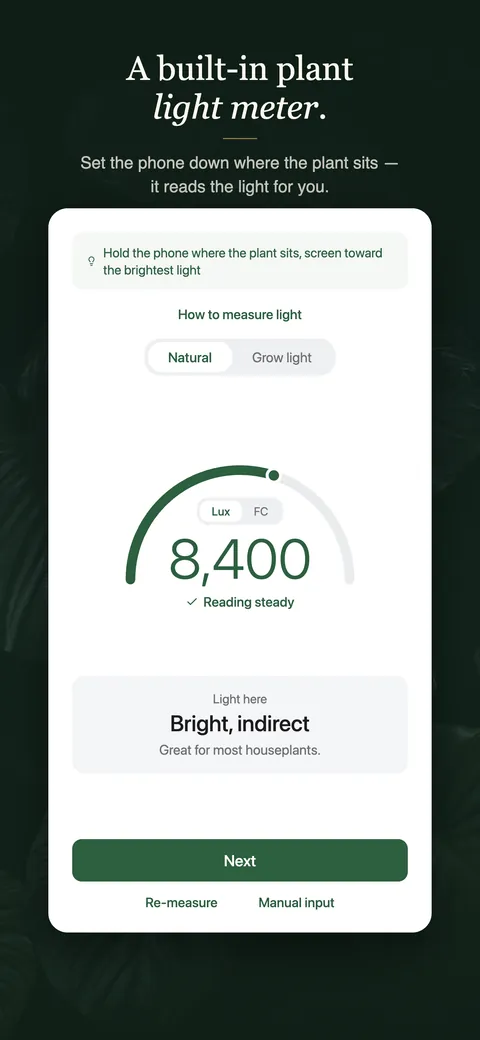
These tables assume an open north window, a clear day and air held where each caption says. A tree outside, or a wall a few metres past the glass, pulls every distance on this page nearer the window. Keep the fronds off the pane on frosty nights, too: at 17 °C the fern already reads a little cool. A hygrometer tells you which of the two tables your room is closer to, and the free spot checker scores your actual spot with the day’s weather where you are.
Published November 28, 2026
