On a clear day a north sill gives an African violet an estimated 3,640 lux. At 22 °C, 50% humidity and light airflow, that scores 65 out of 100: worth a try, with the light a little dim. No distance and no month scores it higher than 66.
Read on 28 November 2026, Google’s answer box says a north window can work for a violet, since it keeps harsh sun off the leaves, though it may be too dim for heavy blooming depending on how bright and open the window is. It wants the pot on the sill or very close and turned a quarter each week, with a grow light if flowers thin out or stems stretch pale. Iowa State’s extension service is among its sources. Nothing on the first page of results gives a lux figure.
That hedge leaves room for a north window that is bright enough. Our estimates don’t find one, even for a clean, unobstructed window on a clear day: the sill’s brightest days, 4,368 lux in May and June, still read a little dim.

Worth a try
It can work here with a little care.
A little dim, but workable
Comfortable temperature
Humidity suits it
Airflow suits it
Is a north window bright enough for an African violet?
Here’s what others publish for a violet, each figure left in its own unit:
| Who publishes it | What it says an African violet needs | What the figure is |
|---|---|---|
| espacepourlavie.ca | 10,760 to 16,140 lux (1,000 to 1,500 foot-candles) | Montreal Botanical Garden: what a violet requires |
| espacepourlavie.ca | 8,600 lux (800 f-c) | Montreal Botanical Garden: young plants |
| espacepourlavie.ca | 5,380 lux (500 f-c) | Montreal Botanical Garden: below this, plants stay vegetative |
| edis.ifas.ufl.edu | ~1000 foot candles | UF/IFAS MG028: bright light but no direct sun, within 3 feet of a southeast or west window |
| edis.ifas.ufl.edu | approximately 600 foot-candles | UF/IFAS MG028: under fluorescent light alone, about 16 hours a day |
| edis.ifas.ufl.edu | 800 to 1,200 foot candles | UF/IFAS EP360: commercial production range |
| edis.ifas.ufl.edu | 150 foot candles | UF/IFAS EP360: indoor minimum after shipping |
| getgrowli.app | 1,500–4,000 lux | Medium Indirect tier, shared by several plants |
| getgrowli.app | 150–400 fc | the same tier in foot-candles |
| foliage-factory.com | approx. 10,000–20,000 lux | shop listing for the cultivar 'Little Love Blue' |
| bloomingexpert.com | 500–600 foot-candle | winter minimum; the page also credits 1,000 foot-candles to UGA Extension, second-hand |
Not by our scores, and the published figure closest to the answer box’s worry points the same way. The Montreal Botanical Garden says violets kept under 5,380 lux stay vegetative. On our estimates a north sill never gets there: 3,640 lux on the card, 4,368 on the year’s brightest days. Our score rates light, not flowering, so this is no bloom forecast. It sets the garden’s line beside our estimate, and the estimate falls short in every month.
Not every source agrees. A University of Georgia bulletin, quoted on our bedroom plants page, says a northern windowsill can measure as little as 200 foot-candles on a clear winter day and calls that optimal for an African violet. Our December estimate for the sill is about that much light, and the score reads it as a little dim. On this one point the bulletin and the engine part ways.
How far from a north window can an African violet sit?
Not far. The same violet, moved back from the glass:
| Distance from the glass | Estimated light | What the light is doing | Verdict |
|---|---|---|---|
| 0.3 m, against the glass | 3,640 lux | A little dim, but workable | Worth a try, 65/100 |
| 1 m back | 2,800 lux | A little dim, but workable | Worth a try, 64/100 |
| 1.5 m back | 2,222 lux | A little dim, but workable | Worth a try, 63/100 |
| 1.7 m back | 2,026 lux | A little dim, but workable | Worth a try, 62/100 |
| 1.75 m back | 1,980 lux | Too dim here | Not the best fit right now, 47/100 |
| 2 m back | 1,764 lux | Too dim here | Not the best fit right now, 47/100 |
| 3 m back | 1,111 lux | Too dim here | Not the best fit right now, 46/100 |
Every row out to 1.7 m stays worth a try, sliding from 65 to 62, and at 1.75 m the light turns from a little dim to too dim and the score drops to 47. No row reads just right. These are clear-day estimates built from the window’s direction and the distance, not meter readings, and anything outside that blocks sky lowers every row.
The table is undated, and winter shrinks it. A metre back reads too dim from 7 November to 3 February, and on 21 December the workable strip ends about 55 cm from the glass. So the answer box is right to keep the pot on the sill or very close. The catch is that the sill is also where winter cold sits. If it chills to 15 °C the score falls to not the best fit, and a step back from the pane by day costs the light instead. The light only matters by day and the cold mostly arrives at night, so a pot slid off the sill at bedtime and put back in the morning loses nothing on either count.
Does a north window get bright enough for an African violet in summer?
It brightens and still stops short. Here is the sill from the card on the 21st of each month, December to June:
| The month it is | Estimated light | What the light is doing | Verdict |
|---|---|---|---|
| December | 2,124 lux | A little dim, but workable | Worth a try, 63/100 |
| January | 2,366 lux | A little dim, but workable | Worth a try, 63/100 |
| February | 2,976 lux | A little dim, but workable | Worth a try, 64/100 |
| March | 3,618 lux | A little dim, but workable | Worth a try, 65/100 |
| April | 4,179 lux | A little dim, but workable | Worth a try, 66/100 |
| May | 4,368 lux | A little dim, but workable | Worth a try, 66/100 |
| June | 4,368 lux | A little dim, but workable | Worth a try, 66/100 |
The light roughly doubles between the December and June rows, from 2,124 to 4,368 lux, and the light column never leaves a little dim; the score only creeps from 63 to 66. That’s latitude 40, about Denver or Naples. We ran the same sill from 25 to 55 degrees as well, and none of those latitudes gets it to just right. Farther north the winter end is worse: at latitude 50, about Frankfurt or Winnipeg, the sill itself reads too dim from 16 November to 24 January.
Which window would suit an African violet better?
Any of the other three, on light. Round the corner, a west sill holds the same violet at a great fit from 21 February to 19 October. An east window gives it about two feet of great fit and a south one about two metres. The north window guide counts the violet among the three plants there that miss a great or good fit even on the sill.
If north is the only window you have, the answer box’s grow light is where these numbers point too. We haven’t scored a lamp at this sill, but the croton page works through what one has to add for a plant whose light turns just right at the same point as a violet’s. And if the stems are already stretching pale, the leggy houseplants guide has the violet among the plants that score worse on a north sill than on a south one.
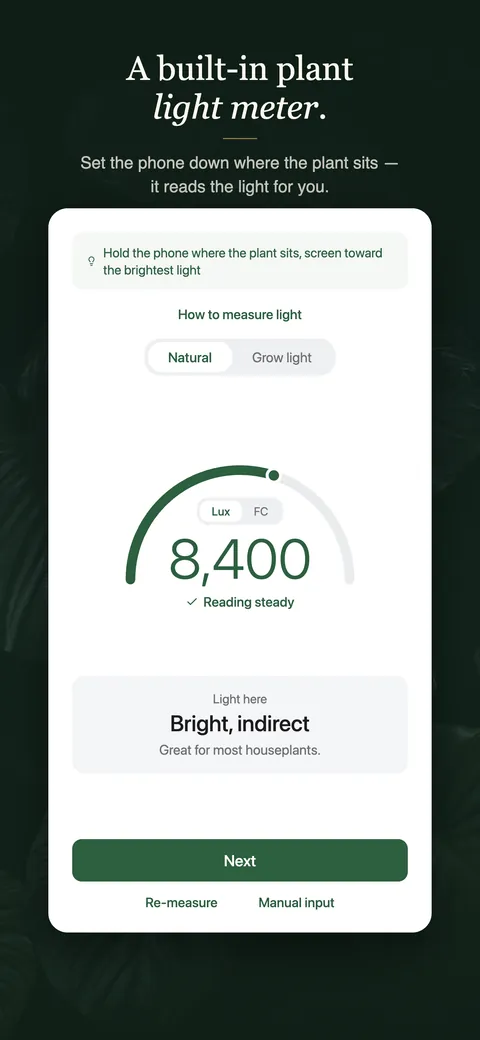
Every figure here assumes a clean north window under an open sky. A tree or the building across the street takes light off every row, and neither is an input. The spot checker scores your own sill with the weather where you live.
Published November 28, 2026
