Right against west glass, where we estimate 7,800 lux on a clear day, an African violet scores 99 out of 100 at 22 °C, 50% humidity and light airflow. The great fit holds to one metre back, at 6,000 lux; five centimetres further the light turns a little dim and the score drops to 69. At latitude 40 even June’s 9,360 lux reads just right for it.
Read on 28 November 2026, Google’s answer box says a violet can grow in a west window as long as it’s protected from harsh direct afternoon sun, set to one side of the sill or behind a sheer. It reads pale or crispy patches as too much sun or heat and dark leaves with few flowers as too little light. The New York Botanical Garden is among its sources. No page under it gives the light in lux.
On our numbers that warning comes apart. Too much light never shows up in the score, in any month or at any distance. Heat does, and so does too little light from late October to late February.

Great fit
This plant should be happy in this spot.
Just the right amount of light
Comfortable temperature
Humidity suits it
Airflow suits it
Is a west window too much sun for an African violet?
First, the light figures published for a violet, none of them converted:
| Who publishes it | What it says an African violet needs | What the figure is |
|---|---|---|
| espacepourlavie.ca | 10,760 to 16,140 lux (1,000 to 1,500 foot-candles) | Montreal Botanical Garden: what a violet requires |
| espacepourlavie.ca | 8,600 lux (800 f-c) | Montreal Botanical Garden: young plants |
| espacepourlavie.ca | 5,380 lux (500 f-c) | Montreal Botanical Garden: below this, plants stay vegetative |
| edis.ifas.ufl.edu | ~1000 foot candles | UF/IFAS MG028: bright light but no direct sun, within 3 feet of a southeast or west window |
| edis.ifas.ufl.edu | approximately 600 foot-candles | UF/IFAS MG028: under fluorescent light alone, about 16 hours a day |
| edis.ifas.ufl.edu | 800 to 1,200 foot candles | UF/IFAS EP360: commercial production range |
| edis.ifas.ufl.edu | 150 foot candles | UF/IFAS EP360: indoor minimum after shipping |
| getgrowli.app | 1,500–4,000 lux | Medium Indirect tier, shared by several plants |
| getgrowli.app | 150–400 fc | the same tier in foot-candles |
| foliage-factory.com | approx. 10,000–20,000 lux | shop listing for the cultivar 'Little Love Blue' |
| bloomingexpert.com | 500–600 foot-candle | winter minimum; the page also credits 1,000 foot-candles to UGA Extension, second-hand |
Not by the Montreal Botanical Garden’s figures. The sill’s brightest clear day in our dated table, 9,360 lux, sits under the 10,760 to 16,140 lux the garden says a violet requires. Of the ranges above, only the care app’s shared tier has a ceiling below it. Our own band runs from the one-metre row’s 6,000 lux to far above anything a west window delivers, so the card calls the sill a great fit and no month reads too bright. A moth orchid on the same sill reads a bit bright from April to August; a violet’s band reaches higher, and the same summer light lands inside it.
What the score can’t see is the beam itself. Our figures are clear-day estimates for the spot, built from the window’s direction and the distance, not meter readings, and for part of the afternoon the low sun falls straight across a west sill. The side-of-the-sill and sheer advice is aimed at that stretch. We haven’t scored either, so take them as the sources’ advice rather than ours.
How far from a west window should an African violet sit?
Within a metre. One violet, stepped back from the glass:
| Distance from the glass | Estimated light | What the light is doing | Verdict |
|---|---|---|---|
| 0.3 m, against the glass | 7,800 lux | Just the right amount of light | Great fit, 99/100 |
| 0.6 m back | 7,218 lux | Just the right amount of light | Great fit, 99/100 |
| 1 m back | 6,000 lux | Just the right amount of light | Great fit, 98/100 |
| 1.05 m back | 5,863 lux | A little dim, but workable | Worth a try, 69/100 |
| 2 m back | 3,780 lux | A little dim, but workable | Worth a try, 65/100 |
| 3.35 m back | 2,026 lux | A little dim, but workable | Worth a try, 62/100 |
| 3.4 m back | 1,979 lux | Too dim here | Not the best fit right now, 47/100 |
Up to the one-metre row the light reads just right and the score holds at 98 or 99. At 1.05 m the light reads a little dim and the score is 69; after that the slope is shallow, 65 at two metres and 62 at 3.35, until 3.4 m takes it to 47. The University of Florida’s guide puts a violet within three feet of a west window. Three feet is 0.91 m, inside our first metre by about a hand’s width.
So a violet pulled back from the afternoon sun has a short leash here: past a metre, light is what it lacks. An east window gives it even less room, about two feet, and a north sill never reaches its band at all.
Is a west sill bright enough for an African violet in winter?
Not all winter. Here is the sill from the card on the 21st of every other month:
| The month it is | Estimated light | What the light is doing | Verdict |
|---|---|---|---|
| February | 6,023 lux | Just the right amount of light | Great fit, 98/100 |
| April | 9,305 lux | Just the right amount of light | Great fit, 100/100 |
| June | 9,360 lux | Just the right amount of light | Great fit, 100/100 |
| August | 9,322 lux | Just the right amount of light | Great fit, 100/100 |
| October | 5,909 lux | A little dim, but workable | Worth a try, 69/100 |
| December | 3,900 lux | A little dim, but workable | Worth a try, 65/100 |
From the February row to the August one the light reads just right, peaking at 9,360 lux. By October it has slipped to a little dim, and December’s 3,900 lux scores 65. Day by day at latitude 40, about the line through Madrid or Beijing, the sill holds a great fit from 21 February to 19 October. Step back and that season shortens at both ends: a metre back it runs from 22 March to 20 September, and a metre and a half back it never arrives.
So if a sheer goes up for summer, take it down in late October. From then until late February the sill has no light to spare.
What does a hot west sill do to an African violet?
In the months when the light reads just right, warm air is what takes points off. Hold the pot on the sill, warm nothing but the air, and the engine keeps a great fit up to 27 °C, drops to worth a try at 28 and to not the best fit at 31, with the light column unchanged. The south page tabulates the same comfortable run, 18 to 27 °C. A west sill reaches the top of it more often, because the afternoon sun lands on a room that has been warming since morning.
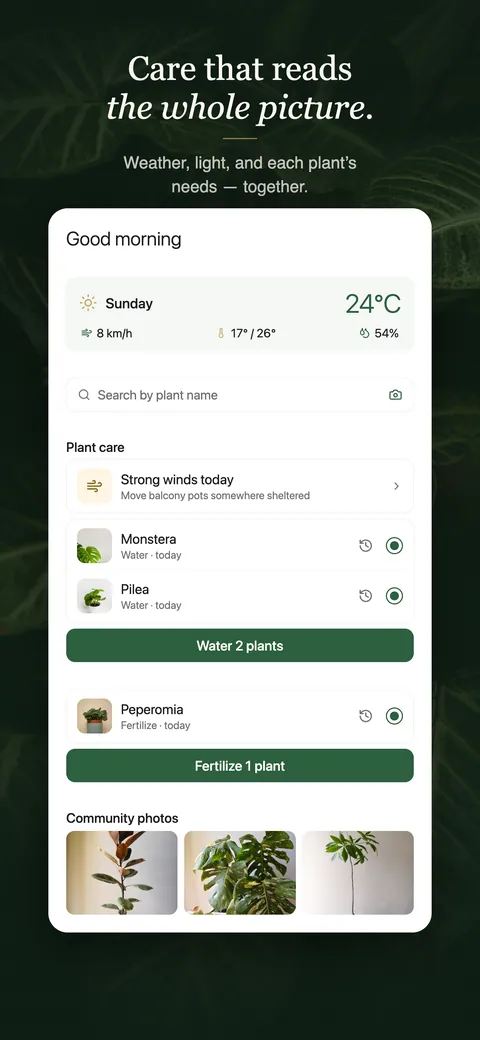
A thermometer left on the sill through one sunny afternoon tells you which side of 27 °C yours sits on. Every other figure here assumes a clean west window on a clear day. A tree or the building opposite takes light off every row, and the west window guide covers what else shapes the afternoon there. For your own sill, the spot checker runs the same scoring on your local weather.
Published November 28, 2026
