Set on a north sill, a croton scores 65 out of 100 on an estimated 3,640 lux, with the air at 22 °C, 50% humidity and a light airflow. That’s worth a try, the light flagged a little dim, and the verdict holds out to 1.7 metres. At 1.8 metres the light turns too dim and the score falls to 47. No distance from this window gets the plant to a great fit.
Read on 22 October 2026, Google’s answer box for this search says a north window is too dark for a croton. It wants intense light or direct sun, six hours or more, to hold its colours; short of that they fade to plain green and the stems stretch. Its fix: move it to another window, or hang a full-spectrum LED grow light over it for 12 to 14 hours a day. A Reddit post below compares mid-May with today, about a foot from a north-facing window.
The box has the verdict about right and leaves out what you’d act on. Our scoring also finds a usable strip at the glass, and it can put a number on the lamp.

Worth a try
It can work here with a little care.
A little dim, but workable
Comfortable temperature
Humidity suits it
Airflow suits it
Is a north window too dark for a croton?
These are the light figures published for a croton, left unconverted:
| Who publishes it | What it says a croton needs | What the figure is |
|---|---|---|
| getgrowli.app | 4,000–8,000 lux | Its “bright, indirect” tier, the same band the app prints for several plants |
| getgrowli.app | 400–800 fc | The same tier, given again in foot-candles |
| foliage-factory.com | approx. 20,000–40,000 lux | Shop product page for croton ‘Petra’: very bright, some direct sun |
| mrec.ifas.ufl.edu | 3000 to 5000 ft-c | University of Florida notes for commercial pot production, “or higher”; read from a 2025 web.archive.org copy, the live page is gone |
| mrec.ifas.ufl.edu | 6000 to 7000 ft-c | Same archived notes: acceptable for production if high temperatures can be controlled |
| lifetips.alibaba.com | 1,500–2,500 foot-candles | Target at peak daylight for a black croton; a content site that cites no source |
| lifetips.alibaba.com | 1,200 fc | Floor on the same page: below it, it expects fading and loss of leaf contrast |
| bloomingexpert.com | 200 foot-candles (FC) | Pigment floor: below roughly this, it says the plant stops keeping its colours |
Too dark for a great fit, bright enough at the glass for worth a try. The card’s 3,640 lux falls short of Growli’s 4,000 to 8,000 band, the nearest thing in the table to a houseplant target, and a long way short of Lifetips’ 1,200 foot-candle floor. Blooming Expert’s 200 foot-candles is the one figure a north window meets, out to about 1.6 metres; our own too-dim step comes about 15 centimetres further back, at 1.73.
The bright-indirect page builds its worked example on a spot like these, a croton a metre from glass that gets no direct sun, and lands on the same verdict as our 1-metre row. Bright and indirect describes a north window well. For a croton, that light still reads a little dim.
How far from a north window can a croton go?
About 1.7 metres, and less in winter. The same croton, moved back from the north glass a row at a time:
| Distance from the glass | Estimated light | What the light is doing | Verdict |
|---|---|---|---|
| 0.3 m, against the glass | 3,640 lux | A little dim, but workable | Worth a try, 65/100 |
| 1 m back | 2,800 lux | A little dim, but workable | Worth a try, 64/100 |
| 1.5 m back | 2,222 lux | A little dim, but workable | Worth a try, 63/100 |
| 1.7 m back | 2,026 lux | A little dim, but workable | Worth a try, 62/100 |
| 1.8 m back | 1,935 lux | Too dim here | Not the best fit right now, 47/100 |
| 3 m back | 1,111 lux | Too dim here | Not the best fit right now, 46/100 |
For the first metre and a half the score barely moves, 65 down to 63, because those rows share one verdict and one reason: the light is a little dim. Between 1.7 and 1.8 metres the light crosses into too dim, and the score goes to 47. Stepping a centimetre at a time, 1.72 metres holds and 1.73 doesn’t, about five foot eight from the glass.
That’s the depth at the equinoxes. Given a date and latitude 40, the line sits about 2.1 metres out in June and pulls in to under 60 centimetres by late December, while the sill stays worth a try in every month. So in winter the pot belongs on the sill. No month gets this window to a great fit, June included.
How much light would a croton need at a north window?
A great fit starts at 6,000 lux on the leaves. Here is the same plant on the same sill as the light reaching it goes up:
| Light on the leaves | Light | What the light is doing | Verdict |
|---|---|---|---|
| Daylight alone, clear day | 3,640 lux | A little dim, but workable | Worth a try, 65/100 |
| Topped up, still short | 5,500 lux | A little dim, but workable | Worth a try, 68/100 |
| Topped up to the line | 6,000 lux | Just the right amount of light | Great fit, 98/100 |
| Topped up to south-sill light | 13,000 lux | Just the right amount of light | Great fit, 100/100 |
The light reads a little dim at 5,500 lux and just right at 6,000, so the step is sharp, and it sits well above the sill’s clear-day 3,640. Past it, more light adds very little: topped up to south-sill light the score is 100, two points over the line.
That’s the number the box’s grow-light advice leaves out. Its 12 to 14 hours is a duration, and our scoring has no input for hours; what it can say is how bright the leaves need it. Daylight and lamplight add up on a leaf, but the daylight share shrinks in winter and on grey days, so the safer target is a lamp that puts 6,000 lux on the top leaves by itself. Then the window counts as a bonus.
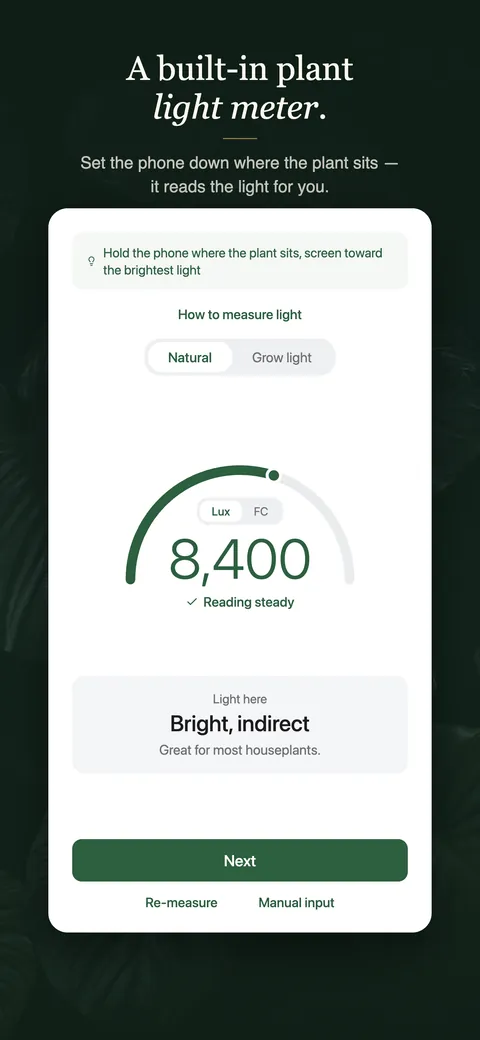
Does humidity matter for a croton at a north window?
Less than at a sunny one. On the north sill the light has already set the verdict, and the air can’t move it: from 5% humidity to 90%, the sill reads worth a try. Dry air still costs a few points, so a humidifier isn’t wasted, but it won’t change the answer the way it does on a south sill, where 20% humidity knocks a great fit down to worth a try.
What temperature is too cold for a croton?
Google lists this question under the search, and our scoring’s answer is below 16 °C. On the north sill that’s where the verdict falls to not the best fit; between 16 and 18 °C the plant loses a few points and stays worth a try. The west window page takes a croton through the rest of the range, the hot end included. What’s particular to north is the glass: it gets no sun to warm it on a winter day, so trust a thermometer on the sill over the one on the wall.
Which window would suit a croton better?
Any of the other three, as long as the pot goes close. At an east window a croton keeps a great fit to 60 centimetres, and only from mid-March to the end of September. West and south give it more floor, about a metre and just past two metres. Set at the back of any of those rooms it scores worth a try or worse, which it already gets on this sill.
The fiddle leaf fig page runs one sill round all four walls for a plant with the same light needs, if you want that comparison as a table. If this window is the only one you have, the sill plus a lamp is the setup our numbers back, and the north window guide lists plants that hold a great fit here without one.
What could make your north window darker than this?
Anything outside it. These rows assume clear glass and open sky to the north, and every lux figure on this page is a clear-day estimate built from the window’s direction and the distance, not a reading. A building across the street, a balcony overhead, a tree or a net curtain takes light off every row and pulls the 1.7-metre line toward the glass. The free spot checker reads the real spot, with your local weather.
Published October 22, 2026
