A pilea, the Chinese money plant, scores 67 out of 100 right against south glass, at 22 °C and 50% humidity. The clear-day estimate there is 13,000 lux, a bit bright for this plant, and nothing else on the card loses points. Two feet back it scores 68. The light settles inside its band between 0.85 and 0.9 m from the pane.
Read on 28 November 2026, Google’s answer box says to keep a pilea a short way back from a south window, a couple of feet rather than against the glass, or behind a sheer. It credits Plant Addicts for that, and UrbanStems for the warning signs: leaves that scorch or cup from too much sun, leggy stems from too little. It also cites Reddit for the view that bright light near a south window brings strong growth. No page under it puts a number on the light.
The direction is right and the distance falls short. Two feet back reads a bit bright for most of the year, and in nearly all the weeks it doesn’t, neither does the sill.

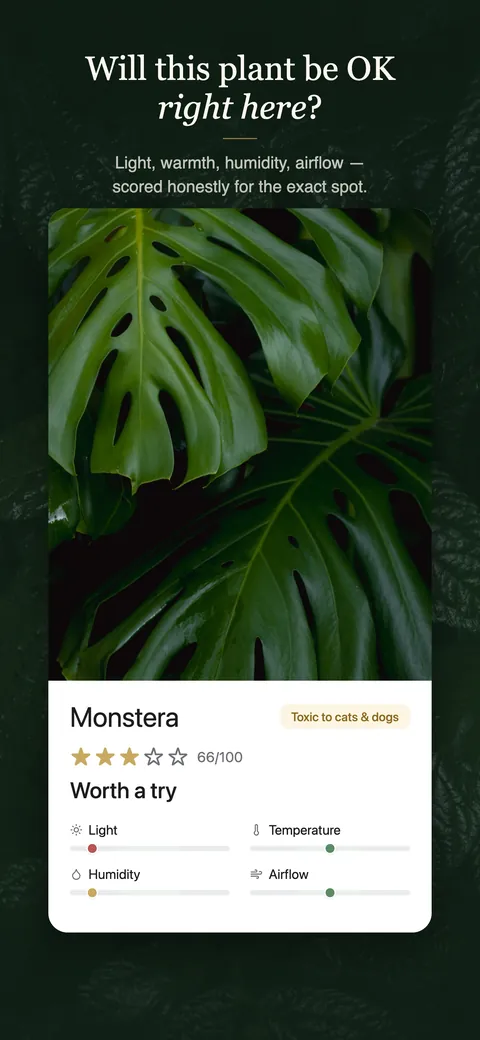
Worth a try
It can work here with a little care.
A bit bright, but workable
Comfortable temperature
Humidity suits it
Airflow suits it
Is a south window too bright for a pilea?
On the sill, a little, by our scoring. The published figures pull the other way. Here they are, in the units their sources use:
| Who publishes it | What it says a pilea needs | What the figure is |
|---|---|---|
| getgrowli.app | 4,000–8,000 lux | Its "Bright Indirect" tier, a band the site prints for several other plants as well |
| getgrowli.app | 400–800 fc | The same tier, given in foot-candles |
| foliage-factory.com | approx. 10,000–20,000 lux | "Bright indirect" on a shop's product page for this plant |
| scienceinsights.org | 10,000 and 20,000 lux | The range it says bright indirect light typically falls between, in an article on pilea light (10 November 2025) |
| bloomingexpert.com | 1,000 to 2,000 foot-candles | Stated as what a pilea needs |
| bloomingexpert.com | roughly 1,000 foot-candles | A grow-light target, run 12 to 14 hours a day |
Foliage Factory and Science Insights both give 10,000 to 20,000 lux, and our south-sill estimate of 13,000 sits inside that range. Taken as targets, those two rows would keep a pilea within about a metre of the glass, and most of that metre reads a bit bright on our scale. Growli’s 4,000 to 8,000 band doesn’t begin until somewhere between the 1.1 and 2 m rows of the next table.
Our care data files a pilea under medium light. The top of that band falls between two rows of the next table: 12,030 lux two feet back reads a bit bright, and 10,473 at 0.9 m reads just right. An east sill stays under that ceiling in every month at latitude 40.
How far back from a south window should a pilea sit?
Just under a metre on an ordinary clear day. The same pot, moved back from the glass with no date attached:
| Distance from the glass | Estimated light | What the light is doing | Verdict |
|---|---|---|---|
| 0.3 m, against the glass | 13,000 lux | A bit bright, but workable | Worth a try, 67/100 |
| 0.6 m back | 12,030 lux | A bit bright, but workable | Worth a try, 68/100 |
| 0.9 m back | 10,473 lux | Just the right amount of light | Great fit, 98/100 |
| 1.1 m back | 9,548 lux | Just the right amount of light | Great fit, 99/100 |
| 2 m back | 6,300 lux | Just the right amount of light | Great fit, 100/100 |
| 3.2 m back | 3,618 lux | Just the right amount of light | Great fit, 100/100 |
| 4.5 m back | 1,984 lux | A little dim, but workable | Worth a try, 69/100 |
The change comes between 0.85 and 0.9 m, a little under three feet, where the score jumps from worth a try to 98. From there the great fit runs to 4.45 m before the light turns a little dim in the 4.5 m row, a longer stretch of floor than this plant gets at any other window on the same clear day. A corn plant has the same edge.
That lux column is modelled from the window’s direction and the pot’s distance on a clear day. It isn’t a meter reading.
When is a south sill right for a pilea?
In summer. Scored day by day at latitude 40, the sill is a great fit from 21 April to 22 August and a bit bright on every other day of the year. Its brightest light comes in mid-October and again in late February, not in June. The monstera page for this window has the reason: a low sun strikes upright glass almost square on, while a high summer sun meets it at a slant.
Two feet back tracks the sill almost day for day:
| Month, scored on the 21st | Estimated light | What the light is doing | Verdict |
|---|---|---|---|
| January | 12,070 lux | A bit bright, but workable | Worth a try, 68/100 |
| February | 12,938 lux | A bit bright, but workable | Worth a try, 67/100 |
| March | 12,094 lux | A bit bright, but workable | Worth a try, 68/100 |
| April | 9,636 lux | Just the right amount of light | Great fit, 99/100 |
| May | 7,555 lux | Just the right amount of light | Great fit, 100/100 |
| June | 6,773 lux | Just the right amount of light | Great fit, 100/100 |
| July | 7,480 lux | Just the right amount of light | Great fit, 100/100 |
| August | 9,595 lux | Just the right amount of light | Great fit, 99/100 |
| September | 12,063 lux | A bit bright, but workable | Worth a try, 68/100 |
| October | 12,917 lux | A bit bright, but workable | Worth a try, 67/100 |
| November | 12,018 lux | A bit bright, but workable | Worth a try, 68/100 |
| December | 11,382 lux | A bit bright, but workable | Worth a try, 68/100 |
That spot is a great fit from 11 April to 31 August, about ten days longer at each end than the sill, and a bit bright for the rest of the year. February and October are its brightest rows, at 12,938 and 12,917 lux; June is down at 6,773.
So the couple of feet in the answer box works in the months when the sill works too. The distance that holds on every day is 1.1 m. A metre back still reads a bit bright from 6 February to 10 March and from 2 October to 4 November. The year-round strip ends at 3.2 m; at 3.25 m the light dips to a little dim for twelve days around midsummer, when the high sun puts the least light into the back of the room.
Those summer weeks, when the light on the sill comes right, are also when the air at the glass runs warmest. A pilea holds its great fit up to 26 °C (a money tree to 28), and the west-window page follows what the score does above that.
Is a south window a good choice for a pilea?
In winter it gives a pilea more room than any other window, as long as the pot stays off the sill. On 21 December the great fit runs from 0.8 to 4.35 m back from south glass. At a north window on the same day it ends 55 cm from the pane, so the plant that has to back away from a south sill has to hug a north one.
From late April to late August all four sills read a great fit, south included.
That calendar belongs to latitude 40. At 52 degrees north the south sill is also a great fit through midwinter, from 2 November to 7 February, and reads a bit bright in the spring and autumn stretches on either side of it.
Will my own south window read the same?
Not exactly. Every row assumes nothing shades the pane. An eave or a balcony overhead cuts the high summer sun first, and a building opposite takes the low winter sun, so on a real window the sill may read less bright than these rows and the back of the room dimmer. The south window guide covers what else does well at this glass, and the free spot checker runs your own window with your local weather.
Published November 28, 2026
