One metre back from a south window, at 22 °C and 50% humidity with gentle air, a money tree scores 99 out of 100. On the sill it scores 67, because the light right at the glass is a bit bright for it. Let the room warm up and the metre-back spot stays a great fit all the way to 28 °C.
Read on 28 November 2026, Google’s answer box says a south window can work for a money tree if the light reaching it is bright and indirect rather than harsh, and cites Costa Farms for the warning that direct afternoon sun can scorch the leaves. Its fix is a few feet of distance from an unshaded pane, or a sheer. It reads crispy or bleached leaves as too much sun and slow, leggy growth as too little. No result on the first page gives a lux figure.
The direction is right. What the box leaves out is how warm the room can get before it matters, and the fact that more than one plant goes by a money name.

Great fit
This plant should be happy in this spot.
Just the right amount of light
Comfortable temperature
Humidity suits it
Airflow suits it
Can a money tree go right on a south sill?
For most of the year our scores say no, and the care pages lean the same way:
| Who publishes it | What it says a money tree needs | When |
|---|---|---|
| plants.ces.ncsu.edu | The money tree prefers indirect sunlight or a mix of sun and shade. | Its plant profile |
| plants.ces.ncsu.edu | Leaf scorch can occur from exposure to direct sunlight. | Direct sun |
| libguides.nybg.org | Money trees prefer bright, filtered light but will put up with some light shade and continue to grow. | As a houseplant |
| libguides.nybg.org | For best health, your plant should be in a room that gets sun for most of the day, but not right in the window. | Where in the room |
| costafarms.com | Money trees grow best in bright, indirect light. | As a houseplant |
| costafarms.com | Morning sun is the exception — a money tree can handle direct sun until about 10 a.m. without issue, since morning light is gentler and less intense than midday or afternoon sun. | Morning sun |
NC State’s scorch warning and the Botanical Garden’s “not right in the window” both land on the sill, and Costa Farms makes its exception only for morning sun, which it calls gentler than the midday kind a south window gets. Our verdict on the sill is milder than any of theirs: a bit bright, but workable, and that one flag is what holds it to 67. The scores begin with modelled light for a clear day at that distance from a south pane, not a meter reading, so they smooth over the hour when a beam sits on one leaf and can’t rule scorch out.
How far back from a south window should a money tree sit?
About a metre. On an ordinary clear day the light comes inside its band 0.9 m from the glass, a little under three feet, and stays there to about 4.45 m; the money tree light page walks the plant back from south glass row by row. The season moves the near edge. At latitude 40 the sill itself is a great fit from 21 April to 22 August, a metre back reads a bit bright from early February to early March and again from early October to early November, and 1.1 m keeps a great fit on every day of the year. A pilea shares the light band and the calendar, and its south-window page follows the spot two feet back through the year.
Does every money plant want the same spot?
No, and the shared name is where it goes wrong. The jade also goes by money plant and sometimes money tree, while the pilea is the Chinese money plant. In many parts of the Indian subcontinent the money plant is a golden pothos. Here are all four on the same south sill:
| The plant | What the light is doing | Verdict |
|---|---|---|
| Money tree (Pachira aquatica) | A bit bright, but workable | Worth a try, 67/100 |
| Chinese money plant (pilea) | A bit bright, but workable | Worth a try, 65/100 |
| Jade plant (Crassula ovata) | A little dim, but workable | Worth a try, 62/100 |
| Golden pothos (Epipremnum aureum) | Too bright here | Not the best fit right now, 41/100 |
One sill, and three different readings of the same light. The money tree and the Chinese money plant both find it a bit bright and both come right 0.9 m back, so at this window they are one plant as far as light goes. The jade finds even the glass a little dim and turns too dim 2.15 m in, and the jade’s south-window page makes the case for keeping it at the pane. A golden pothos reads the sill as too bright and needs about two and a half metres; the pothos page for this window walks it back.
So if the plant you call a money tree is a succulent, it is probably a jade, and the few-feet advice works against it. A money tree in the Pachira sense is a tree, sometimes sold with several trunks braided together.
How warm can a south room get for a money tree?
Warmer than for a pilea. Here is the card’s spot a metre back, read up through the warm end of the thermometer:
| Air temperature at the spot | What the light is doing | What the warmth is doing | Verdict |
|---|---|---|---|
| 22 °C | Just the right amount of light | Comfortable temperature | Great fit, 99/100 |
| 26 °C | Just the right amount of light | Comfortable temperature | Great fit, 99/100 |
| 27 °C | Just the right amount of light | Comfortable temperature | Great fit, 98/100 |
| 28 °C | Just the right amount of light | Comfortable temperature | Great fit, 97/100 |
| 29 °C | Just the right amount of light | A little warm, but workable | Worth a try, 67/100 |
| 31 °C | Just the right amount of light | A little warm, but workable | Worth a try, 63/100 |
| 32 °C | Just the right amount of light | Too hot here | Not the best fit right now, 47/100 |
The great fit holds to 28 °C and slips to worth a try just above it, 67 at 29 °C; from just over 31 °C the spot is not the best fit. The light column reads just right on every row, so every point lost here is the heat. A pilea at the same spot keeps its great fit only to 26 °C, so on a 27 °C afternoon the two plants part ways.
Summer is also when the sill’s light comes right, and the same 28 °C edge holds there from late April to late August. A hot room invites a fan, though, and on our scores a fan blowing on a money tree costs it far more than 28 °C does; the north-window page has the airflow table, and the drop is just as steep at this spot.
What about the sheer curtain the answer box suggests?
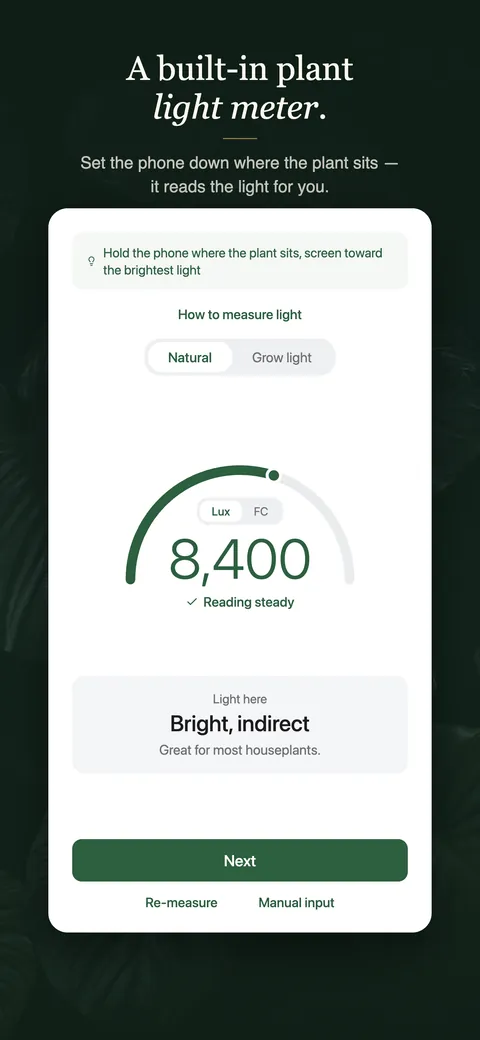
We can’t score one, because a curtain isn’t an input to the estimate and sheers vary too much to guess. Hang one and a meter reading behind it settles whether the sill comes inside the band; skip it and a metre of floor does the same job. The south window guide sorts the plants that enjoy this glass from the ones it scorches, and the spot checker scores your actual window against the weather where you are.
Published November 28, 2026
