Right against south glass a corn plant scores 67 out of 100, its light a bit bright under a clear-day estimate of 13,000 lux, and it comes good 0.9 m back. The Madagascar dragon tree does the same. The Canary Islands dragon tree scores 100 on that sill, and the plain snake plant needs to be past 2.1 m.
Read on 28 November 2026, Google’s answer box calls a south window fine for a dracaena if harsh direct sun is kept off it, since that can scorch leaves or fade variegation; it credits Plant Addicts. Its remedy is a sheer, or a few feet between pot and glass. Corn plants and dragon trees, it adds, like bright indirect light a little back from the glass, while snake plants, now Dracaenas too, take brighter sun. A r/HouseplantsUK thread on the same page worries about the opposite: a dragon tree under-lit in a recessed south corner. No page gives the light a number.
On our scores the box is right about corn plants and the Madagascar dragon tree, and has the other two backwards.

Worth a try
It can work here with a little care.
A bit bright, but workable
Comfortable temperature
Humidity suits it
Airflow suits it
How bright is a south sill for a dracaena?
Brighter than most of them want. Here are the published light figures, in whatever unit each source chose:
| Who publishes it | What it says a dracaena needs | What the figure is |
|---|---|---|
| houseplantjournal.com | 100 FC (20 µmol) | Minimum indirect light for dracaenas (several species) |
| houseplantjournal.com | 200 FC (40 µmol) | Good indirect light for dracaenas |
| houseplantjournal.com | 30-50 FC | Where the writer saw one last for years, long, thin and spindly |
| libguides.nybg.org | about five to six feet from a bright south-facing window | Far enough that the sun’s direct rays don’t touch it |
| plantaddicts.com | three to five feet away from a west-facing window | To keep the afternoon sun from burning the leaves |
Only one row is written for a south window, and it comes from the New York Botanical Garden: keep the plant five to six feet from bright south glass, out of reach of the direct rays. That puts it 1.5 to 1.8 m back, where on our scores a corn plant and a Canary Islands dragon tree are both a great fit and a plain snake plant still reads a bit bright.
The dracaena light page has the corn plant’s band in lux and foot-candles, with the same plant scored at all four windows.
Which dracaena can take a south sill?
Of the ones we set there, only the Canary Islands dragon tree:
| On the south sill | What the light is doing | Verdict |
|---|---|---|
| Corn plant (D. fragrans) | A bit bright, but workable | Worth a try, 67/100 |
| Dragon tree (D. marginata) | A bit bright, but workable | Worth a try, 67/100 |
| Canary dragon tree (D. draco) | Just the right amount of light | Great fit, 100/100 |
| Song of India (D. reflexa) | A bit bright, but workable | Worth a try, 67/100 |
| Lucky bamboo (D. sanderiana) | A bit bright, but workable | Worth a try, 67/100 |
| Snake plant (D. trifasciata) | A bit bright, but workable | Worth a try, 65/100 |
The corn plant scores 67, its light a bit bright, and the Madagascar dragon tree, Song of India and lucky bamboo match it point for point. Dracaena draco, the Canary Islands dragon tree, scores 100 on the same glass. Our care data puts it a light band above everything else in the table.
The snake plant takes the sill no better than a corn plant does. It scores 65, the lowest in the table, with its light a bit bright too.
So the common name deserves a second look. Two species are sold as dragon tree, and on this sill one is the only great fit in the table while the other is flagged with the corn plants. The Latin name on the label tells you which you have.
How far back should a dracaena sit from a south window?
That depends on which one. Here is the Canary Islands dragon tree walked back from the glass it likes:
| Distance from the glass | Estimated light | What the light is doing | Verdict |
|---|---|---|---|
| 0.3 m, against the glass | 13,000 lux | Just the right amount of light | Great fit, 100/100 |
| 1 m back | 10,000 lux | Just the right amount of light | Great fit, 100/100 |
| 2.1 m back | 6,015 lux | Just the right amount of light | Great fit, 98/100 |
| 2.15 m back | 5,878 lux | A little dim, but workable | Worth a try, 69/100 |
| 3 m back | 3,969 lux | A little dim, but workable | Worth a try, 66/100 |
| 4.5 m back | 1,984 lux | Too dim here | Not the best fit right now, 47/100 |
Its light reads just right out to 2.1 m, at 6,015 lux. At 2.15 m, 5,878 lux, the light turns a little dim and the tree drops to 69, and by 4.5 m it is not the best fit. A corn plant has the opposite shape: flagged at the glass, a great fit from 0.9 m, and still one at 4.45 m.
Taken together, a south room sorts the genus by distance. The Canary dragon tree wants the first two metres. Corn plants and the Madagascar dragon tree are a great fit anywhere from 0.9 to 4.45 m, and the plain snake plant only comes good at 2.15 m, the row where the Canary’s light turns dim.
A pilea shares the corn plant’s band, and its south-window page follows the same window through the year. The snake plant’s own page walks the bird’s nest variety back from the same glass.
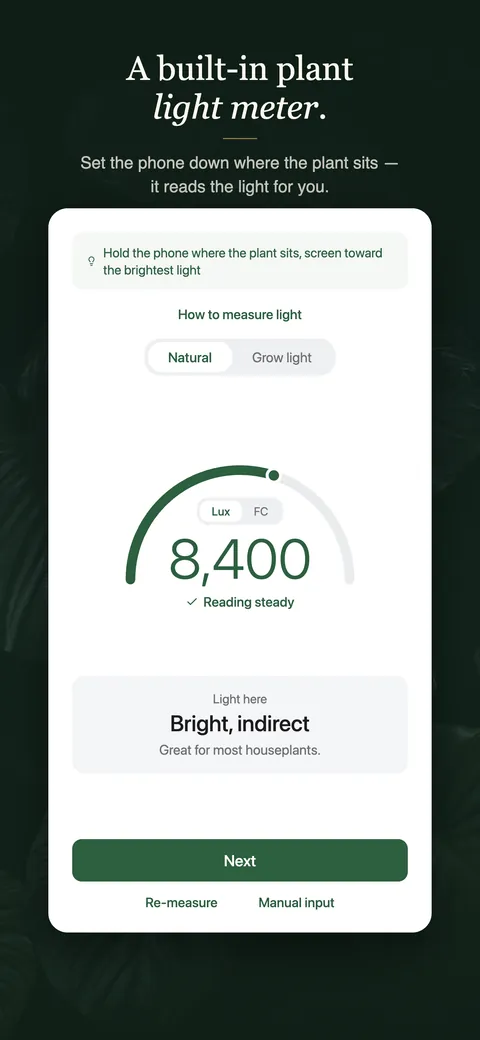
The lux column is an estimate built from the bearing of the glass and the distance on a clear day; no meter was involved.
Where should a dracaena sit by a south window in winter?
Further from the glass than in summer, unless it’s the Canary Islands dragon tree. At latitude 40, roughly Philadelphia or Madrid, a corn plant’s sill comes good only from late April to late August, when a high sun meets the pane at a slant, and 1.1 m is the nearest spot that holds a great fit all year.
The Canary dragon tree never has to leave the sill. It is a great fit there on every day of the year at that latitude, and the stretch behind it is longer in the cool months: on 21 December its great fit reaches 1.95 m, on 21 June only 0.85 m. One kept 1.5 m back reads a little dim from 28 April to 14 August, so in summer it belongs at the glass.
Further north the calendar shifts. At London’s latitude a corn plant’s sill is a great fit from 4 November to 6 February and again in high summer, and a bit bright in the months between. On 21 December there, the Canary’s light turns a little dim just past a metre from the glass and the Madagascar dragon tree’s at 3.4 m, so a recessed corner of a British south room can leave either one short.
Would shade or a sheer change the answer?
Yes, and not the same way for every dracaena. Every table here treats the window as open glass under a clear sky. Shade from an overhang, or a sheer pulled across, lowers every row, which helps a corn plant on the sill and works against a Canary dragon tree further back. The south window guide lists the plants that want this much sun, the north-window page tests the answer box’s colour rule for corn plants, and the free spot checker will run the numbers for the spot you have in mind.
Published November 28, 2026
