Set a pilea, the Chinese money plant, right against west glass and it scores 100 out of 100, under an estimated 7,800 lux with the room at 22 °C and 50% humidity. Three metres back it still reads 99. Here the number moves with the air. At 27 °C the same sill drops to 67, and the light reading hasn’t changed at all.
Read on 14 October 2026, the answer box at the top of Google’s results says a west window works if you manage the hot afternoon sun, and suggests a few feet back from the sill or about a metre. Below it, Savvy Gardening rates east or west as the ideal window for a pilea, with west a little brighter, and Plant Addicts and the RHS put the plant close by or near the glass. Planet Desert lumps west in with south, as a window you settle for, and wants a few feet of distance or a sheer curtain.
Nobody puts a number on the window. The scores below pull apart two things that advice treats as one: how bright a west sill is, and how warm it gets.

Great fit
This plant should be happy in this spot.
Just the right amount of light
Comfortable temperature
Humidity suits it
Airflow suits it
That’s the sill on an ordinary day, and the card has nothing to flag on any of its four scales. Each table further down changes one thing from here and holds the rest still.
Is a west window too bright for a pilea?
First, the light figures other sources publish for a pilea, copied the way each one prints them:
| Who publishes it | What it says a pilea needs | What the figure is |
|---|---|---|
| getgrowli.app | 4,000–8,000 lux | "roughly 4,000–8,000 lux of bright, indirect light"; the site's 'Bright Indirect' tier, which it prints for several plants |
| getgrowli.app | 400–800 fc | The same tier in foot-candles, "Roughly 400–800 fc" |
| foliage-factory.com | approx. 10,000–20,000 lux | Product page: "Bright indirect • approx. 10,000–20,000 lux" |
| scienceinsights.org | 10,000 and 20,000 lux | Its definition of bright indirect light, "typically ranges between 10,000 and 20,000 lux" (dated 10 November 2025) |
| bloomingexpert.com | 1,000 to 2,000 foot-candles | "Pilea needs 1,000 to 2,000 foot-candles of light" |
| bloomingexpert.com | roughly 1,000 foot-candles | A grow-light target, not a window figure: 12 to 14 hours a day at roughly 1,000 foot-candles |
Laid against the table further down, those figures pick out different spots. Growli’s band takes in the west sill and the 1 m row and stops short of the 2 m row at 3,780 lux. The two ranges that start at 10,000 skip every west row. Only the south rows reach them: the spot a metre back from south glass, and the south sill at 13,000 lux, which our scoring reads as a bit bright for this plant.
Our scoring reads the light on the west sill as ideal, which is why the card gives it a hundred. That 7,800 is an estimate built from the window direction, the distance and a clear day, not a meter reading. Given a June date at latitude 40, the engine pushes the sill estimate higher, and it still lands inside the pilea’s band.
The bleached, crispy patches the answer box describes do happen, mostly on a pilea that grew its leaves somewhere dim and then met the late beam all at once.
How far back from a west window should a pilea sit?
For light, anywhere from the glass to three metres. Here is one pilea walked back from a west window, with a south sill and the metre behind it added at the bottom:
| Where the pot is | Estimated light | What the light is doing | Verdict |
|---|---|---|---|
| West sill | 7,800 lux | Just the right amount of light | Great fit, 100/100 |
| 1 m back | 6,000 lux | Just the right amount of light | Great fit, 100/100 |
| 2 m back | 3,780 lux | Just the right amount of light | Great fit, 100/100 |
| 3 m back | 2,381 lux | Just the right amount of light | Great fit, 99/100 |
| 3.5 m back | 1,890 lux | A little dim, but workable | Worth a try, 68/100 |
| South sill | 13,000 lux | A bit bright, but workable | Worth a try, 67/100 |
| South, 1 m back | 10,000 lux | Just the right amount of light | Great fit, 99/100 |
Down the west rows the score doesn’t fall below 99 until the step between three metres and three and a half. There the estimate drops from 2,381 to 1,890 lux and the score to 68, with the light marked a little dim. That’s the side of the range the answer box ties to stretched, leggy growth. A monstera at this window hits its step in the same place; the two plants read west light the same way and part company on warmth.
The south rows show where the step-back advice comes from. A south sill reads a bit bright for a pilea and scores 67, and a metre back it’s 99. On west glass the same metre takes the estimate from 7,800 to 6,000 lux and leaves the score at 100. The advice is right about south and borrowed for west. A pilea at an east window runs out of light a little nearer the glass than it does here.
Does a pilea need to sit closer to a west window in winter?
Only if it lives deep in the room. Winter takes some of that depth back. Scored on dates at latitude 40, two metres from the west glass stays a great fit in every month, while three metres slips to worth a try from October through February, the light again marked a little dim. A pilea at the far end of a west room wants to come a metre forward for those months.
What does afternoon heat do to a pilea on a west sill?
More than the light does. Keep the pot on the sill, change only the air temperature, and watch the two middle columns:
| Air at the sill | What the light is doing | What the warmth is doing | Verdict |
|---|---|---|---|
| 24 °C | Just the right amount of light | Comfortable temperature | Great fit, 100/100 |
| 26 °C | Just the right amount of light | Comfortable temperature | Great fit, 99/100 |
| 27 °C | Just the right amount of light | A little warm, but workable | Worth a try, 67/100 |
| 28 °C | Just the right amount of light | A little warm, but workable | Worth a try, 65/100 |
| 29 °C | Just the right amount of light | A little warm, but workable | Worth a try, 64/100 |
| 30 °C | Just the right amount of light | Too hot here | Not the best fit right now, 47/100 |
The light column never moves. Between 26 and 27 °C the score falls from 99 to 67 as the warmth tips into a little warm, and it stays at worth a try through 29 °C before dropping to 47 at 30 °C. On a west sill that warm stretch is most likely late on a summer afternoon, while the sun is on the glass.
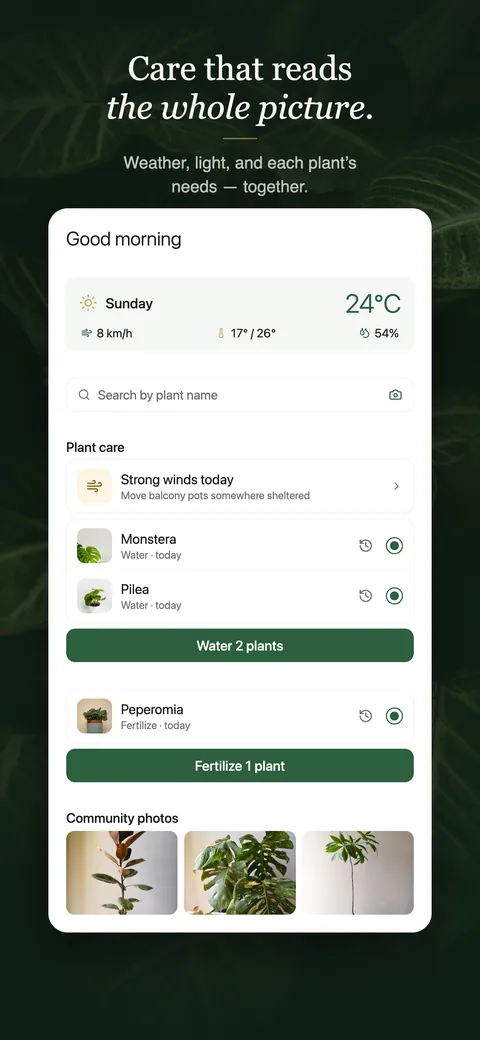
So a few feet back helps a pilea in a west room only if the air there is cooler. For light, the 1 m row was already full marks. The spider plant page works through the same trap for a plant that gives up its great fit at the same step. One thermometer reading, taken on the sill late on a sunny July afternoon, tells you which side of that step your window sits on. The cool end of the band, 17 °C, is the one the east-window page deals with, along with cold glass in winter.
Will my own west window score the same?
Not exactly. Every row above is an unshaded west window on a clear day. Anything that shades the glass lowers the light, and for a pilea that eats into the far end of those three metres long before it reaches the sill, which has plenty to spare. The west window guide covers what else does well in the afternoon beam, and the free spot checker scores your own spot with live weather where you live.
Published October 14, 2026
