With the air at 22 °C and 50% humidity, a beetle peperomia at west glass scores 100 out of 100, the window giving it an estimated 7,800 lux. Warm the air and nothing else, and it holds a great fit to 27 °C, then reads 67 at 28 °C and 47 at 31 °C. The light reads ideal on every one of those rows, and dated through the year at latitude 40 it never leaves the beetle’s band.
Read on 22 October 2026, the answer box at the top of Google’s results gives a west window a conditional yes for a peperomia: fine, as long as the intense afternoon sun is managed. It calls one to three feet back “ideal” and allows the bare sill only behind a sheer curtain or tree shade, because hot afternoon sun can scorch or bleach the waxy leaves. The first two results under it are Reddit threads, one asking whether west is a good spot at all.
That warning folds heat into light. Our score keeps them apart, and on a bare west sill only one of them ever pulls the verdict down.

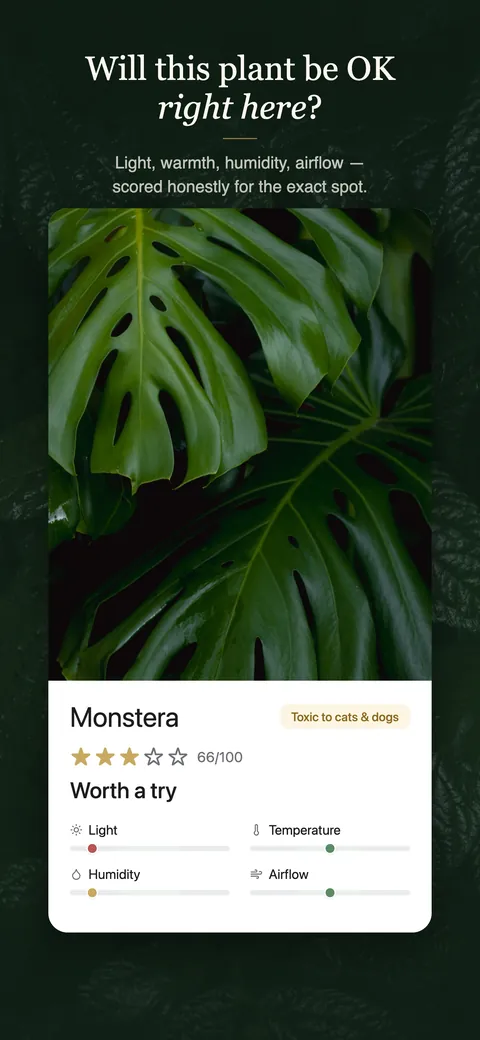
Great fit
This plant should be happy in this spot.
Just the right amount of light
Comfortable temperature
Humidity suits it
Airflow suits it
This card is the beetle peperomia, Peperomia angulata. For light it speaks for the leafy kinds too: our care data files the baby rubber plant, the emerald ripple, the string of turtles and the watermelon in the same band. The columnar peperomia, the ruby glow and the happy bean sit a band higher, and at a west window that gap decides which of them should get the sill.
Does a peperomia need a sheer on a west window?
For light, no. Here are the published figures first, each one left in the unit its publisher used:
| Who publishes it | What it says a peperomia needs | What the figure is |
|---|---|---|
| peperomiaobtusifolia.com | 2,000–4,000 lux | Baby rubber plant: the optimum at the leaf surface |
| peperomiaobtusifolia.com | 800–1,000 lux | Baby rubber plant: the tolerated minimum |
| getgrowli.app | 1,500–4,000 lux | Peperomia, placed in the site's medium indirect tier; the site prints the same band for other plants in that tier |
| getgrowli.app | 150–400 fc | The same tier, given in foot-candles |
| foliage-factory.com | approx. 10,000–20,000 lux | Baby rubber plant, on a product page: bright indirect |
| extension.illinois.edu | 150 foot candles | A tier figure: the page lists the baby rubber plant as medium light and gives that tier 150 foot candles |
| bloomingexpert.com | 250–1,000 foot-candles | Second-hand: the page credits this medium-light range to the University of Missouri Extension, whose original we could not open |
Foliage Factory’s bright indirect range for the baby rubber plant starts above anything a west window reaches, the June sill included. The optimum from peperomiaobtusifolia.com, a leaf-level figure for the same plant, takes in the 2 m and 3.35 m rows of the walk-back table below and runs out before 3.4 m. That’s where our score steps down for the leafy kinds too.
At the bright end, the sill was dated through all 365 days at every latitude we tried between 25 and 55. Its brightest stretch runs from late spring through summer, and even that stays inside the beetle’s band, which every leafy peperomia we tried shares; the thick-leaved kinds have headroom above it. For light, then, the sheer has nothing to do. A plant that has never had direct sun can still scorch the first time it meets the late beam, and the score doesn’t know where a plant lived before.
When does a west sill get too hot for a peperomia?
Past 27 °C, for a beetle. Here is the card’s sill with nothing changing but the air:
| Air at the sill | What the light is doing | What the warmth is doing | Verdict |
|---|---|---|---|
| 22 °C | Just the right amount of light | Comfortable temperature | Great fit, 100/100 |
| 25 °C | Just the right amount of light | Comfortable temperature | Great fit, 100/100 |
| 27 °C | Just the right amount of light | Comfortable temperature | Great fit, 99/100 |
| 28 °C | Just the right amount of light | A little warm, but workable | Worth a try, 67/100 |
| 30 °C | Just the right amount of light | A little warm, but workable | Worth a try, 64/100 |
| 31 °C | Just the right amount of light | Too hot here | Not the best fit right now, 47/100 |
The light column reads just right all the way down. The warmth column turns to a little warm at 27.5 °C and the verdict goes with it, from 99 at 27 °C to 67 at 28 °C. By 31 °C the warmth reads too hot, and the verdict has slid to not the best fit right now.
We can’t estimate your sill’s afternoon temperature, and glass with late sun on it can run past 27 °C while the thermostat reads fine. A pilea in the same spot gives up a degree earlier and a monstera hangs on two degrees longer; both pages look at what stepping back from a hot sill does and doesn’t change.
Peperomias don’t share one ceiling, either. A watermelon, an emerald ripple and a string of turtles drop out of their great fit at 26.5 °C, and the baby rubber plant where the beetle does. Happy bean and columnar peperomias hold to 28 °C, a ruby glow to 29 °C.
How far into a west room can a peperomia go?
A leafy one, further than most rooms run. The thick-leaved kinds want the glass. Both, walked back from one window:
| Where the pot is | Estimated light | Beetle peperomia | Ruby glow |
|---|---|---|---|
| West sill, against the glass | 7,800 lux | Great fit (100) | Great fit (99) |
| 1 m back | 6,000 lux | Great fit (100) | Great fit (98) |
| 1.5 m back | 4,762 lux | Great fit (100) | Worth a try (67) |
| 2 m back | 3,780 lux | Great fit (100) | Worth a try (65) |
| 3.35 m back | 2,026 lux | Great fit (98) | Worth a try (62) |
| 3.4 m back | 1,979 lux | Worth a try (69) | Not the best fit right now (47) |
The beetle holds a great fit to 3.35 m and reads 69 at 3.4 m, under 1,979 lux. The box’s one to three feet sits inside the first metre of that, so for a leafy peperomia it scores the same as the sill. A ruby glow’s great fit ends at about 1 m, close to where the box’s range does, and by 1.5 m it’s worth a try under light the beetle still scores 100.
What changes at a west window in winter?
For a leafy peperomia within 1.5 m of the glass, nothing. Dated at latitude 40, the sill, 1 m and 1.5 m keep a great fit all year. Two metres loses it from 29 November to 11 January and 3 m from 11 October to 1 March; on 21 December the run ends at 1.85 m.
Thick-leaved peperomias give up the sill itself, from 20 October to 20 February for a ruby glow. A hoya on the same sill drops out and comes back on the same dates. A south sill holds a ruby glow at a great fit all winter, so that’s where it should spend those months if you have one.
Which peperomia should get the west sill?
The thick-leaved ones. They need the glass for light, and they take a hot afternoon a degree or two better than the leafy kinds. A beetle or a baby rubber plant has more than three metres of good floor here, so if the sill runs hot, that’s the pot to move back, as long as the air back there is cooler. At east glass the same leafy kinds keep a great fit about 40 cm less deep, and the thick-leaved ones get a shorter sill season at both ends.
What if your west window is shaded?
Then the lines move toward the glass. Each row above stands for clear west glass under a clear sky, and its lux figure comes from the window’s compass bearing and the distance, not from a meter. An awning or a tree across the way cuts the light at every distance, which shortens the beetle’s 3.35 m and can drop a ruby glow under its line even on the sill. The west window guide lists plants that want the beam itself, and for your own glass and local weather there’s the free spot checker.
Published October 22, 2026
