In a room at 22 °C and 50% humidity, a beetle peperomia on an east sill gets 100 out of 100 from an estimated 6,500 lux. It keeps a great fit to 2.95 m into the room. At 3 m the light estimate is down to 1,984 lux, and the beetle drops to 69. A ruby glow also reads a great fit on the sill, then loses it at 0.65 m.
Read on 22 October 2026, the answer box at the top of Google’s results rates an east window ideal for a peperomia and credits Plant Addicts: gentle morning sun, then steady bright light. It puts the pot directly on the sill or right beside it, and if the morning sun bleaches or browns the leaves, it says to pull the pot back a foot or two. Under it sit care pages from Costa Farms, Clemson’s extension and The Spruce, a baby rubber plant site’s page on window direction and distance, and two Reddit threads.
The box has the sill right. The foot or two is where the genus splits, because peperomias don’t all want the same light.

Great fit
This plant should be happy in this spot.
Just the right amount of light
Comfortable temperature
Humidity suits it
Airflow suits it
The card is a beetle peperomia, Peperomia angulata, standing in for the leafy group: the watermelon, the baby rubber plant, the string of turtles and the emerald ripple score exactly like it at every distance on this page. The thick-leaved group wants more light. The ruby glow speaks for it below, and the columnar peperomia and the happy bean match it row for row.
Does a peperomia burn on an east sill?
Not by our score, on any day of the year. First the published side, light figures from other sites, most of them about the baby rubber plant and left in their own units:
| Who publishes it | What it says a peperomia needs | What the figure is |
|---|---|---|
| peperomiaobtusifolia.com | 2,000–4,000 lux | Baby rubber plant: the optimum at the leaf surface |
| peperomiaobtusifolia.com | 800–1,000 lux | Baby rubber plant: the tolerated minimum |
| getgrowli.app | 1,500–4,000 lux | Peperomia, placed in the site's medium indirect tier; the site prints the same band for other plants in that tier |
| getgrowli.app | 150–400 fc | The same tier, given in foot-candles |
| foliage-factory.com | approx. 10,000–20,000 lux | Baby rubber plant, on a product page: bright indirect |
| extension.illinois.edu | 150 foot candles | A tier figure: the page lists the baby rubber plant as medium light and gives that tier 150 foot candles |
| bloomingexpert.com | 250–1,000 foot-candles | Second-hand: the page credits this medium-light range to the University of Missouri Extension, whose original we could not open |
At 6,500 lux, our sill estimate sits above the optimum peperomiaobtusifolia.com gives for the baby rubber plant, a figure taken at the leaf. Against the east estimates in the next table, that optimum begins between the 0.9 and 1.5 m rows and runs out between 2.95 and 3 m. The far end is where our score steps down as well. At the near end they part: by that figure the sill is brighter than ideal, and our score marks nothing down there.
Brightness never becomes the problem on this sill. We ran it through a whole year of dates, from 25 to 55 degrees of latitude, and it never read too bright for any peperomia we scored, the thick-leaved kinds included. So the score has no reason of its own to move a pot off east glass. If leaves do bleach there, look for something it can’t see, such as a pot carried straight over from a dim shelf.
Where does an east room run out of light for a peperomia?
That depends on the kind. Here is one east window, walked back with a beetle peperomia and a ruby glow side by side:
| Where the pot is | Estimated light | Beetle peperomia | Ruby glow |
|---|---|---|---|
| East sill, against the glass | 6,500 lux | Great fit (100) | Great fit (98) |
| 0.6 m back | 6,015 lux | Great fit (100) | Great fit (98) |
| 0.9 m back | 5,236 lux | Great fit (100) | Worth a try (68) |
| 1.5 m back | 3,969 lux | Great fit (100) | Worth a try (66) |
| 2.95 m back | 2,031 lux | Great fit (98) | Worth a try (62) |
| 3 m back | 1,984 lux | Worth a try (69) | Not the best fit right now (47) |
The beetle doesn’t lose a point until past 1.5 m and still reads 98 at 2.95 m. Five centimetres on, it’s 69, the light a little dim. The ruby glow’s step comes at 0.65 m: by the 0.9 m row it’s 68, under 5,236 lux that the beetle scores 100.
Lay the box’s foot or two over those rows. From a pot on the sill, a foot back is about 0.6 m from the glass and two feet about 0.9 m. A leafy peperomia loses nothing either way. A ruby glow keeps its great fit at one foot and loses it at two.
Our care data puts the thick-leaved kinds a band above the leafy ones. At north glass they never reach a great fit, even on the sill, while a south sill suits them better than it suits the leafy ones.
How much of an east room does a peperomia keep in winter?
The glass end of it. Winter takes the far end of the room first. Here is the beetle 2 m back, dated, at 40 degrees north, the latitude of Denver and Beijing:
| The month | Estimated light | What the light is doing | Verdict |
|---|---|---|---|
| June | 3,780 lux | Just the right amount of light | Great fit, 100/100 |
| September | 3,139 lux | Just the right amount of light | Great fit, 99/100 |
| October | 2,386 lux | Just the right amount of light | Great fit, 99/100 |
| November | 1,768 lux | A little dim, but workable | Worth a try, 68/100 |
| December | 1,575 lux | A little dim, but workable | Worth a try, 67/100 |
| January | 1,789 lux | A little dim, but workable | Worth a try, 68/100 |
| February | 2,432 lux | Just the right amount of light | Great fit, 99/100 |
| March | 3,128 lux | Just the right amount of light | Great fit, 99/100 |
From February to October that spot holds a great fit, October being the dimmest of those months at 2,386 lux. November, December and January drop it to worth a try, between 1,575 and 1,789 lux. Scored day by day, the dip runs from 8 November to 2 February.
The sill and the 1 m spot never leave a great fit, and 1.5 m only misses 9 December to 1 January. At 2.5 m the gap stretches from 16 October to 24 February. On 21 December the beetle’s whole great-fit run ends at 1.45 m, about half what the distance table shows. An Ocean spider plant matches the beetle row for row at this window, so that page’s 2.5 m season table reads for a peperomia too.
A ruby glow loses even the sill. Between 1 October and 11 March it reads worth a try there, and nothing further back does better. A south sill keeps it at a great fit through that whole stretch at this latitude, so if you have one, that’s its winter spot.
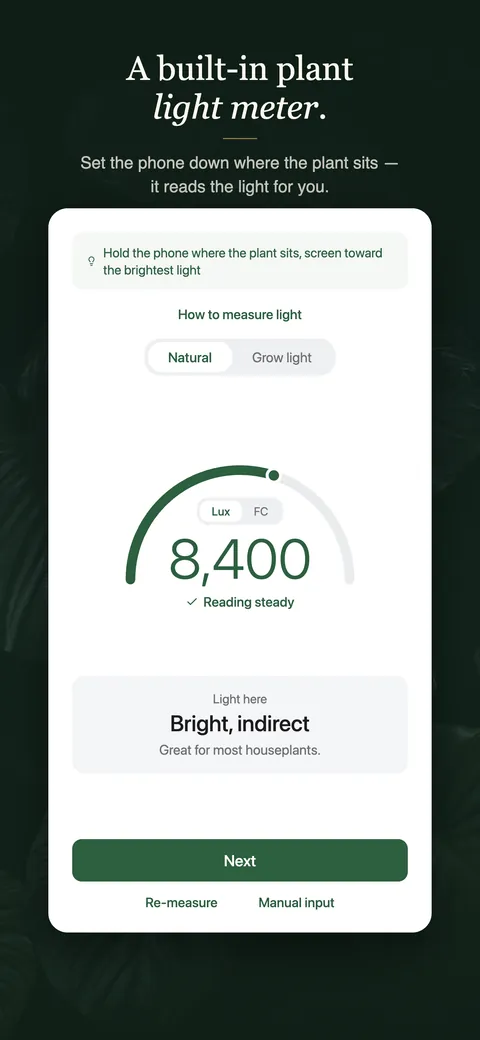
Is east better than west for a peperomia?
On light, no. West glass gives the leafy kinds the same great fit about 40 cm deeper on every date we compared. A ruby glow gets about a metre there, and a west sill season from 21 February to 19 October, longer at both ends than east’s 12 March to 30 September.
East’s case is timing. Its sun arrives before the room has warmed up. A west sill takes the beam late in the day, and a beetle starts giving up its great fit once the air passes 27 °C.
What can change these numbers in your room?
Anything outside the glass. Every row above assumes clear east glass and a cloudless day, and each lux figure is our estimate from the compass direction and the distance, not a meter reading. A street tree or a balcony overhead takes light off every row. That pulls the beetle’s 2.95 m toward the window and tips a ruby glow’s sill under its line sooner in autumn. The east window guide covers the plants that share this wall with a peperomia, and the free spot checker can score your actual window, local weather and all.
Published October 22, 2026
