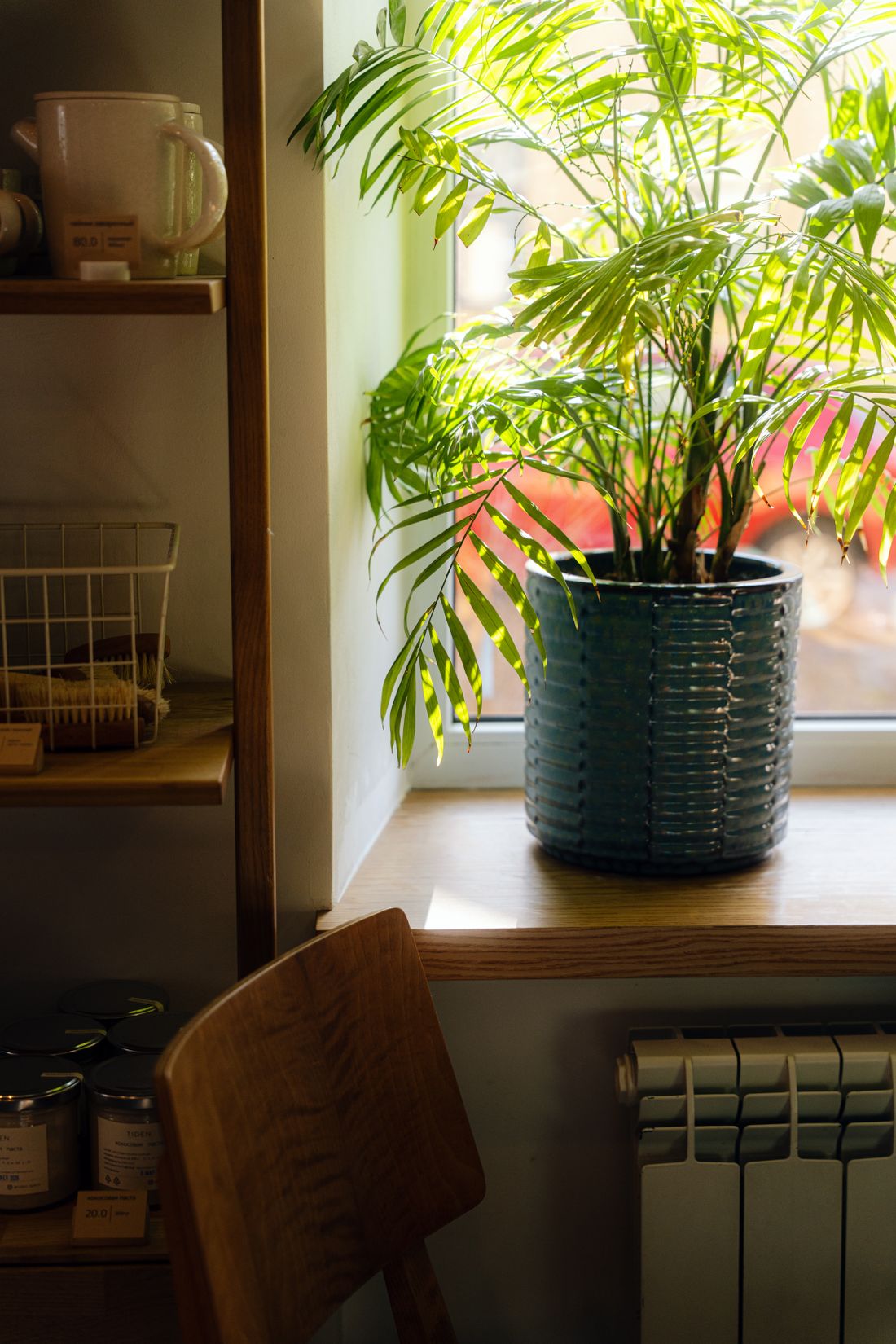
A parlor palm reads its light just right from about 400 to 5,160 lux on our scores, about 37 to 479 foot-candles. That is low for a palm, and a north window gives it from the sill to well past 3 m into the room. The brighter windows overshoot: an east sill reads a bit bright until about a metre back, a west sill until about 1.35 m, and a south sill is too bright at the glass and turns a great fit only about 2.5 m in. The palms it gets sold beside are not the same plant in the light. In our data the kentia and the bamboo palm sit a band higher, the areca two bands higher and the European fan palm higher again. The card below sits 2 m back from a north window at 21 °C and 45% humidity and scores 100 out of 100. The lux behind each verdict is modelled for a clear day from the compass direction, the distance and the date, not measured in your room.

Great fit
This plant should be happy in this spot.
Just the right amount of light
Comfortable temperature
Humidity suits it
Airflow suits it
Read on 22 November 2026, Google’s answer box for how much light a parlor palm needs gives medium to bright indirect light, says it tolerates low light, puts north and east windows first and sends it several feet back from a south or west one. It adds a Reddit view that ordinary office lighting of around 500 lux is near the minimum. On our scores 500 lux is already inside the great-fit band, which starts at about 400, and the north window is the one that holds the band from the sill back; the east sill is the spot that reads a bit bright.
Which window is best for a parlor palm?
North, from the glass back. Here is a parlor palm at seven spots, without a date:
| Where it stands | Estimated light | What the light is doing | Verdict |
|---|---|---|---|
| North sill, against the glass | 3,640 lux | Just the right amount of light | Great fit, 100/100 |
| 3 m back from a north window | 1,111 lux | Just the right amount of light | Great fit, 99/100 |
| East sill, against the glass | 6,500 lux | A bit bright, but workable | Worth a try, 67/100 |
| 1 m back from an east window | 5,000 lux | Just the right amount of light | Great fit, 98/100 |
| West sill, against the glass | 7,800 lux | A bit bright, but workable | Worth a try, 65/100 |
| South sill, against the glass | 13,000 lux | Too bright here | Not the best fit right now, 44/100 |
| 2.5 m back from a south window | 5,000 lux | Just the right amount of light | Great fit, 98/100 |
Given dates, at latitude 40 an east sill turns a great fit only from 17 October to 23 February and a west sill from 4 November to 5 February; the rest of the year both read a bit bright. A south sill is too bright from late August to late April and a bit bright in between. A north window holds the band on every day of the year at latitude 40, from the sill to 4 m back. The pages we read describe the same windows without a light level:
| Who publishes it | What it says a parlor palm needs | What the figure is |
|---|---|---|
| bababerry.co | low to medium indirect light | What a parlor palm needs |
| bababerry.co | several feet back from a north- or east-facing window | Where that light level is found |
| bababerry.co | no direct sun at all | Even a few hours of unfiltered midday sun scorches the fronds |
| livelyroot.com | About 10 hours of light daily | What it needs to thrive |
| livelyroot.com | a north- or east-facing window | The best place to keep it |
| patchplants.com | out of direct sunlight | Near a window that gets plenty of natural light |
| hgic.clemson.edu | tolerate lower light levels well | Parlor palms, the Chamaedorea species |
| hgic.clemson.edu | a minimum winter temperature of 60 °F | What parlor palms need in winter |
| libguides.nybg.org | lower light situations than most other palms | Where the parlour palm can thrive |
BabaBerry’s several feet back from an east window lands where our scores put the start of the band, about a metre, or three feet, in; several feet back from a north window costs nothing, since the north sill itself is a great fit. Lively Root’s ten hours of light a day is a different measure: our scores rate how bright a spot is on a clear day, not for how long. Clemson’s minimum winter temperature of 60 °F, about 15.6 °C, reads worth a try, a little cool, on our scores.
Which indoor palms can take low light?
The parlor palm, and not much else. Here are five indoor palms 2 m back from the same north window:
| The palm | What the light is doing | Verdict |
|---|---|---|
| Parlor palm (Chamaedorea elegans) | Just the right amount of light | Great fit, 94/100 |
| Kentia palm (Howea forsteriana) | A little dim, but workable | Worth a try, 66/100 |
| Bamboo palm (Chamaedorea seifrizii) | A little dim, but workable | Worth a try, 68/100 |
| Areca palm (Dypsis lutescens) | Too dim here | Not the best fit right now, 44/100 |
| European fan palm (Chamaerops humilis) | Too dim here | Not the best fit right now, 45/100 |
The parlor palm is a great fit there; the kentia and the bamboo palm read worth a try, a little dim; the areca and the European fan palm read not the best. Clemson’s indoor palm factsheet sorts them the same way: parlor palms tolerate lower light well, kentias tolerate relatively low light but grow best with bright light, arecas do best in bright indirect light near an east, west or south window, and European fan palms need three to four hours of direct sun a day. The New York Botanical Garden adds that the bamboo palm can tolerate lower light. Move the five onto a south sill and the order turns over: the areca is a great fit there, while the parlor palm reads too bright. The ponytail palm, which is not a palm, sits at the European fan palm’s end of the scale: its light page has both a little dim even there.
What temperature does a parlor palm like?
Ordinary room temperature. On our scores a parlor palm is a great fit from 17 to 27 °C (about 63 to 81 °F), worth a try from 13 to 16.9 °C, and not the best below 13 °C, 55 °F; above 30 °C, about 86 °F, it reads too hot. Its comfortable humidity starts at 40%, so a heated room in winter is close to its lower edge. For a spot you can’t picture, the free spot checker scores a parlor palm against your local weather.
Published November 22, 2026
