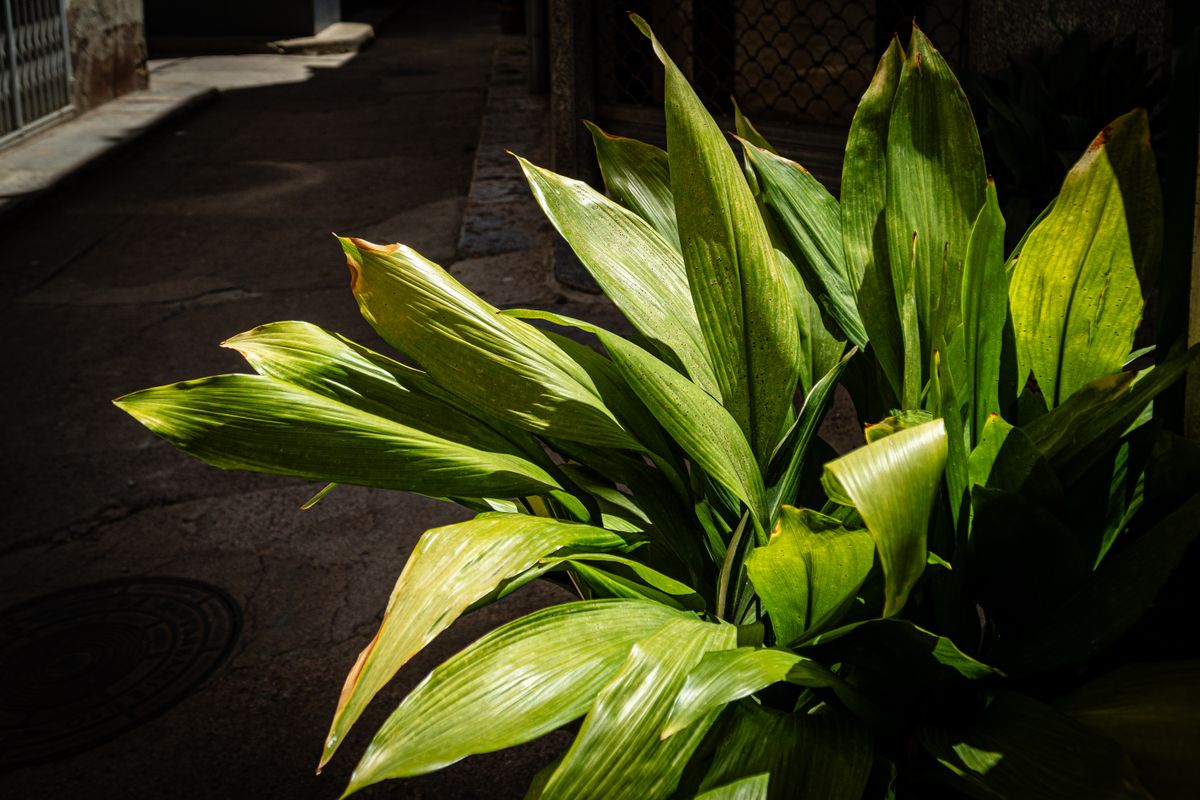
Less than most houseplants, and much less sun than its tough name suggests. On our scores a cast iron plant reads its light just right from 400 to about 5,170 lux, about 37 to 480 foot-candles; below 400 it reads a little dim, and from about 10,360 too bright. At latitude 40, about where Denver and Beijing sit, a north sill keeps it just right every day of the year, and on 21 December the band still reaches 4 m back. A bare south sill is too bright from 21 August to 21 April and a bit bright the rest of the year, never just right. East and west sills read a bit bright from February into October or November. The card below sits right on a north sill at 21 °C, about 70 °F, with 45% humidity, and scores 100. Its lux is modelled for a clear day from the compass direction, the distance and the date, not measured in your room.

Great fit
This plant should be happy in this spot.
Just the right amount of light
Comfortable temperature
Humidity suits it
Airflow suits it
Read on 27 November 2026, Google’s answer box for how much light a cast iron plant needs says low to medium indirect light, warns that direct sun can scorch, bleach or yellow the leaves, and puts the plant near a north-facing window or a few feet back from an east, south or west one. Our scores agree on every window. What they add is how far a few feet has to be on a clear day: 0.95 m from an east window, 1.35 m from a west one and 2.45 m from a south one.
Which window is best for a cast iron plant?
North, anywhere from the sill to the far side of the room. Here it is at nine spots in one home on a clear day, without a date:
| Where it stands | Estimated light | What the light is doing | Verdict |
|---|---|---|---|
| North sill, against the glass | 3,640 lux | Just the right amount of light | Great fit, 100/100 |
| 3 m back from a north window | 1,111 lux | Just the right amount of light | Great fit, 100/100 |
| 6 m back from a north window | 420 lux | Just the right amount of light | Great fit, 98/100 |
| East sill, against the glass | 6,500 lux | A bit bright, but workable | Worth a try, 67/100 |
| 1 m back from an east window | 5,000 lux | Just the right amount of light | Great fit, 99/100 |
| West sill, against the glass | 7,800 lux | A bit bright, but workable | Worth a try, 66/100 |
| South sill, against the glass | 13,000 lux | Too bright here | Not the best fit right now, 45/100 |
| 2.5 m back from a south window | 5,000 lux | Just the right amount of light | Great fit, 99/100 |
| A dim corner, 2 m from the nearest window | 315 lux | A little dim, but workable | Worth a try, 67/100 |
The north room holds the whole way: 6 m back the model still puts 420 lux there, inside the band. Every other window needs a step back from the glass, and the south one the longest. With dates, at latitude 40, an east sill reads a bit bright from 24 February to 16 October and a west sill from 6 February to 3 November; both are just right through the darkest weeks, when a north sill still keeps the band out to 4 m. On 21 December the south window turns just right 2.35 m back; on 21 June, with the sun high, from 1.2 m.
How dark is too dark for a cast iron plant?
Below 400 lux it reads a little dim, and below 100 too dim. In the table’s dim corner, 2 m from the nearest window, it gets 315 lux and reads worth a try. That dark edge is the same for every low-light plant in our care data: a golden pothos, a ZZ, a snake plant and a peace lily all turn a little dim at the same 400 lux. So on our scores a cast iron plant takes no more darkness than a pothos does. Where it differs is the other end.
Can a cast iron plant take direct sun?
Less than a ZZ or a snake plant can. Here are eight low-light plants on the same bare south sill:
| The plant | What the light is doing | Verdict |
|---|---|---|
| ZZ plant (Zamioculcas zamiifolia) | A bit bright, but workable | Worth a try, 66/100 |
| Snake plant (Dracaena trifasciata) | A bit bright, but workable | Worth a try, 66/100 |
| Golden pothos (Epipremnum aureum) | Too bright here | Not the best fit right now, 44/100 |
| Heartleaf philodendron (Philodendron hederaceum) | Too bright here | Not the best fit right now, 44/100 |
| Cast iron plant (Aspidistra elatior) | Too bright here | Not the best fit right now, 45/100 |
| Chinese evergreen (Aglaonema commutatum) | Too bright here | Not the best fit right now, 41/100 |
| Parlor palm (Chamaedorea elegans) | Too bright here | Not the best fit right now, 41/100 |
| Peace lily (Spathiphyllum wallisii) | Too bright here | Not the best fit right now, 37/100 |
The ZZ and the snake plant read a bit bright there, worth a try at 66. The cast iron plant reads too bright, with golden pothos, heartleaf philodendron, Chinese evergreen, parlor palm and peace lily. In our care data its light turns a bit bright at 5,170 lux and too bright at about 10,360; for the ZZ and the snake plant those lines sit at about 6,010 and 20,010. A metre back from the south window the model still puts 10,000 lux there, a bit bright for a cast iron plant; it needs 2.45 m.
What do care guides say about its light?
Three institutional sources rate it for shade, and all three keep it out of direct sun:
| Who publishes it | What it says a cast iron plant needs | When |
|---|---|---|
| plants.ces.ncsu.edu | Cast iron plants prefer partial to full shade and are intolerant of direct sun. | In the garden |
| plants.ces.ncsu.edu | Dappled Sunlight (Shade through upper canopy all day) | One of its two light ratings |
| plants.ces.ncsu.edu | Deep shade (Less than 2 hours to no direct sunlight) | Its other light rating |
| plants.ces.ncsu.edu | It makes a good evergreen "hosta substitute", especially for low light areas as well as indoors in pots. | In the garden and indoors |
| gardeningsolutions.ifas.ufl.edu | does equally well in filtered and deep shade—just don’t plant it in full sun | Outdoors in Florida |
| gardeningsolutions.ifas.ufl.edu | it’s especially suited for homes and offices that don’t receive much light | As a houseplant |
| plantfinder.mobot.org | Best sited in bright indirect light, but tolerates full shade. Avoid direct sun. | As a houseplant |
| plantfinder.mobot.org | Direct sun will bleach leaves. | Among its problems |
| plantfinder.mobot.org | Part shade to full shade | Its sun rating |
The Missouri Botanical Garden calls bright indirect light best but says it tolerates full shade; NC State rates it for dappled sunlight and deep shade; UF/IFAS says filtered and deep shade suit it equally well. On our scores the bright half of that range is the just-right half: a north sill at 3,640 lux scores 100, while the dim corner reads worth a try. All three warn off direct sun, and the Missouri Botanical Garden says it will bleach the leaves. The striped forms in our care data, ‘Asahi’ and ‘Milky Way’, score exactly like the plain plant in every condition we ran; the answer box says variegated types want slightly brighter light, which our data does not separate.
For a spot you can’t picture, the free spot checker scores a cast iron plant against your local weather.
Published November 27, 2026
