Every calathea in our data reads its light just right from about 2,000 to 9,000 lux on our scores, about 186 to 836 foot-candles; the rattlesnake, the orbifolia, the medallion and the peacock plant all share the band. A north window gives it from the sill to about 1.7 m into the room, and an east window to just short of 3 m. A south sill overshoots: it reads a bit bright until about 1.25 m back, and from there the band holds to just short of 4.5 m. Light is half of it. A calathea also wants damp air, and in a heated room in winter the air is what marks it down. The card below sits 1 m back from a north window at 21 °C and 50% humidity and scores 91 out of 100; the one thing it marks down is the air, a little dry. The lux behind each verdict is modelled for a clear day from the compass direction, the distance and the date, not measured in your room.
Great fit
This plant should be happy in this spot.
Just the right amount of light
Comfortable temperature
A little dry, but workable
Airflow suits it
Read on 22 November 2026, Google’s answer box for how much light a calathea needs gives medium to bright indirect light and no direct sun. It cites Low Light Leaf for at least 75 foot-candles to survive and about 150 to 200 for vivid leaves and steady growth, puts east and north windows first, and sends a calathea a few feet back from a west or south one, or behind a sheer curtain. On our scores 75 foot-candles, about 807 lux, reads worth a try, a little dim, and so does 150; the great fit starts at about 186, so 200 is just inside it.
Which window is best for a calathea?
North or east, from the glass back. Here is a calathea at seven spots, without a date:
| Where it stands | Estimated light | What the light is doing | Verdict |
|---|---|---|---|
| North sill, against the glass | 3,640 lux | Just the right amount of light | Great fit, 91/100 |
| 2.5 m back from a north window | 1,400 lux | A little dim, but workable | Worth a try, 63/100 |
| 5 m back from a north window | 441 lux | Too dim here | Not the best fit right now, 42/100 |
| East sill, against the glass | 6,500 lux | Just the right amount of light | Great fit, 91/100 |
| West sill, against the glass | 7,800 lux | Just the right amount of light | Great fit, 91/100 |
| South sill, against the glass | 13,000 lux | A bit bright, but workable | Worth a try, 63/100 |
| 1.5 m back from a south window | 7,937 lux | Just the right amount of light | Great fit, 91/100 |
Given dates, at latitude 40 a north sill and an east sill hold the band on every day of the year. A west sill reads a bit bright from 14 April to 28 August and is a great fit the rest of the year. A south sill is a great fit only from 9 May to 3 August and reads a bit bright the rest of the year; a metre back it is a great fit from 7 April to 4 September, and 1.5 m back on every day. Further north the north sill runs short in midwinter: at latitude 51.5, London’s, it reads worth a try, a little dim, from 13 November to 28 January. The pages we read describe the same windows without a light level:
| Who publishes it | What it says a calathea needs | What the figure is |
|---|---|---|
| lowlightleaf.com | at least 75 foot-candles | What it needs to survive |
| lowlightleaf.com | 150 to 200 | Foot-candles for it to look its best |
| livelyroot.com | near a north- or east-facing window | Where to move it, in bright, indirect light |
| bababerry.co | North | The single best calathea light placement |
| bababerry.co | several feet back | From a west window, or filter with a sheer |
| bababerry.co | well back from the glass | From a south window, unless diffused with a sheer curtain |
| plantaddicts.com | an east- or west-facing window | Limited light early or late in the day |
| plantaddicts.com | several feet back from a south-facing window | Or closer if there is a sheer curtain |
| planethouseplant.com | close to a north or east-facing window | Where to move it when it needs more light |
Several feet back from a south window, which BabaBerry and Plant Addicts both give, lands where our scores put the start of the band, about 1.25 m, or four feet, in. BabaBerry’s several feet back from a west window is about right from mid-April to late August at latitude 40; the rest of the year the west sill itself is a great fit. Low Light Leaf’s 75 foot-candles is a figure for surviving, and on our scores it reads worth a try, a little dim; its 150 to 200 straddles the start of our great fit at about 186.
How much humidity does a calathea need?
More than a heated room gives it. The peacock plant on the card reads its humidity just right from 60%, a little dry from 45 to 59% and too dry below 45%; no calathea in our data has a comfortable range starting below 50%. Penn State Extension notes that indoor humidity can easily fall below 30% in the winter heating season. Here are nine houseplants 1 m back from the same north window in 30% air:
| The plant | What the air is doing | Verdict |
|---|---|---|
| Boston fern (Nephrolepis exaltata) | Too dry here | Worth a try, 63/100 |
| Rex begonia (Begonia rex) | Too dry here | Worth a try, 62/100 |
| Prayer plant (Maranta leuconeura) | Too dry here | Worth a try, 63/100 |
| Peacock calathea (Calathea makoyana) | Too dry here | Worth a try, 63/100 |
| Cast iron plant (Aspidistra elatior) | Humidity suits it | Great fit, 93/100 |
| Chinese evergreen (Aglaonema commutatum) | A little dry, but workable | Great fit, 91/100 |
| Golden pothos (Epipremnum aureum) | A little dry, but workable | Good fit, 85/100 |
| Heartleaf philodendron (Philodendron hederaceum) | A little dry, but workable | Good fit, 85/100 |
| Corn plant (Dracaena fragrans) | A little dry, but workable | Good fit, 84/100 |
The Boston fern, the rex begonia, the prayer plant and the calathea read too dry there and come out worth a try, on light that suits all four. The cast iron plant’s air suits it; the Chinese evergreen, golden pothos, heartleaf philodendron and corn plant read a little dry and still come out a good or great fit. That is the University of Nebraska–Lincoln Extension’s split in two lines: its Lancaster County office names ferns, rex begonias, prayer plants and calatheas among the plants that need high humidity to grow well, and the cast iron plant, Chinese evergreen, devil’s ivy, philodendrons and dracaenas among the ones that tolerate low humidity. At 40% the rex begonia moves up to a little dry, while the other three stay too dry until 45%. An angel-wing begonia, a cane kind, reads only a little dry at 30% there and comes out a good fit. Low Light Leaf finds 40 to 60% enough for a calathea in a home; on our scores the low end of that reads too dry, and from 50% the calathea is a great fit.
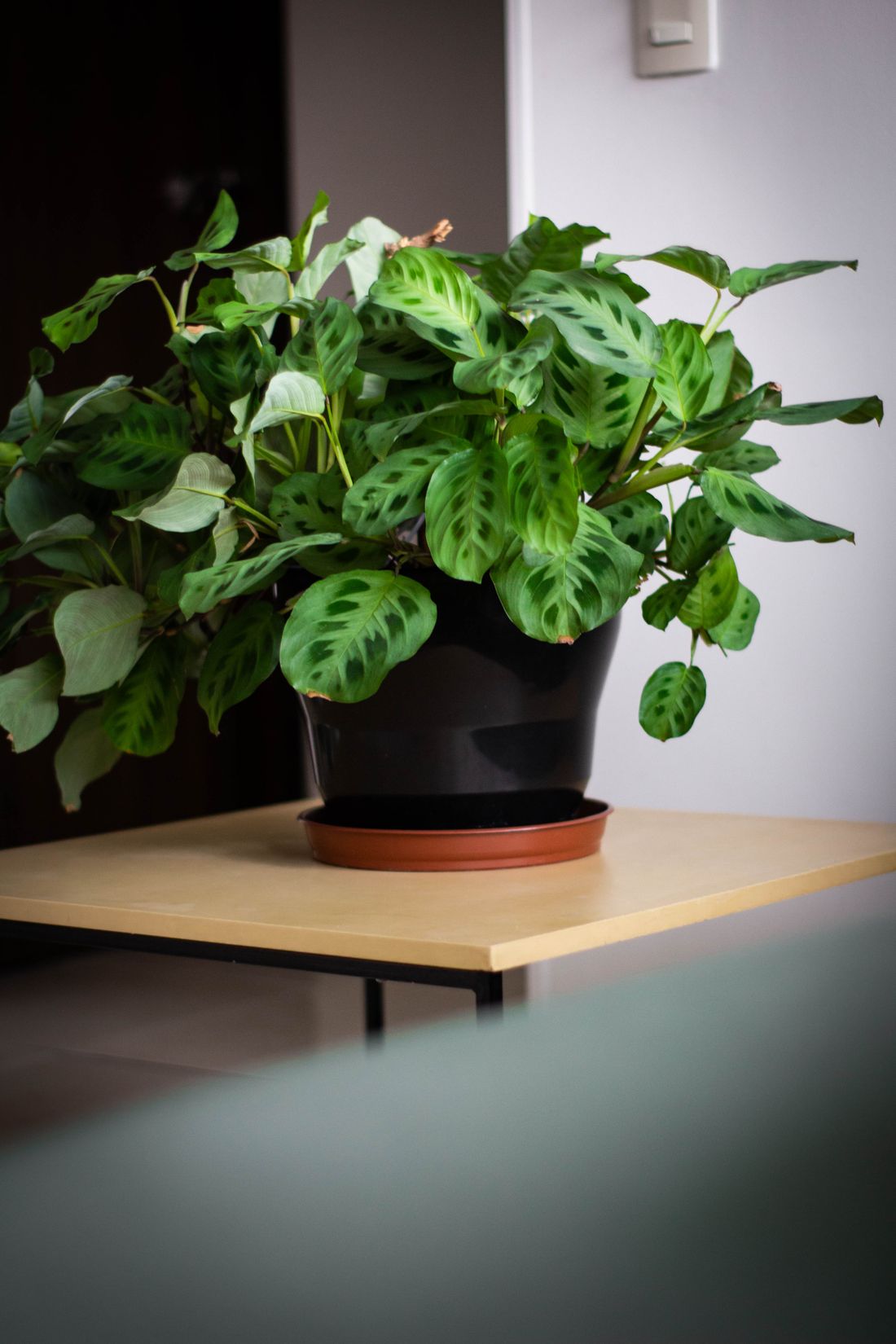
What temperature does a calathea like?
Ordinary room temperature. On our scores the peacock plant is a great fit from 18 to 27 °C (about 64 to 81 °F), worth a try from 16 to 17.9 °C, and not the best below 16 °C, about 61 °F; above 30 °C, 86 °F, it reads too hot. Low Light Leaf’s 65 to 80 °F and NC State Extension’s 65 to 75 °F both sit inside that great fit. For a spot you can’t picture, the free spot checker scores a calathea against your local weather.
Published November 22, 2026
