Put an areca palm on an east sill, at 22 °C and 50% humidity with light airflow, and it scores 98 out of 100, a great fit: about 6,500 lux on a clear day, and the light rates just right. At 0.6 m back it still scores 98. A metre back the light has gone a little dim and it’s 67, worth a try; three metres in, 47.
Read on 28 November 2026, Google’s answer box rates an east window a great spot for an areca, with gentle morning light and no harsh afternoon sun (it cites Penn State Extension). It places the palm a couple of feet from the glass, or right beside it if the morning sun is soft. Crispy or yellow-brown tips mean move back or add a sheer; pale, stretched fronds mean move closer.
Our numbers pick the glass and leave neither fix much room. Moved back in centimetre steps, the pot is out of its just-right light by 0.61 m. That’s two feet, so a couple of feet out is the first spot past the line.

Great fit
This plant should be happy in this spot.
Just the right amount of light
Comfortable temperature
Humidity suits it
Airflow suits it
Does an east window give an areca palm enough light?
At the glass, and only just. Other sites put numbers on what this palm wants. None of them is about an east window, but each one can be set against it:
| Who publishes it | What it says an areca palm needs | What the figure is |
|---|---|---|
| getgrowli.app | 4,000–8,000 lux | Its "Bright Indirect" tier, a band the site prints for several plants |
| getgrowli.app | 400–800 fc | The same tier, given in foot-candles |
| foliage-factory.com | approx. 10,000–20,000 lux | Listed as bright indirect, under the older name Chrysalidocarpus lutescens |
| mrec.ifas.ufl.edu (UF/IFAS) | 5,000 to 6,000 foot-candles | Best light for commercial production, about 50% shade; read from a 13 August 2025 archive copy, as the live page now returns 404 |
Against this window the two lux bands pull opposite ways. Foliage Factory’s band begins at 10,000, and no east spot reaches that on any day of our dated runs; the brightest is the sill in June, at 7,800 lux. By that figure an east window never suits this palm. Growli’s 4,000 to 8,000 would pass the first metre and a half of the room. Our scoring lands between the two: just right on the sill, a little dim by the one-metre row.
Each lux figure is what our model expects at that distance from open east glass on a clear day. None comes from a meter, and the difference matters more at this window than at most, because the sill clears the band by so little.
How far from an east window should an areca palm be?
As close as it will go. One palm, carried back from the glass in steps:
| Distance from the glass | Estimated light | What the light is doing | Verdict |
|---|---|---|---|
| 0.3 m, against the glass | 6,500 lux | Just the right amount of light | Great fit, 98/100 |
| 0.6 m back | 6,015 lux | Just the right amount of light | Great fit, 98/100 |
| 1 m back | 5,000 lux | A little dim, but workable | Worth a try, 67/100 |
| 2 m back | 3,150 lux | A little dim, but workable | Worth a try, 64/100 |
| 3 m back | 1,984 lux | Too dim here | Not the best fit right now, 47/100 |
The whole great-fit zone is the sill and about 30 cm behind it. Across that strip the estimate eases from 6,500 to 6,015 lux and the score stays at 98; one centimetre on, the light reads a little dim. Behind the edge the score sags slowly: one metre gets 67, two metres 64, and the palm stays worth a try until just short of three metres. There the light is marked too dim and the palm drops to 47.
So the box’s two suggestions fall in different bands. Right beside the glass is a great fit, and a couple of feet back is the first worth-a-try spot. If that’s where your floor space is, the next two metres cost very little more. For a palm that has to live that far in, a kentia is the better choice at this window: our scores keep it a great fit nearly three metres into the room.
Can morning sun burn an areca palm on an east sill?
Not through the amount of light, on our scoring. The light on an east sill never reads bright for this palm on any day of the year. It peaks from late April into August at 7,800 lux, the June row of the dated table below, and still reads just right. Some palms do find that sill too much: a parlor palm there is flagged for it and wants to sit about a metre back. The areca isn’t one of them.
The answer box’s crispy-tip fix comes at a price here. Moving back or hanging a sheer takes light from a palm with almost none to spare, and the edge is only about 30 cm behind the sill. If the tips crisp on an east sill, our numbers give no reason to blame too much light. What the score can’t see is a sudden change: a palm carried straight from a dim corner onto the glass can still mark, so move it up in stages over a week or two.
What happens to an areca palm at an east window in winter?
For almost half the year it runs short of light. Here is the card’s sill again, dated for latitude 40, which passes close to Denver and Beijing:
| The 21st of | Estimated light | What the light is doing | Verdict |
|---|---|---|---|
| February | 5,019 lux | A little dim, but workable | Worth a try, 67/100 |
| March | 6,455 lux | Just the right amount of light | Great fit, 98/100 |
| June | 7,800 lux | Just the right amount of light | Great fit, 99/100 |
| September | 6,477 lux | Just the right amount of light | Great fit, 98/100 |
| October | 4,924 lux | A little dim, but workable | Worth a try, 67/100 |
| December | 3,250 lux | A little dim, but workable | Worth a try, 64/100 |
Day by day, the sill stays in its band from 12 March through September; on 1 October the light dips under it and the palm drops to worth a try until 11 March. The low point is the winter solstice, at 3,250 lux and 64. The answer box’s couple of feet splits the year in two: two feet back is a great fit from 23 March to 20 September and worth a try for the rest.
Here the answer box’s other fix runs out of room: pale, stretched fronds mean bring it closer, and from October there’s nowhere closer to go. For those months an east window gives an areca what a north window gives it all year, a workable sill and nothing better behind it. Brighter glass is the way out. In our dated runs a south sill keeps this palm a great fit all winter, and the south page walks it back from that window. A Burgundy rubber plant shares this palm’s light band and hits the same dim months on this sill.
How do you know if your east sill is bright enough?
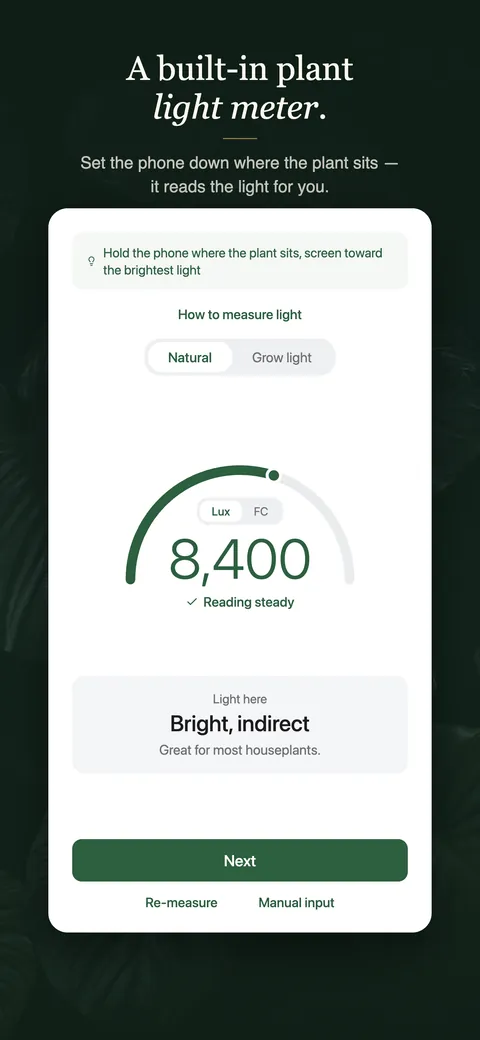
Set the phone down where the pot will stand and take a reading. On a clear day our model gives the sill 6,500 lux and the 0.6 m spot 6,015, both just right, with the edge a centimetre behind. A pale wall opposite can lift a real room above these figures and a tree outside can pull it below them; neither is in our estimate.
These numbers are for an east window with nothing in front of it, north of the equator. The east window guide follows how fast that light fades from the glass and which plants belong at each distance, and the free spot checker puts your own window, with today’s weather, through the same scoring.
Published November 28, 2026
