More than a north window can give it. On our scores an areca palm reads its light just right in a band from 6,000 to 26,400 lux, about 557 to 2,453 foot-candles; from 2,000 to 5,999 it reads a little dim, and below 2,000 too dim. On a clear day a bare south sill puts 13,000 lux on it, and the band reaches 2.10 m into the room. An east sill gives 6,500 and a west one 7,800; both are just right, but only to 0.60 and 1.00 m from the glass. A north sill gives 3,640 and reads a little dim. The card below holds one right on the bare south sill at 22 °C, about 72 °F, with 50% humidity and light airflow, and scores 100 out of 100. Its lux is modelled for a clear day from the window’s direction and the pot’s distance, not measured in your room.

Great fit
This plant should be happy in this spot.
Just the right amount of light
Comfortable temperature
Humidity suits it
Airflow suits it
Read on 28 November 2026, Google’s answer box asks for bright, indirect light, says the palm copes with lower light or gentle morning sun, and warns that harsh afternoon sun can scorch the fronds. Indoors it says east- and north-facing windows work well, and wants a south or west one pulled back or screened with sheers. Our scores rank those windows the other way round. The north one never reaches the band, and east and west reach it only near the glass. The bare south sill has room to spare: the band holds 2 m back from it, and its 13,000 lux is about half the 26,401 at which our scores would first call the light a bit bright.
Where is the best place to put an areca palm?
By a south window, on the sill or close to it. Here it is at the sill and 2 m back from each window, on a clear day without a date:
| Where it stands | Estimated light | What the light is doing | Verdict |
|---|---|---|---|
| North sill, at the glass | 3,640 lux | A little dim, but workable | Worth a try, 65/100 |
| 2 m back from a north window | 1,764 lux | Too dim here | Not the best fit right now, 47/100 |
| East sill, at the glass | 6,500 lux | Just the right amount of light | Great fit, 98/100 |
| 2 m back from an east window | 3,150 lux | A little dim, but workable | Worth a try, 64/100 |
| West sill, at the glass | 7,800 lux | Just the right amount of light | Great fit, 99/100 |
| 2 m back from a west window | 3,780 lux | A little dim, but workable | Worth a try, 65/100 |
| South sill, at the glass | 13,000 lux | Just the right amount of light | Great fit, 100/100 |
| 2 m back from a south window | 6,300 lux | Just the right amount of light | Great fit, 98/100 |
Only the south window keeps it just right 2 m into the room. Its band holds to 2.10 m, and the light reads too dim only from 4.50 m. At the east and west windows the band is a strip along the glass, 0.60 and 1.00 m deep, and a north window has none: the sill reads a little dim, and from 1.75 m back the light is too dim; that glass suits a parlor palm instead. The north window guide sets the areca beside five other palms on that sill; the south one walks it back to 5 m and tries the sill in cooler and warmer air. The east window, where the band is shallowest, has its own guide.
Does an areca palm get enough light in winter?
At a south window it does. At an east or west one, at latitude 40, it doesn’t. Here is the west sill on the 21st of nine months:
| The month on the sill | Estimated light | What the light is doing | Verdict |
|---|---|---|---|
| January | 4,429 lux | A little dim, but workable | Worth a try, 66/100 |
| March | 7,746 lux | Just the right amount of light | Great fit, 99/100 |
| April | 9,305 lux | Just the right amount of light | Great fit, 100/100 |
| June | 9,360 lux | Just the right amount of light | Great fit, 100/100 |
| August | 9,322 lux | Just the right amount of light | Great fit, 100/100 |
| September | 7,773 lux | Just the right amount of light | Great fit, 99/100 |
| October | 5,909 lux | A little dim, but workable | Worth a try, 69/100 |
| November | 4,377 lux | A little dim, but workable | Worth a try, 66/100 |
| December | 3,900 lux | A little dim, but workable | Worth a try, 65/100 |
The west sill is just right from 21 February to 19 October and a little dim for the four months between, and an east sill holds the band only from 12 March to 30 September. Pulling the pot back, as the answer box suggests for west, only takes more light away. The bare south sill is just right on every day of the year. Its low point, in June with the sun high, is still inside the band, and its peak, near 14,000 lux in mid-October, is well short of a bit bright. What moves with the seasons is how far that band reaches into the room: 1.95 m from the glass on 21 December, and only 0.85 m on 21 June, so keep it close in summer.
What do care guides say about areca palm light?
Most ask for bright light, and they split over sun and shade:
| Who publishes it | What it says an areca palm needs | When |
|---|---|---|
| plants.ces.ncsu.edu | In the home, they prefer a bright location in a warm to average room and high humidity. | As a houseplant |
| plants.ces.ncsu.edu | Outdoors in zones 10-11, the plant tolerates full sun but prefers partial shade and moist but well-drained soils. | Outdoors, in the tropics |
| rhs.org.uk | Grow under glass in a peat-free, loam-based potting compost in bright indirect light. | Under glass |
| rhs.org.uk | Partial shade | Its position field |
| ask.ifas.ufl.edu | Light requirement: full sun, partial sun, or partial shade; shade tolerant | Landscape fact sheet |
| ask.ifas.ufl.edu | Young palms in full sun and those in high pH soils develop yellow leaves. | Outdoors |
| extension.psu.edu | Finding the sweet spot near a south- or east-facing window with filtered sunlight ensures their optimal growth. | Indoor palms in general, not the areca by name |
Our scores side with Penn State, which writes about palms as houseplants in general rather than the areca by name. Of its two windows, the south one holds the band furthest into the room, the east one only near the glass. NC State’s bright location in the home fits too. Where they differ is shade. UF/IFAS, writing about the areca as a landscape palm in Florida, calls it shade tolerant, and RHS gives its position as partial shade; on our scores even the sill of a north window, the shadiest of the four, reads a little dim. The full sun in these sources is outdoors: NC State says that outdoors in zones 10 to 11 it tolerates full sun but prefers partial shade, and UF/IFAS that young palms in full sun develop yellow leaves. Indoors, the brightest spot on this page, the bare south sill, reads just right. Scorch, the answer box’s worry, is outside what our scores rate; they weigh only how much light reaches a spot.
How can you tell if an areca palm is getting enough light?
Measure the spot. Every figure above is modelled for a clear day, and a reading where the pot stands is worth more:
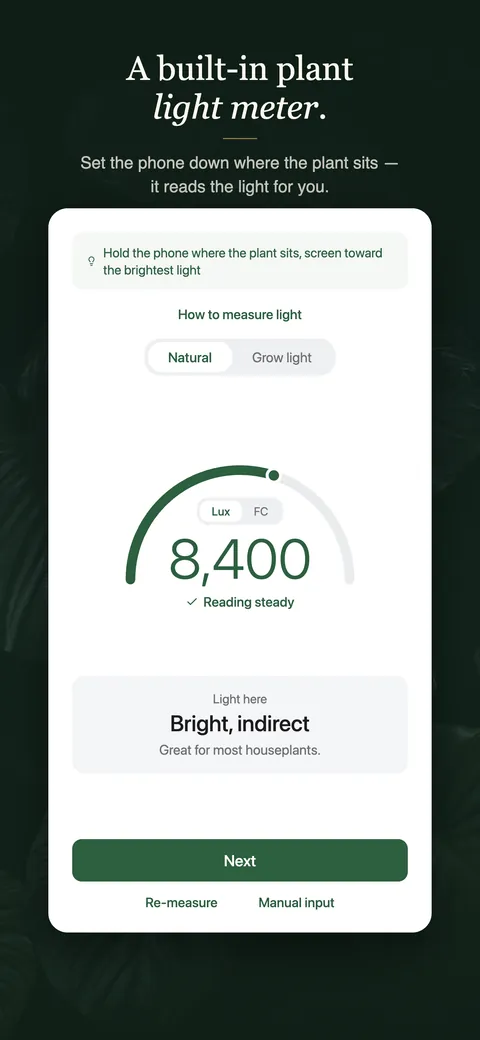
The 8,400 lux in the picture would sit inside an areca’s band on our scores. The label under it uses RHS’s words, and the meter gives that label to anything from 2,500 to just under 10,000 lux; below 6,000 an areca reads a little dim, so read the number. A grey afternoon reads lower than the same spot on a clear day, which is what every figure here assumes. The answer box’s six to eight hours a day counts time; the meter, like our scores, reads how bright the spot is.
For your own window, the free spot checker scores an areca palm with your local weather.
Published November 28, 2026
