Right against north glass, at 22 °C, 50% humidity and the light airflow this palm prefers, an areca scores 65 out of 100. That’s worth a try, with the light marked a little dim and nothing else against it, and it’s the best this window does for the plant. A metre and a half back the score is 63. Two metres back it’s 47.
Read on 14 October 2026, the answer box at the top of Google’s results says an areca can manage near a north window if the room gets bright ambient light, and can thrive right beside an unobstructed north sill. If the room is too dark, it says, move the pot as close to the glass as it goes or add a grow light. Under the box the pages split hard. Elho calls north “the ideal spot” and Easyplant rates north or east as ideal. Growli says a sunless north wall is “far too dim”. Houseplants Nook has done best with a north window plus a grow light.

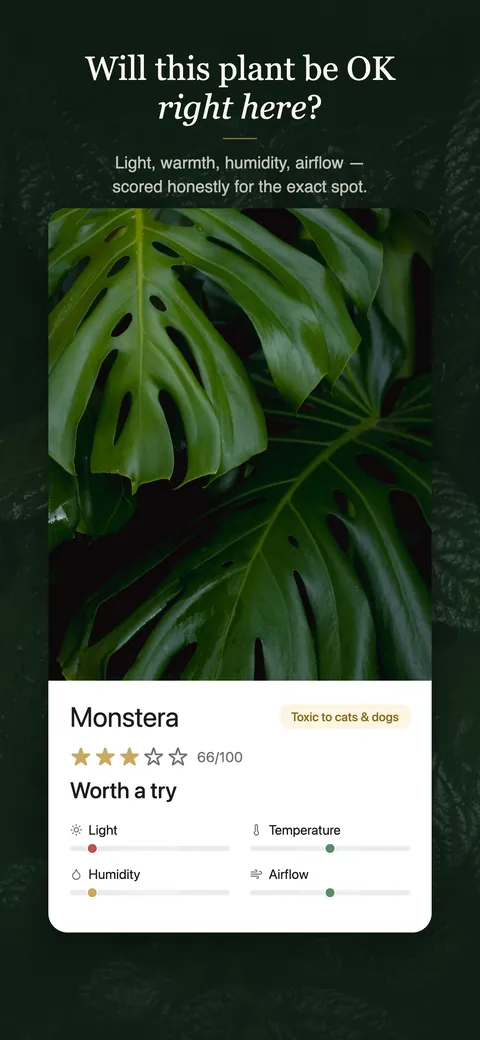
Worth a try
It can work here with a little care.
A little dim, but workable
Comfortable temperature
Humidity suits it
Airflow suits it
Our scoring hands each side half. Nowhere at this window is ideal for an areca, which is less than the two pages calling north ideal promise. But the sill is workable, and the too-dim part of the room Growli describes starts well in from the glass.
Is a north window enough light for an areca palm?
Not by the figures other sites publish. The card flags one dimension of the four, the light, and every published number we found sits above what this window gives. Here they are, each in its source’s own unit:
| Who publishes it | What it says an areca palm needs | What the figure is |
|---|---|---|
| getgrowli.app | 4,000–8,000 lux | Its "Bright Indirect" tier, a band the site prints for several plants |
| getgrowli.app | 400–800 fc | The same tier, given in foot-candles |
| foliage-factory.com | approx. 10,000–20,000 lux | Listed as bright indirect, under the older name Chrysalidocarpus lutescens |
| mrec.ifas.ufl.edu (UF/IFAS) | 5,000 to 6,000 foot-candles | Best light for commercial production, about 50% shade; read from a 13 August 2025 archive copy, as the live page now returns 404 |
Both lux figures in that table start above the 3,640 lux our estimate gives a north sill, the brightest spot this window has. Growli’s band begins at 4,000, so its verdict on a north wall follows from its own number, and Foliage Factory’s starts at 10,000, nearly three times the sill. The Florida figure is a different kind of thing: a light level for commercial growers at about half shade, set for a production bench rather than a room.
Those lux numbers are estimates worked out from the window’s direction, the pot’s distance and a clear day. They aren’t meter readings. A grey week or a building opposite pulls every one of them lower, and at this window the areca has none to spare.
How far from a north window can an areca palm go?
About a metre and a half, and getting closer than that buys very little. One palm, walked back from the same north window:
| Distance from the glass | Estimated light | What the light is doing | Verdict |
|---|---|---|---|
| 0.3 m, against the glass | 3,640 lux | A little dim, but workable | Worth a try, 65/100 |
| 1 m back | 2,800 lux | A little dim, but workable | Worth a try, 64/100 |
| 1.5 m back | 2,222 lux | A little dim, but workable | Worth a try, 63/100 |
| 2 m back | 1,764 lux | Too dim here | Not the best fit right now, 47/100 |
| 3 m back | 1,111 lux | Too dim here | Not the best fit right now, 46/100 |
| 4 m back | 700 lux | Too dim here | Not the best fit right now, 46/100 |
From the sill to a metre and a half, the estimate falls from 3,640 to 2,222 lux and the score only from 65 to 63. Then the light column turns from a little dim to too dim, and at two metres the palm is at 47. Probing between the rows puts the step at about 1.75 m, a little short of six feet. Behind it nothing recovers. Three and four metres both score 46, so a pot in the middle of a north room gets the same verdict as one in the far corner.
So the answer box’s fix for a dark room, the pot as close to the glass as it goes, is worth two points over a metre and a half back. What matters is staying in front of the step, and the deep corner Growli warns about is everything behind it. A rubber plant at the same north glass gets this curve point for point, and its page follows that sill through the year.
Which palms do suit a north window?
Nearly every other palm sold as a houseplant. The card’s north sill again, the same air, six palms:
| The palm, on the north sill | What the light is doing | Verdict |
|---|---|---|
| Parlor palm | Just the right amount of light | Great fit, 100/100 |
| Kentia palm | Just the right amount of light | Great fit, 100/100 |
| Majesty palm | Just the right amount of light | Great fit, 99/100 |
| Lady palm | Just the right amount of light | Great fit, 94/100 |
| Bamboo palm | Just the right amount of light | Great fit, 92/100 |
| Areca palm | A little dim, but workable | Worth a try, 65/100 |
The areca is the one of the six that misses a great fit. The parlor palm and the kentia score a full hundred, the majesty palm 99. The lady and bamboo palms have their light just right as well and lose a few points on airflow, since both like more moving air than the light airflow held here.
Two metres in, the list shrinks to one. Only the parlor palm is still a great fit there in our runs; the other four slip to worth a try and the areca sits a band below. The parlor palm’s north-window page scores it on all four sills, and north is the only one where its light isn’t flagged.
For a tall feather palm here, the kentia is the swap: in our runs it holds a great fit out to a metre and a half, as deep as an areca can go at all. A metre from south glass, the same six palms line up the other way round, areca first and parlor palm last.
Can an areca palm live on a north sill for good?
It can hold on. With light the only flag, what it costs is growth, the slow, leggy kind the answer box warns about.
A cold night can tip it over. In our scoring this palm drops to not the best fit on the sill at 15 °C; a parlor palm doesn’t until 12 °C.
Houseplants Nook’s grow light is the one fix in those results that adds light rather than moving the pot, and here it’s the kind that can work: no spot at this window reaches the light our scoring reads as just right for an areca.
Or change the wall. In our runs an east sill already scores this palm a great fit, a west window holds that out to about a metre, and south glass keeps its light just right as far as two metres back.
Before the areca goes by the glass
Every row above assumes an open north window in the northern hemisphere on a clear day. A balcony overhead or a wall across the street dims them all. The hallway guide files the areca with the fiddle leaf fig and the rubber plant, high-light plants that end up on lists for their looks, and the north window guide scores plants that suit this glass better. For your own spot, the free spot checker reads it with live weather where you live.
Published October 14, 2026
