On a north sill a string of hearts scores 65 out of 100, worth a try. The clear-day estimate there, 3,640 lux, reads as a little dim but workable for it, and nothing else on the card counts against it. Back from the glass the score barely moves until 1.7 metres; at 1.75 the light turns too dim and it drops to 47.
Read on 22 October 2026, the answer box at the top of Google’s results says a north window generally gives a string of hearts too little light to thrive, though growers report mixed results. It warns of longer gaps between leaves, faded marbling, paler undersides and soil that stays wet long enough to rot roots, and its fix is a full-spectrum grow light 12 to 18 inches above for 8 to 14 hours. Below it, seen only as snippets, sit a Reddit question and a Facebook video billed as a north-window success.
Mixed results are what our numbers predict. The sill stays workable all year, while a pot a metre back spends about three winter months in light that reads too dim. Growers a metre apart can both be right.

Worth a try
It can work here with a little care.
A little dim, but workable
Comfortable temperature
Humidity suits it
Airflow suits it
Is a north-facing window enough light for a string of hearts?
Enough to grow on, not enough for its best. Temperature, humidity and airflow all sit in their bands at the card’s settings, so light is the whole gap between 65 and a great fit, and no spot at a north window closes it, at any distance or in any month.
That says more about the plant than the window. A monstera is a great fit a metre back from the same glass, where a string of hearts is only worth a try. Our care data files this plant in the same light band as the fiddle leaf fig, and the fig gets the same verdicts at every distance its north-window page scores.
The other windows show what it’s missing. At the glass, an east sill gives it a great fit from mid-March to September and a west sill from late February to mid-October, while a south sill holds one in every month.
Here are the light figures other sites publish for it, each kept in its own unit:
| Who publishes it | What it says a string of hearts needs | What the figure is |
|---|---|---|
| getgrowli.app | 4,000–8,000 lux | Its Bright Indirect tier, a band the site prints for several plants, not one set for this species |
| getgrowli.app | 400–800 fc | The same Bright Indirect tier, given in foot-candles |
| foliage-factory.com | approx. 20,000–40,000 lux | Product page light line: very bright, some direct sun |
| theplantmanual.com | 1,500-3,000 foot-candles (fc) | The range it calls ideal (bright indirect) |
| theplantmanual.com | 500 foot-candles | Its floor: under this, it says, the vines get severely leggy |
| deepgreenpermaculture.com | 250 to 1000 lux | Its medium-light tier, which it calls the optimal range |
Every row of the distance table below falls between two of those. Each is brighter than the top of Deep Green Permaculture’s optimal 250 to 1000 lux, and none reaches the bottom of Growli’s 4,000 to 8,000. Believe the first and a north room has light to spare; believe the second and nowhere in it will do. Our scoring sits between them: workable at the glass, too dim from 1.75 metres.
The Plant Manual’s 500 foot-candles is the one figure framed as a warning. Below it, that page says, the vines get severely leggy, and legginess is the first thing the answer box lists.
How far from a north window can a string of hearts hang?
About 1.7 metres, and nothing along the way beats the sill. Here is one pot walked back from the glass, with two rows five centimetres apart at the end:
| Distance from the glass | Estimated light | What the light is doing | Verdict |
|---|---|---|---|
| 0.3 m, against the glass | 3,640 lux | A little dim, but workable | Worth a try, 65/100 |
| 1 m back | 2,800 lux | A little dim, but workable | Worth a try, 64/100 |
| 1.5 m back | 2,222 lux | A little dim, but workable | Worth a try, 62/100 |
| 1.7 m back | 2,026 lux | A little dim, but workable | Worth a try, 62/100 |
| 1.75 m back | 1,980 lux | Too dim here | Not the best fit right now, 47/100 |
| 3 m back | 1,111 lux | Too dim here | Not the best fit right now, 46/100 |
From the sill to 1.7 metres the score slides from 65 to 62 while the light falls from 3,640 to 2,026 lux. Five centimetres further, at 1,980 lux, the light column turns too dim and the score drops to 47; three metres in, it’s 46. Inside that strip every spot gets the same verdict, so the only real decision is to stay short of the line.
These lux figures are clear-day estimates from the window’s direction and the distance, not meter readings, and the table carries no date. North light is steady through the day. Through the year it isn’t.
Does a north window give a string of hearts enough light in winter?
At the glass, yes. A metre back, no. Here is the one-metre row on the 21st of seven months at latitude 40 degrees, which crosses Naples and Beijing:
| Month (scored on the 21st) | Estimated light | What the light is doing | Verdict |
|---|---|---|---|
| January | 1,820 lux | Too dim here | Not the best fit right now, 47/100 |
| February | 2,289 lux | A little dim, but workable | Worth a try, 62/100 |
| March | 2,783 lux | A little dim, but workable | Worth a try, 63/100 |
| June | 3,360 lux | A little dim, but workable | Worth a try, 64/100 |
| October | 2,263 lux | A little dim, but workable | Worth a try, 62/100 |
| November | 1,803 lux | Too dim here | Not the best fit right now, 46/100 |
| December | 1,634 lux | Too dim here | Not the best fit right now, 46/100 |
June, at the top, reads 3,360 lux and 64. October still reads worth a try at 62, then November and December fall to 46 on 1,803 and 1,634 lux, and January is 47 before February climbs back to 62. Day by day, the light at this spot reads too dim from 7 November to 3 February.
The sill never crosses that line at this latitude; scored day by day, it stays worth a try all year. The strip that does the same is only about 55 centimetres deep, because the line travels: about 2.1 metres out from May to July, under 60 centimetres by late December. At 52 degrees, roughly London’s latitude, even the sill drops to not the best fit from 12 November to 29 January.
So the answer box’s leggy-growth warning bites hardest in winter, on a pot hung back from the glass. The leggy-plants guide treats stretched stems as a light reading, and widening gaps between leaf pairs in January are this plant taking one.
Will a grow light fix a string of hearts in a north window?
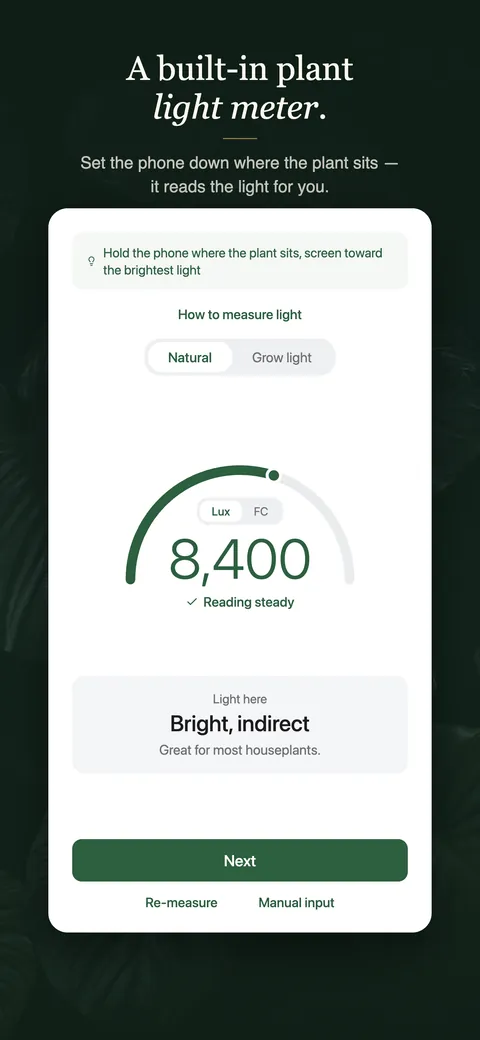
It can, but the box gives a height and a schedule rather than a brightness, and fixtures differ too much for 12 to 18 inches to stand in for one. At the screenshot’s 8,400 lux this plant would score a great fit; the north sill’s estimate is under half that.
The label won’t settle it: the meter calls everything from 2,500 lux to just under 10,000 bright, indirect, which covers the north sill and the one-metre row, and for this plant both read a little dim. Go by the number at the pot, light on. Hours aren’t an input to our score, so the 8 to 14 goes unchecked.
What can block a north window’s light?
Anything that hides the sky. A north window runs on sky light, so a building across a narrow street or a balcony overhead takes light this plant can’t spare; neither is an input here. The north window guide lists the plants that are a great fit on this sill; the free spot checker scores your own spot with local weather.
Published October 22, 2026
