On an east sill a string of hearts scores 97 out of 100, and still 97 with the pot 60 cm from the glass. At 70 cm it’s 68. That short step takes an east room from great fit to worth a try, and it stays worth a try out to two and a half metres.
Read on 14 October 2026, the answer box at the top of Google’s results calls east a great spot: soft morning sun for an hour or two, bright indirect light after that, and a move toward the glass if the vines stretch. Below it, The Plant Manual calls east windows perfect and keeps the pot within two to three feet of the glass. Greenery Unlimited rates a few feet back from south or west glass higher, and says right in an east window will “also suffice”.
Scored, east earns more than “suffice”, but only right in the window, where Greenery Unlimited puts it. Of The Plant Manual’s two limits, two feet holds and three doesn’t. In winter the move toward the glass runs out, because the sill itself drops a band.

Great fit
This plant should be happy in this spot.
Just the right amount of light
Comfortable temperature
Humidity suits it
Airflow suits it
Does a string of hearts get enough light in an east window?
At the glass, yes. The estimate on the sill is 6,500 lux, the card reads the light as just right, and every other dimension sits in its band at the settings on this page, so the sill comes back 97.
Soltech pairs east with north as the balanced choice for this plant, and that pairing doesn’t survive scoring. A north sill only reaches worth a try for a string of hearts. Of the windows that give it a great fit at the glass, east is the dimmest, and it clears the bar with little to spare.
Here is what other sites publish as the light it needs, each in its own unit:
| Who publishes it | What it says a string of hearts needs | What the figure is |
|---|---|---|
| getgrowli.app | 4,000–8,000 lux | Its Bright Indirect tier, a band the site prints for several plants, not one set for this species |
| getgrowli.app | 400–800 fc | The same Bright Indirect tier, given in foot-candles |
| foliage-factory.com | approx. 20,000–40,000 lux | Product page light line: very bright, some direct sun |
| theplantmanual.com | 1,500-3,000 foot-candles (fc) | The range it calls ideal (bright indirect) |
| theplantmanual.com | 500 foot-candles | Its floor: under this, it says, the vines get severely leggy |
| deepgreenpermaculture.com | 250 to 1000 lux | Its medium-light tier, which it calls the optimal range |
The lowest lux figure there and the highest are more than a hundred times apart, so the published numbers won’t tell you where the pot goes. Comparing plants at the same glass does better. A monstera at an east window keeps its top verdict out to nearly three metres. A string of hearts loses it before a metre.
The edge sits between the 60 and 70 cm rows below: 6,015 lux on one side of it, 5,743 on the other. That’s a small change in light for a whole band of verdict. The sill doesn’t sit far above that line either.
How far from an east window can a string of hearts hang?
Sixty centimetres, for the top verdict. Here’s one pot walked back from the glass, with two feet and three feet in the middle rows:
| Distance from the glass | Estimated light | What the light is doing | Verdict |
|---|---|---|---|
| 0.3 m, against the glass | 6,500 lux | Just the right amount of light | Great fit, 97/100 |
| 0.6 m back | 6,015 lux | Just the right amount of light | Great fit, 97/100 |
| 0.7 m back | 5,743 lux | A little dim, but workable | Worth a try, 68/100 |
| 0.9 m back | 5,236 lux | A little dim, but workable | Worth a try, 67/100 |
| 2.5 m back | 2,500 lux | A little dim, but workable | Worth a try, 63/100 |
| 3 m back | 1,984 lux | Too dim here | Not the best fit right now, 47/100 |
From 0.6 to 0.7 m the light reading tips from just right into a little dim, and the score falls from 97 to 68. Then it hardly moves: 67 at 0.9 m, 63 at 2.5 m. At three metres the light is too dim, and the verdict drops to 47.
So The Plant Manual’s limit works if you read it as two feet. Two feet is the last great-fit row in the room. Three feet is already out on the plateau, in the same band as a spot two and a half metres in.
For a hanging pot, that decides where the hook goes. A curtain rail or bracket that keeps the pot at the glass puts it on the sill row. A ceiling hook one stride into the room lands it on the 70 cm row or past it. At a west window the same plant stays a great fit until about a metre back.
Why does a string of hearts get leggy in an east window in winter?
Because the sill drops a band in October and there’s nowhere closer to go. Here’s that same sill scored through the year at latitude 40 degrees, about Madrid or Denver:
| Month, scored on the 21st | Estimated light | What the light is doing | Verdict |
|---|---|---|---|
| June | 7,800 lux | Just the right amount of light | Great fit, 98/100 |
| September | 6,481 lux | Just the right amount of light | Great fit, 97/100 |
| October | 5,253 lux | A little dim, but workable | Worth a try, 67/100 |
| December | 3,793 lux | A little dim, but workable | Worth a try, 65/100 |
| February | 5,314 lux | A little dim, but workable | Worth a try, 67/100 |
| March | 6,461 lux | Just the right amount of light | Great fit, 97/100 |
June scores 98 and September 97. By late October the sill reads 67, by late December 65 on 3,793 lux, and February is still 67 before March brings it back to 97. The jade plant page found the same calendar on an east sill, one band lower, because the two plants change verdict at the same light level. At 30 and 52 degrees the dates move by a few days to a week.
That’s where the answer box’s advice runs out. Moving a stretching vine toward the glass works from March to September. In winter an east-window pot is already at the glass, and the spot still reads a little dim. There’s no closer spot to buy the light back, and too little light is what stretches the gaps between leaf pairs. The leggy-plants guide explains why stretch that has already grown stays, and what changes the growth after it.
If the house has a south window, winter is when it pays. At latitude 40 in December a south sill still scores a great fit for this plant, while east and west sills are both down at worth a try.
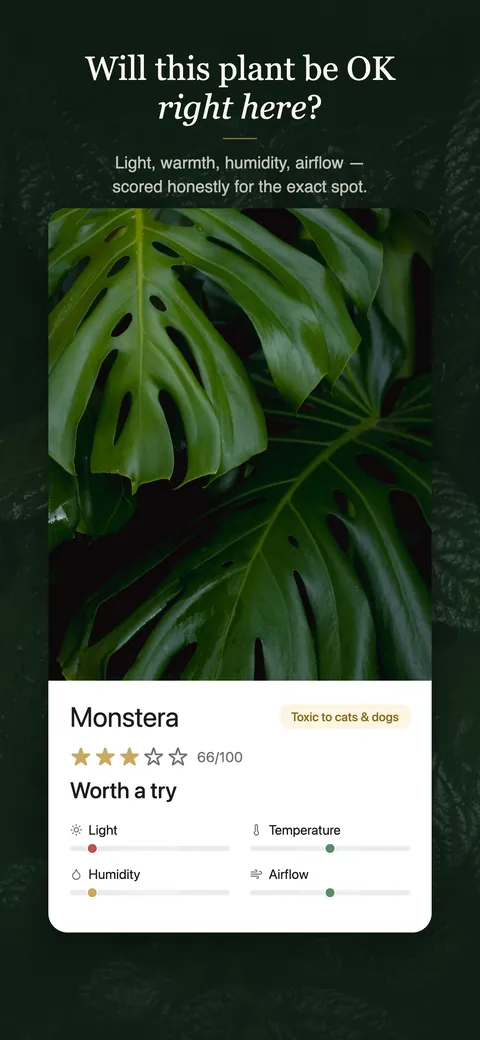
That screen shows a monstera. A string of hearts on a December east sill reads close to it, 65 in the table above, but with only the light flagged: at the settings used here its warmth, humidity and airflow all stay in their bands.
What do these numbers leave out?
Every lux figure here is worked out from which way the window faces, how far back the pot sits and a clear sky. None of it came off a meter. Anything outside that shades the glass in the morning, a tree or the block opposite, eats into a margin that’s already thin, and it doesn’t take much to move the sill down a band.
Air is the other input at a window. Scored with the airflow set to still, the same sill falls to worth a try while the light reading stays put. The east window guide tells the story of a fern that blackened at a bright window where the air never moved. To score your own sill against the weather where you live, use the free spot checker.
Published October 14, 2026
