Scored for a heartleaf philodendron at 22 °C and 50% humidity, a north sill comes back 100 out of 100, and two metres into the room it’s still 100. A Pink Princess or a Birkin at those same two metres drops to 68, worth a try, with the light flagged as a little dim. At a north window the genus splits, and the heartleaf is the kind that barely notices distance.
Read on 14 October 2026, the top results agree that a north window suits a philodendron, and nearly all of them mean the heartleaf. Hunker, Gardening Chores, Smart Garden Guide and Savvy Gardening each put the trailing heartleaf on a north-window list. Smart Garden Guide stretches that to most of the genus, and Bob Vila says philodendrons grow in deep shade, only more slowly. The one distance we found is a blanket rule for a whole list: within a foot of the glass. Plant Addicts suggests a grow light if north is your only window.
On the heartleaf, our numbers agree and give it far more of the room. On the philodendrons sold beside it, they don’t.

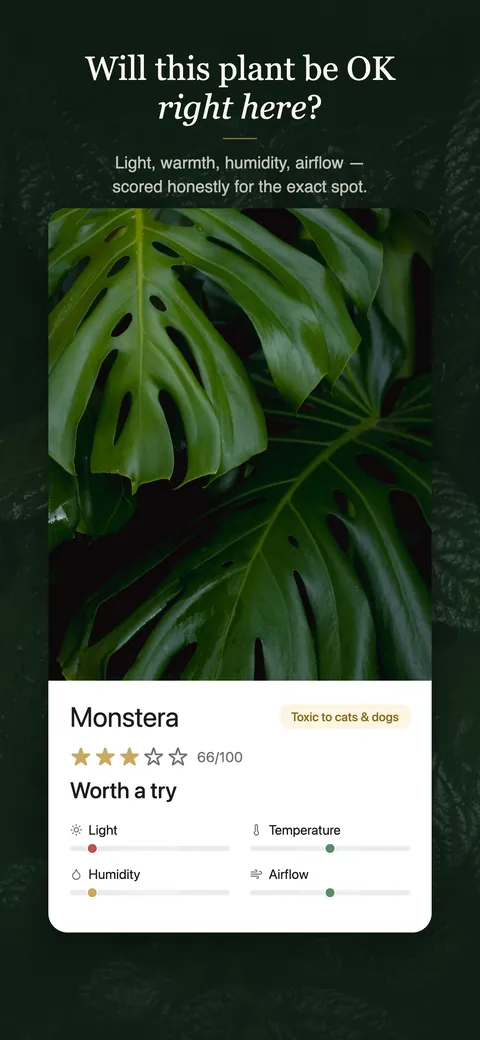
Great fit
This plant should be happy in this spot.
Just the right amount of light
Comfortable temperature
Humidity suits it
Airflow suits it
Is a north-facing window enough light for a philodendron?
Here is what other people publish for a philodendron’s light, each figure in its source’s own unit and wording:
| Who publishes it | What it says a philodendron needs | What the figure is |
|---|---|---|
| theplantrunner.com | 800–2,000+ lux | Standard foliage plants (pothos, Philodendron, Monstera deliciosa …) — a general band, not a single-species figure |
| theplantrunner.com | 1,500–5,000 lux | Light-hungry aroids & Ficus divas (Fiddle Leaf Fig, variegated Monstera) |
| houseplantjournal.com | 100 foot-candles | Philodendron Vines — minimum indirect light |
| houseplantjournal.com | 200 foot-candles | Philodendron Vines — good indirect light |
| growlightmeter.com | 5 – 10 PPFD / DLI | Philodendron |
| extension.arizona.edu | 75–150 foot-candles | listed under the heading "Medium Light (75–150 fc)"; carries the page' |
| houseplantsnook.com | 50–100 foot-candles | chart fc level |
| houseplantsnook.com | 200–400 foot-candles | chart fc level |
Two of those rows are written for philodendron vines, and the broadest band names philodendron among everyday foliage plants. None of them names a Pink Princess or a Birkin, and at a north window that turns out to be the gap that matters. Chinese evergreens split the same way, between the green plant and the red cultivars.
For a heartleaf the answer is yes, with room to spare. Our care data files it in the low-light band, and a north sill sits inside that band with nothing flagged on either side, which is why the card above gives the glass a clean 100. No other compass direction does that for this plant. An east sill flags it as a bit bright until a metre back. On a west sill the same heartleaf is flagged as a bit bright until about a metre and a half back, and at a south window its comfortable band doesn’t begin until roughly three metres in.
Which philodendrons can sit far back from a north window?
The heartleaf and its own cultivars, and nothing else in this table. Here is one spot two metres back, about six and a half feet, with seven philodendrons scored in it one at a time:
| Philodendron | What the light is doing | Verdict |
|---|---|---|
| Heartleaf philodendron | Just the right amount of light | Great fit, 100/100 |
| Philodendron Brasil | Just the right amount of light | Great fit, 100/100 |
| Velvet-leaf (Micans) | Just the right amount of light | Great fit, 100/100 |
| Moonlight | A little dim, but workable | Worth a try, 68/100 |
| Birkin | A little dim, but workable | Worth a try, 68/100 |
| Pink Princess | A little dim, but workable | Worth a try, 68/100 |
| Xanadu | A little dim, but workable | Worth a try, 67/100 |
Three rows keep the full score: the plain heartleaf, the Brasil and the velvety Micans, all forms of one species and all filed in the low-light band. The other four slip to worth a try, and the light column gives each of them the same reason, a little dim. Our care data puts them one band higher. They hold a great fit to about a metre and a half from north glass and lose it over the next half metre.
So the Moonlight that Savvy Gardening lists for a north window belongs near the glass, and so does a Pink Princess. The shade reputation the search results hand to the whole genus is really the heartleaf’s. For the rest, the within-a-foot rule is on the safe side, and a metre and a half is about where the room runs out.
The north window guide moves every plant on six published north-window lists to this same two-metre spot, and the ones that hold there are the low-band plants, the heartleaf and the Brasil among them.
Does a Pink Princess get enough light at a north window in winter?
At London’s latitude, not even on the sill. Here is a Pink Princess on the sill from the first card at 51 degrees north, roughly London or Calgary, through one summer and the winter after it:
| The month it is | Estimated light | What the light is doing | Verdict |
|---|---|---|---|
| June | 4,368 lux | Just the right amount of light | Great fit, 100/100 |
| October | 2,648 lux | Just the right amount of light | Great fit, 99/100 |
| November | 1,841 lux | A little dim, but workable | Worth a try, 68/100 |
| December | 1,820 lux | A little dim, but workable | Worth a try, 68/100 |
| January | 1,870 lux | A little dim, but workable | Worth a try, 68/100 |
| February | 2,695 lux | Just the right amount of light | Great fit, 99/100 |
June puts 4,368 lux on that sill, and October still holds a great fit. From November to January the estimate sits between 1,820 and 1,870 lux, the light column reads a little dim and the score is 68. February brings it back. At this latitude the sill is the brightest spot a north room has, so for those three months there’s nowhere in it to move a Pink Princess to.
The heartleaf reads a great fit on that same sill in every one of those months, under exactly the same light, and in December it still holds a great fit three and a half metres back. Same window, same lux, opposite verdicts.
Further south the dark stretch shortens. At 45 degrees only December takes the Pink Princess sill down to worth a try. At 40 the sill holds all winter, though a metre back drops to worth a try from November to January. At 51, an east or west sill reads a great fit for it from November to January, so a move to another window for those months is the simple fix, and Plant Addicts’ grow light is the other one.
All of these lux figures are estimates from the window’s direction, the pot’s distance and a clear day on the 21st of the month. None of them is a meter reading.
What slows a heartleaf philodendron in a north room?
Cold, before light. A heartleaf and a golden pothos carry identical care data in our scoring, so the pothos page’s walk down a cooling north sill applies to this plant line for line: a great fit at 19 °C and worth a try at 18. Bob Vila puts its danger line at 55 °F, about 13 °C. Our scoring has already marked the sill down by 18 °C, and it calls 14 °C not the best fit.
Light only starts to count deep in the room, and only in the dark months. Four metres back at latitude 51 slips to worth a try from November to January; at 40 the same happens at four and a half metres. That’s the far wall of a big living room, so in most homes the heartleaf’s north-window question gets settled by the thermometer.
How close is your window to these numbers?
Every number here describes an unobstructed north window on a clear day. A building across the street or a deep balcony overhead takes light off the reading, and neither is an input. That matters most for the Pink Princess, which has less room to give. The free spot checker scores your own spot with the weather where you live, and if you grow both kinds, it’s the quickest way to see which one should get the sill.
Published October 14, 2026
